The Hidden Leak: Why Counterfeits Are a P&L Crisis, Not Just a Brand Issue
Why counterfeit auto parts are a P&L problem, not just a brand issue: warranty inflation, oversized recalls and liability, and how item-level tracing helps.
By Abhijeet Kumar, ARVOPublished Updated 5 min read
In short
Counterfeit auto parts hit the P&L, not only the brand. OEMs pay warranty claims on failures caused by fakes, recall far more vehicles than needed when they cannot trace which units received a bad batch, and carry liability when they cannot trace a part from factory to workshop. Item-level traceability closes these gaps.
- Without item-level traceability, service centres replace failed parts without checking whether the original was genuine, so OEMs can end up paying for failures caused by fakes.
- When a bad batch cannot be traced to specific vehicles, OEMs recall far more vehicles than were ever at risk.
- Digital Product Passport rules and stricter liability norms make an untraceable part a legal exposure.
- A non-cloneable identity on each part lets mechanics and dealers verify it with a smartphone before installation.
- Tracking each serialised part through distribution shows when genuine stock lands in unauthorised regions or channels.
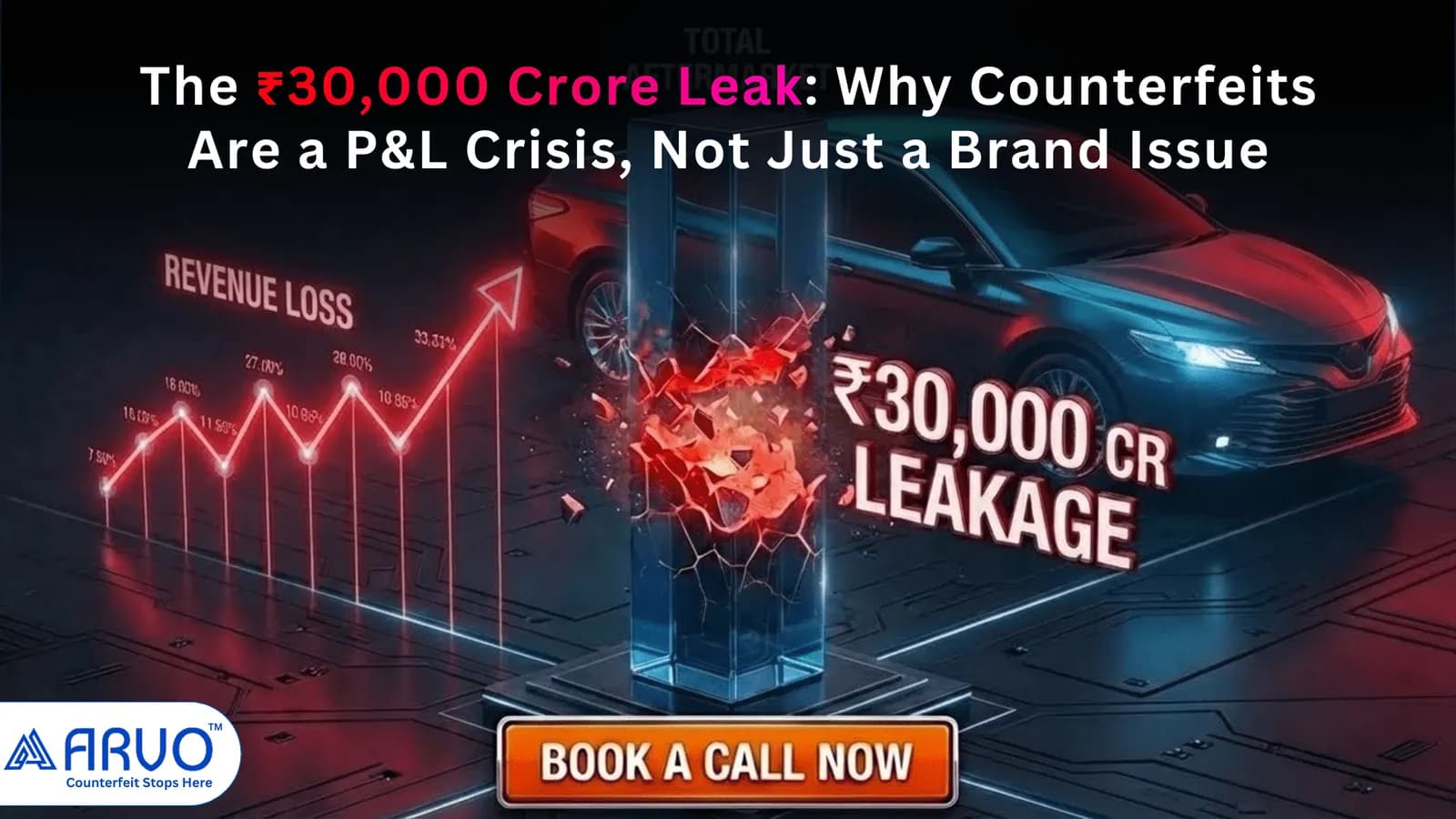
For decades, the automotive industry has categorised counterfeit auto parts crisis as a “brand protection” issue. It was a problem for the legal department, managed through cease-and-desist letters and occasional raids. But this siloed view is dangerous. It ignores the massive financial reality hiding in plain sight. In the Indian automotive aftermarket, a sector rapidly approaching a valuation of ₹1 lakh crore, estimates suggest that 30-40% of components are leaking into grey and counterfeit channels. We are not just talking about lost sales. We are talking about annual revenue leakage that directly erodes the bottom line of OEMs and Tier-1 suppliers.
When you look past the “brand” argument and analyse the P&L, counterfeiting reveals itself for what it truly is: a massive, unmanaged financial risk.
The Three Hidden Costs Destroying Your Margins
Lost revenue from a fake sale is painful, but the secondary costs are often where the real damage lies. These “hidden” expenses inflate operational costs and dilute profitability without a clear paper trail.
1. The Warranty Cost Inflation
Global automotive OEMs currently spend roughly 2–5% of their total revenue on warranty accruals and claims. In a high-volume market like India, this amounts to thousands of crores.
The critical question for your CFO is: What percentage of these claims are for genuine part failures?
Without item-level traceability, service centres often replace failed parts without verifying if the original component was genuine. If a counterfeit brake pad fails and damages a genuine rotor, the OEM often pays for both. You are effectively subsidizing the very criminals undermining your business.
2. The Recall Multiplier Effect
Recalls are inevitable in manufacturing, but their scope is controllable. Or at least, it should be.
When a defect is detected in a specific batch of components, a lack of digital traceability forces OEMs to cast a wide net. Instead of recalling the specific 5,000 vehicles that received the bad batch, manufacturers must recall 50,000 vehicles just to be safe.
Industry data suggests that poor traceability can drive recall costs up by a factor of 47x. You are paying for logistics, replacement parts, and labor for vehicles that were never at risk, simply because you couldn’t prove they were safe.
3. The Liability & Safety Risk
The human cost of counterfeiting translates directly into legal and operational risk. Industry studies indicate that nearly 20% of road accidents in India are linked to counterfeit or substandard parts.
As regulations like the Digital Product Passport (DPP) and stricter liability norms tighten globally, the “I didn’t know” defense will no longer hold up in court. If you cannot trace your part from the factory floor to the mechanic’s workshop, you are exposed.
How ARVO Stops the Counterfeit Auto Parts Crisis and the Leakage
At ARVO, we believe that supply chain visibility is not just a compliance checkbox; it is Revenue Assurance. We help Automotive OEMs and Industrial Manufacturers close these gaps with a technology-first approach to trust.
Here is how the ARVO platform secures your P&L:
1. Non-Cloneable Digital Identity
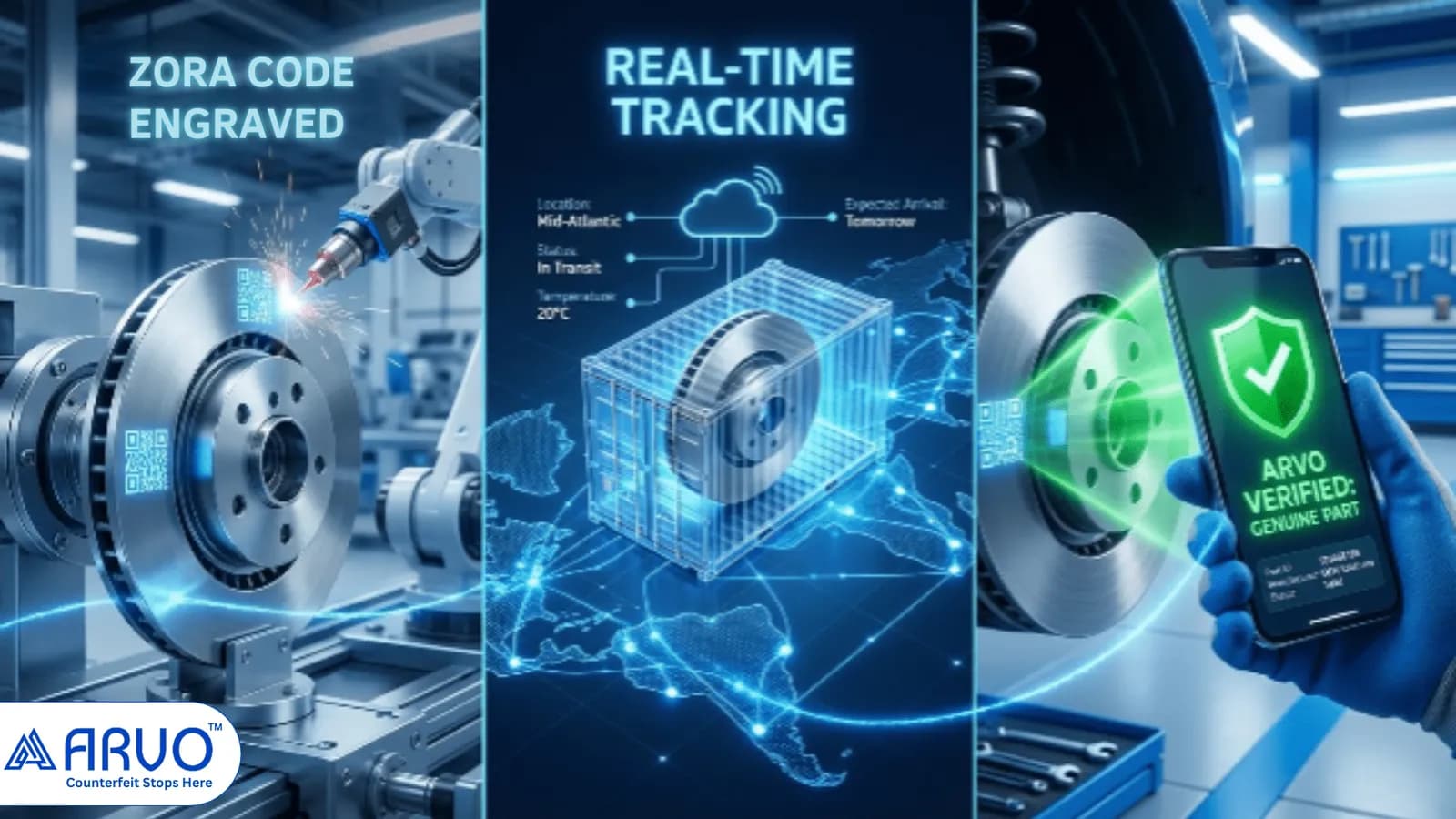
ARVO assigns every part a secure, non-cloneable digital identity that counterfeiters cannot copy. This allows mechanics and dealers to verify authenticity instantly using a smartphone. By blocking fake parts at the point of installation, you prevent failures before they happen. The result is lower warranty costs and direct protection of your revenue.
2. Precision Traceability for Targeted Recalls
ARVO tracks each serialized part from the factory all the way to the exact vehicle it’s installed in. When a defect occurs, you instantly know which units are affected instead of recalling thousands blindly. This enables small, targeted recalls instead of large, expensive ones. The outcome is massive savings in logistics, labour, and customer impact.
3. Grey-Market Diversion Detection
With ARVO, you can see exactly how genuine parts move across your entire distribution network. If products land in unauthorised regions or channels, the system highlights the leak instantly. This gives manufacturers hard evidence to act on, instead of relying on assumptions. The result is reduced diversion, stronger distributor discipline, and recovered revenue.
4. End-to-End Supply Chain Visibility
ARVO connects with your ERP and packaging lines to create real-time visibility from production to installation. You can trace every unit, monitor risks, and detect unusual movement patterns across the supply chain. This clarity helps manufacturers plug operational gaps before they become costly issues. The result is tighter control, cleaner distribution, and better decision-making.
Take Control of Your Supply Chain Today
The technology to stop it is available today.
Don’t let opacity drain your profits. Let’s build a traceability roadmap that protects your brand and your balance sheet.
Questions answered in this article
- Why are counterfeit auto parts a P&L issue and not just a brand problem?
- Counterfeits raise warranty costs, recall expenses and liability risk as well as taking sales. These losses rarely show up clearly on the balance sheet, which makes counterfeiting a hidden P&L leak rather than only a brand issue.
- How do counterfeit parts inflate warranty and service costs?
- Without item-level traceability, service centres replace failed parts without knowing whether the original was counterfeit. The OEM ends up paying for failures caused by fakes, and over time that inflates warranty spend and cuts profitability.
- How can supply chain visibility reduce recall costs?
- Visibility shows exactly which vehicles received parts from a defective batch. The OEM recalls only those vehicles instead of thousands blindly, which cuts logistics, labour and disruption for customers.
- How does ARVO identify grey-market diversion of auto parts?
- ARVO tracks each serialised part across the distribution network and shows where it ends up. When products appear in unauthorised channels or regions, the system highlights them at once, giving the OEM evidence to act on.
- Why is a non-cloneable digital identity better than a standard QR code?
- A standard QR code can be cloned or reused by counterfeiters. A non-cloneable identity cannot be duplicated, and each scan is validated in real time, so a part can be authenticated at any point in the supply chain.