D2C Brand Anti-Counterfeiting in India: Beauty Brands Are Growing, So Are Their Fakes
D2C brand anti-counterfeiting in India: why fast-growing beauty brands attract fakes on quick and social commerce, and how unit-level codes stop them.
By Abhijeet Kumar, ARVOPublished Updated 11 min read
In short
D2C beauty brands are exposed because they sell online, on quick commerce and through social media, where buyers cannot inspect a product before paying. The ASPA/CRISIL 2025 report found 89% of urban Indian consumers have bought a counterfeit at least once. The answer is unit-level authentication from launch: a copy-proof code on every pack that a phone camera verifies.
- Counterfeiters target growing D2C brands because viral demand is public and online buyers cannot inspect a product before they pay.
- FICCI reports that 30% of FMCG products sold in India are counterfeit, and the ASPA/CRISIL 2025 report found 89% of urban Indian consumers have bought a fake at least once.
- A standard QR code is only an encoded URL that can be photographed and reprinted, so on its own it gives no security.
- Authentication works at the product level, so the same code verifies a unit whether it was bought on the brand's site, a marketplace, quick commerce or social commerce.
- Each scan records location, time and the verification result, so clusters of failed checks point to the sellers distributing counterfeits.
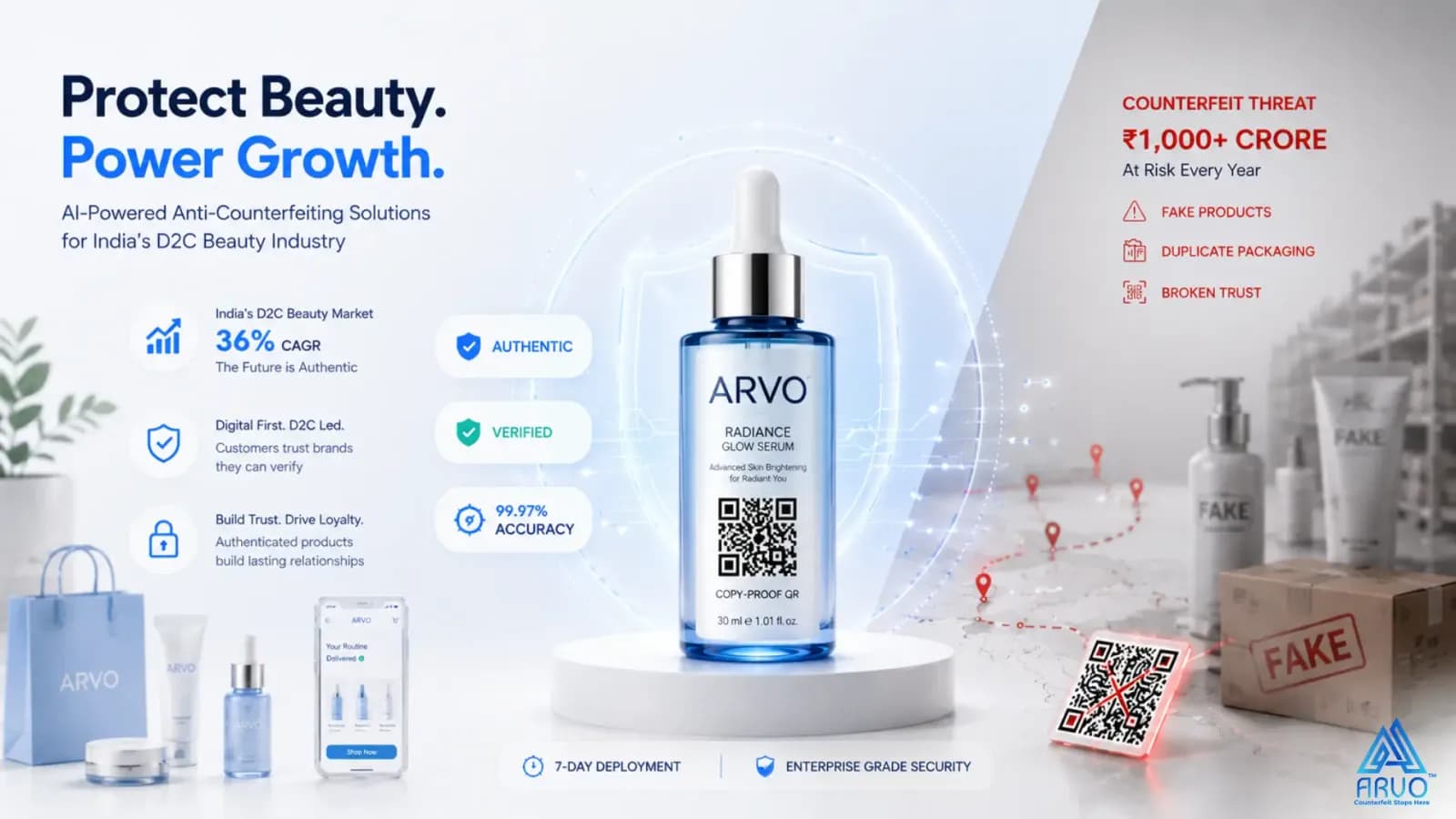
India’s D2C beauty and personal care market is one of the fastest-growing consumer segments anywhere in the world. The market is projected to grow at 36.4% to 36.6% CAGR from 2026 to 2033, with online-only D2C brands commanding 64.9% of the total market share. India now hosts over 800 active D2C beauty brands. Between 2014 and 2022, D2C beauty startups collectively raised over $5 billion in venture and growth funding. Beauty and personal care accounted for nearly 50% of all D2C investment inflows. The broader Indian D2C e-commerce market reached $87.5 billion in 2025 and is projected to hit $322.1 billion by 2031.
The growth story is extraordinary. But it has a shadow. The same digital infrastructure that enables D2C brands to reach millions of consumers has also enabled counterfeiters to reach those consumers first. FICCI reports that 30% of all FMCG products sold in India are counterfeit. The ASPA/CRISIL 2025 report found that 89% of urban Indian consumers have purchased a counterfeit product at least once. Online aggregator platforms account for 53% of all counterfeit purchases. And the counterfeit FMCG market in India is growing at 15% annually. For D2C beauty founders, the mathematics are unforgiving: your brand is scaling at 36% CAGR, but counterfeiting is scaling alongside it.
This article is written for D2C beauty founders, co-founders, and leadership teams. It examines the specific vulnerabilities of the D2C model, quantifies the cost of inaction, and presents a complete D2C brand anti-counterfeiting India framework that can be rolled out in about 15 days.
The D2C Beauty Boom: Growth Numbers That Attract Counterfeiters
The Indian D2C beauty market’s growth trajectory is creating the precise conditions that counterfeiters exploit. To understand why D2C brands are disproportionately targeted, it is necessary to examine the numbers through the counterfeiter’s lens.
The D2C beauty market is growing at 36.4% CAGR. This means consumer demand is accelerating faster than most brands can build distribution infrastructure. Counterfeiters fill that gap. When a D2C serum goes viral on social media and the brand’s direct channels struggle to keep up with demand, counterfeit versions appear on marketplace listings within days. The demand signal is public (social media virality), the product is identifiable (packaging is photographed in unboxing videos), and the price point is high enough to justify the counterfeiting effort.
Online-only D2C brands hold 64.9% market share. This means the majority of D2C beauty products are sold through channels where physical verification before purchase is impossible. A consumer cannot touch, smell, or inspect a product purchased through an e-commerce listing or a quick commerce order. They rely entirely on the listing’s photographs, the seller’s reputation, and the platform’s assurance. Counterfeiters have mastered all three.
D2C brands raised over $5 billion in funding between 2014 and 2022. This level of investment drives aggressive growth, rapid SKU expansion, and multi-channel distribution at a pace that outstrips quality control and supply chain oversight. The faster a D2C brand scales, the more distribution touchpoints it creates, and the more entry points exist for counterfeit products. The paradox is that the very metrics investors reward, growth rate, channel expansion, and market penetration, are the same factors that increase counterfeiting vulnerability.
Quick Commerce and Social Commerce: The Two Channels Where D2C Brands Are Most Exposed
India’s quick commerce segment is projected to reach $5.38 billion in 2025, growing at 17% annually. Beauty is one of the fastest-growing categories on quick commerce platforms, with brands reporting 3x growth on these channels and 25% higher average selling prices compared to traditional e-commerce. But quick commerce’s speed creates a verification gap that counterfeiters exploit.
Quick commerce platforms onboard local suppliers and dark store inventory at speed. The sourcing verification processes that large FMCG companies have built over decades do not exist in the same form for D2C brands selling through quick commerce. A counterfeit product that enters a dark store’s inventory is delivered to a consumer’s doorstep within 10 to 20 minutes, with no opportunity for inspection at any point in the chain.
Social commerce presents an even more direct vulnerability. 71% of Indian beauty consumers discover products via social media. 37% of Indian consumers aged 15 to 24 purchased counterfeit products through social media recommendations in a 2022 survey. The ASPA/CRISIL 2025 report identifies social media advertisements as a rapidly growing counterfeit distribution channel. For D2C brands that build their entire acquisition strategy on social media and influencer marketing, the irony is severe: the channels you invest in to grow are the same channels counterfeiters use to sell fakes under your name.
When a D2C brand’s product goes viral through an influencer unboxing or a trending reel, counterfeiters can have replica listings live on marketplace and social commerce within 48 to 72 hours. The consumer sees a product that looks identical, priced 15% to 20% lower (ASPA data shows counterfeits are sold at approximately 19% below genuine price), and purchases without hesitation. The counterfeit arrives. The consumer uses it. The results are poor. And the negative review lands on the genuine brand’s reputation.
3 Critical Mistakes D2C Beauty Founders Make with Anti-Counterfeiting
Mistake 1: Treating Authentication as a Post-Scale Priority
The most common and most costly mistake is deferring authentication to a later stage of growth. The reasoning is understandable: in the early stages, D2C founders are focused on product-market fit, customer acquisition, and unit economics. Anti-counterfeiting feels like an enterprise-level concern. But counterfeiting does not wait for brands to reach scale. Counterfeiters target brands that are growing, because growth creates demand, and demand is what counterfeiters monetise. By the time a D2C founder discovers counterfeits in the market, the brand damage has already compounded through negative reviews, consumer complaints, and trust erosion that no marketing budget can efficiently reverse.
Mistake 2: Assuming That Standard QR Codes Provide Security
Many D2C brands print a QR code on their packaging and assume it provides authentication. A standard QR code is nothing more than a URL encoded into a pattern. Any counterfeiter can photograph it and reproduce it using a basic printer. Standard QR codes provide zero security. They are not authentication. They are decoration. Copy-proof QR codes with Cryptographic Data Pattern (CDP) encryption are the minimum standard for genuine product authentication. Every code must be mathematically unique at the unit level, non-reproducible, and verifiable against a secure database.
Mistake 3: Neglecting Online Marketplace and Social Commerce Monitoring
D2C brands that do not actively monitor their listings across marketplaces and social commerce channels are operating blind. Counterfeit listings can appear within days of a product launch. They can operate for weeks or months before detection. The DCGI has already directed major e-commerce platforms to remove unauthorised cosmetic listings, establishing regulatory precedent. But the responsibility for identifying and reporting counterfeit listings ultimately rests with the brand. If you are not monitoring, you are not detecting. And what you do not detect, you cannot stop.
The Authentication ROI Framework for D2C Beauty Brands
The economics of authentication for D2C beauty brands are unambiguous when examined against the cost of counterfeiting.
The cost of authentication is a few paise per unit. For a D2C brand producing tens of thousands of units monthly, the total annual authentication investment represents a fraction of what the brand spends on a single influencer campaign or a month of performance marketing. The per-unit cost typically represents less than 1% to 2% of the product’s retail price.
The cost of not authenticating is measured in crores. FICCI CASCADE estimates that FMCG companies lose 21.7% of total market share to counterfeit goods. For a D2C brand generating ₹10 Crore in annual revenue, this implies approximately ₹2.17 Crore captured by counterfeiters. The DRI’s July 2025 Mumbai seizure alone recovered ₹6.5 Crore in counterfeit cosmetics. The Maharashtra FDA seized ₹2.5 Crore in fake beauty products from South Mumbai. The DCGI’s nationwide operation recovered ₹4 Crore.
Beyond direct revenue loss, the indirect costs compound. Negative reviews from consumers who unknowingly purchased counterfeits. Customer service burden from product complaints that the brand never manufactured. Brand trust erosion that increases customer acquisition costs across all channels. Regulatory risk under the Cosmetics Amendment Rules 2025, which mandate stricter documentation and traceability. For D2C brands competing in a market with over 800 players, where consumer switching costs are low and social proof is decisive, a single wave of counterfeit-driven negative reviews can permanently alter the brand’s growth trajectory.
How ARVO Protects D2C Beauty Brands from Day One
ARVO’s anti counterfeiting solution India beauty ecosystem is designed specifically for the speed, scale, and channel complexity of D2C beauty brands. The system rolls out in about 15 days, delivers 99% authentication accuracy, and requires no app download for consumer verification.
Copy-Proof Nova Codes for Unit-Level Authentication
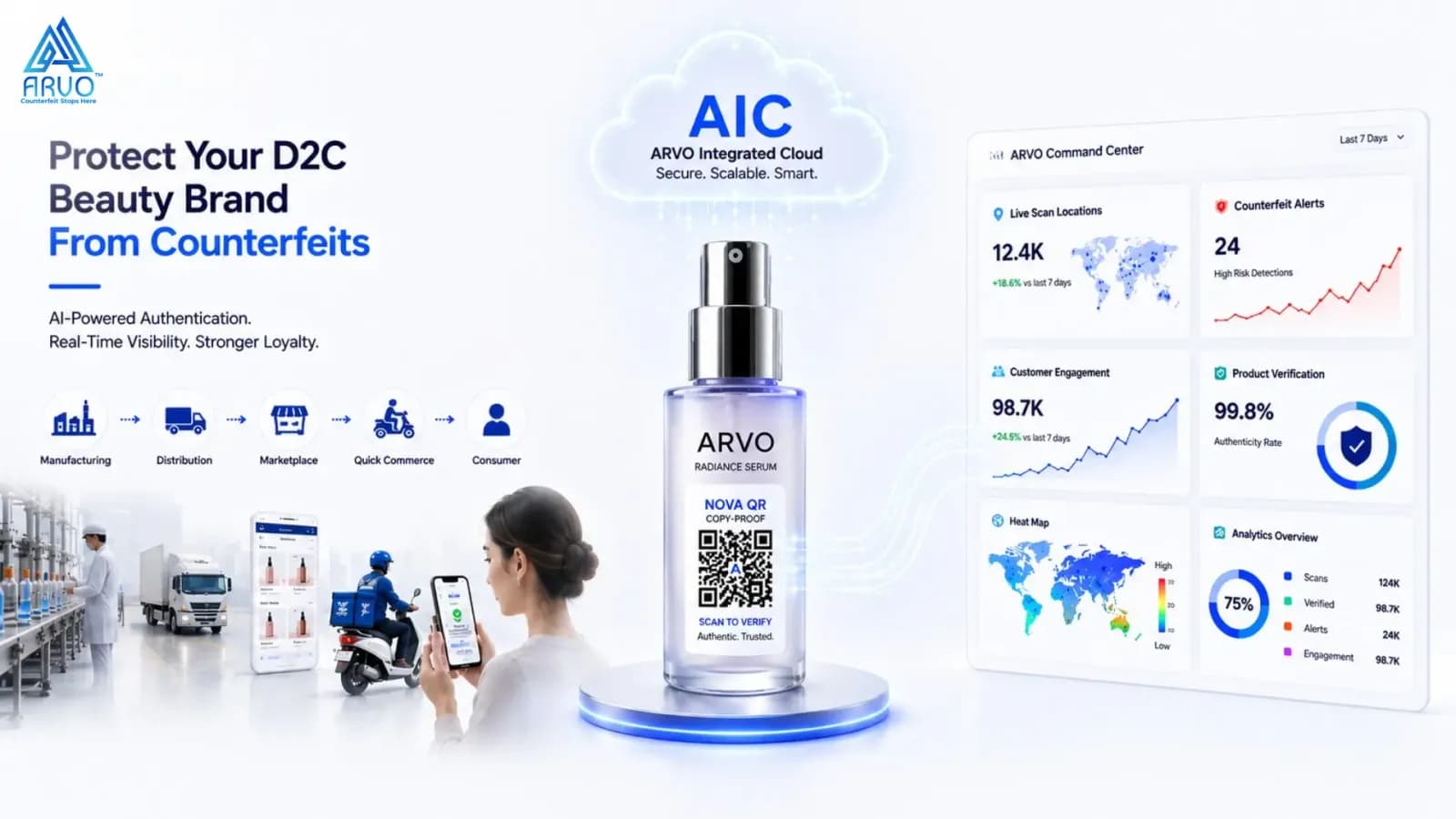
Every product unit receives a copy-proof Nova code, a mathematically unique digital fingerprint that cannot be cloned, photographed, or reproduced. When a consumer scans the code with their smartphone camera, the product is verified instantly through a browser-based interface. No app required. The verification experience is designed for the speed that D2C consumers expect: scan, verify, engage, all within seconds.
Complete Supply Chain Visibility Across Every Channel
Every Nova code scan captures geographic location, timestamp, and verification data in real time. For D2C brands selling through their own website, marketplaces, quick commerce, and social commerce simultaneously, this provides the first unified view of where products are actually being consumed across every channel. Products scanned in locations inconsistent with their distribution are flagged instantly. Grey market diversion is detected. Counterfeit seller patterns are identified through verification failure clustering.
Consumer Engagement with Loyalty Integration
After verification, ARVO opens Arvie, the product’s advisor, trained on the brand’s product knowledge. The consumer receives personalised skincare routines, ingredient transparency, usage guidance, and product recommendations. Arvie supports integrated loyalty programme functionality where every scan earns points, every interaction deepens engagement, and every repeat purchase is rewarded. For D2C brands where customer retention economics are critical, the scan-based loyalty model embeds retention directly into the product.
The AIC Dashboard for Founder-Level Intelligence
The AIC (ARVO Integrated Cloud) dashboard provides D2C founders and leadership teams with centralised intelligence: geographic scan heatmaps, counterfeit alert systems with instant notifications, grey market detection analytics, consumer engagement metrics from Arvie, loyalty programme data, and complete scan history at the unit level. Every scan is a data point. Every data point informs product decisions, channel strategy, and marketing investment.
Rollout: Decision to Live
- Brand onboarding and Arvie training on your product knowledge.
- Nova code label design and printer integration with existing packaging.
- First serialised production run with blockchain records activated.
- Consumer verification, Arvie, loyalty, and the AIC dashboard go live.
The rollout takes about 15 days. No production downtime. No packaging redesign. No capital equipment.
Protect Your D2C Beauty Brand from Day One
Your brand is growing at 36% CAGR. Counterfeiting is growing alongside it. The channels you invest in to drive growth are the same channels counterfeiters use to distribute fakes under your name. Every day without authentication is a day of compounding brand damage.
ARVO delivers complete D2C brand anti-counterfeiting India protection: copy-proof Nova codes, Arvie (the product’s advisor) with loyalty integration, real-time supply chain visibility, and the AIC dashboard for founder-level intelligence. Rolled out in about 15 days. 99% accuracy. No app required.
Protect your D2C beauty brand from Day 1. Schedule a consultation
Questions answered in this article
- At what stage should a D2C beauty brand start product authentication?
- From launch. Counterfeiting does not wait for a brand to scale: fake listings appear within days of a product gaining traction on social media. Authentication belongs in launch infrastructure, not as a reaction after counterfeits are found.
- How does authentication work for D2C brands selling on quick commerce?
- It works at the product level, not the platform level. Every unit leaves the factory with its own NOVA code, so a customer gets the same instant check whether they bought on the brand's website, a marketplace, a quick commerce app or through a social media link. The code travels with the product.
- Can scan data show which sellers are distributing counterfeits?
- Yes. Every scan captures location, time and the verification result. When failed checks cluster around particular platforms, seller accounts or regions, the AIC dashboard flags the pattern so the brand can investigate and request takedowns.
- How does a scan help D2C customer retention?
- After verification the customer can ask Arvie, the product's advisor, about usage, ingredients and routines, and scans can earn loyalty points. The product itself becomes the retention channel, with no separate app or card.
- What does the AIC dashboard show that marketplace analytics do not?
- Marketplace analytics show what was sold and where. The AIC dashboard shows where products are actually scanned and used, what customers ask about, and where verification failures cluster, which reveals counterfeiting before it shows up in complaints.
Sources
- CRISIL, CRISIL