Lithium-Ion Battery Tracking in India: Why Makers Need It Now
India has no central record of battery fires. Why lithium-ion battery tracking matters for safety and recalls, the five data streams, and what draft BPAN says.
By Abhijeet Kumar, ARVOPublished Updated 10 min read
In short
Lithium-ion battery tracking gives each battery a unique identity and records its state of health, cycles, thermal events, ownership and service history for life. India has no central record of battery fires, so makers that track units can recall precisely, value batteries for second life and prepare for the draft Battery Pack Aadhaar system.
- The Ministry of Heavy Industries told the Lok Sabha in February 2026 that India has no centralised data tracking battery-fire incidents.
- Five data streams should follow every battery: state of health, cycles, thermal events, ownership and location, and service history.
- Knowing which units belong to which batch is what makes a targeted recall possible; unit-level tracking narrows it to individual packs.
- Documented state of health lets a used battery be valued on evidence rather than priced as an unknown.
- India's draft BPAN guidelines hold dynamic data such as status and state of health on a central server, but they are not yet notified.

How many lithium-ion batteries caught fire in India last year? Nobody knows. In a written reply in the Lok Sabha on 10 February 2026, the Ministry of Heavy Industries said that specific, centralised data solely tracking battery-fire incidents across the country is not available. The closest official record, MoRTH's eDAR accident portal, logged 23,865 accidents involving electric vehicles from 2023 to 2025, of which 26 involved fire, according to the same reply. A road-accident portal is not designed to capture fires at home chargers or in warehouses.
That gap is the problem this guide is about. Most lithium-ion batteries in India are made, sold and used without any way for their maker to follow an individual unit after it leaves the factory. When something goes wrong, there is no record to show which battery it was, which batch it came from, how it was used, or which other batteries share the same risk.
This guide is for battery makers, pack assemblers and EV OEMs. It covers why lifecycle tracking matters for safety, the five data streams every battery should carry, how traceability changes a recall, how state-of-health data supports second life, and what India's draft Battery Pack Aadhaar guidelines say about dynamic data.
Why do lithium-ion battery makers need lifecycle tracking?
Lithium-ion batteries power most of India's electric vehicles. The draft Battery Pack Aadhaar guidelines published by the Ministry of Road Transport and Highways (MoRTH) note that electric vehicle applications account for approximately 80% to 90% of lithium-ion battery demand in India. Each of those batteries spends years in the field, often changing hands, and the conditions it meets there decide how safely it ages.
Thermal runaway, the chain reaction behind most lithium-ion battery fires, usually has causes that build up over time: cells that run hot, voltage imbalance between cells, faster-than-expected capacity loss, overcharging, physical damage or use beyond the battery's rated life. A battery management system (BMS) sees much of this, but its data stays inside the pack. If the pack is never identified and its history never recorded outside it, the warning signs are invisible to the maker, and the first sign of trouble may be the fire itself.
Manufacturing quality matters, and India's battery safety standards address it. AIS 156, for example, requires pack traceability and a BMS with all protections for L-category electric vehicles, according to the ARAI guide published by EVreporter. But testing at the factory cannot see what happens to a battery after it is sold. Battery safety at scale also needs a record of each battery's life in the field.
What data should follow every lithium-ion battery?
Effective lithium-ion battery tracking is not one measurement. It is five connected data streams, each tied to the battery's unique identity.
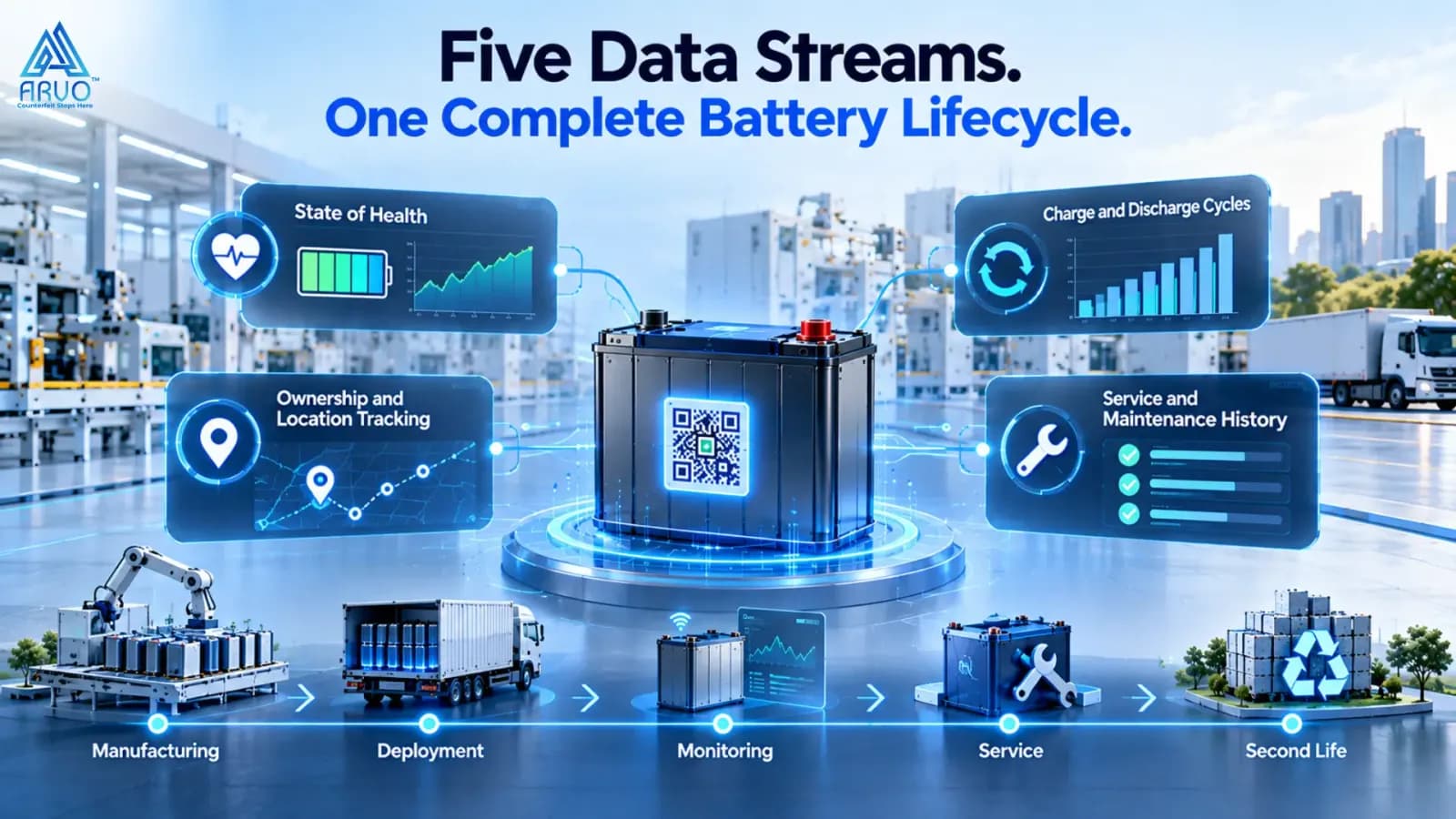
1. State of health
State of health (SoH) compares a battery's current capacity with its original rated capacity. It tells you how much useful life remains, whether the battery suits a second life, and what it is worth. Without SoH on record, every used-battery sale is a guess.
2. Charge and discharge cycles
Every lithium-ion battery has a finite cycle life. Comparing the cycles a battery has actually done with its rated cycle life shows how far along its ageing curve it is. Makers need this for warranty decisions, and second-life buyers need it for valuation.
3. Thermal events
Every thermal excursion should be logged with its time, duration, peak temperature and outcome. A battery with no recorded thermal events carries a very different risk from one with several. Thermal data cannot be rebuilt after the fact: if nothing was recording when the event happened, it is lost.
4. Ownership and location
Who owns the battery, where it is, and whether it is still in the vehicle it was first fitted to. This record supports recalls, extended producer responsibility (EPR) reporting under the Battery Waste Management Rules, 2022, and grey-market detection when batteries turn up in channels they were never shipped to.
5. Service and maintenance history
Every cell replacement, firmware update, balancing adjustment or repair should be recorded against the battery's identity. Under the draft Battery Pack Aadhaar guidelines, a change in a battery's attributes due to recycling or repurposing results in a new BPAN, so service records also help show when a battery has materially changed.
How does traceability change a recall?
When a safety incident happens, a maker's response depends on its traceability. Without it, the scope of a recall is a guess. With it, the scope is a lookup.
| Recall attribute | Without unit-level tracking | With unit-level tracking |
|---|---|---|
| Scope | Every battery from the affected model or period | Only the units linked to the affected batch, cells or line |
| Finding the units | Dealer records and customer outreach | A lookup by identity, with the last known location of each unit |
| Speed | Weeks to define the scope | Scope defined from records already held |
| Cost | Logistics and replacement across the whole range | Limited to the affected units |
| Regulator's view | Unclear why the scope is what it is | A documented, data-backed response |
| Customer trust | Eroded across all products | Kept, because the response is precise |
India has seen what batch-level identification makes possible. On 24 April 2022, Ola Electric announced a voluntary recall of 1,441 scooters after one of its scooters caught fire in Pune, saying it would run a detailed diagnostic and health check of the scooters in that specific batch as a pre-emptive measure, Business Today reported. Knowing which units belong to which batch is what allows a recall of 1,441 vehicles rather than an entire range. Unit-level tracking takes that one step further, down to the individual pack.
For a broader look at following a battery through its life, see our guide to EV battery traceability, and our traceability solution for how a product's journey is recorded scan by scan.
How does state-of-health tracking support a second-life market?
When an EV battery is no longer right for a vehicle, it can still be useful for stationary storage, telecom backup or other applications. Whether it gets that second life, and at what price, depends on what a buyer can learn about it.
RMI wrote in September 2026 that buyers, financiers, repurposers, insurers and recyclers often lack reliable information about a battery's condition. Without it, financiers struggle to price risk, repurposers spend extra time testing and sorting batteries, and used-battery markets stay illiquid. RMI also stresses that SoH is an estimate derived from battery behaviour over time, not a direct reading, so the method behind it matters as much as the number.
The draft Battery Pack Aadhaar guidelines use SoH to define a battery's status: operational above 80%, second life from 60% to 80%, and end of life below 60%. A battery that arrives at those thresholds with a documented history of cycles, thermal events and service can be valued on evidence. A battery that arrives without one is priced as an unknown.
What does the draft BPAN say about dynamic data?
MoRTH published draft guidelines for a Battery Pack Aadhaar System at the end of December 2025. They propose a 21-character Battery Pack Aadhaar Number (BPAN) for each in-scope pack, marked as text and as a QR code, plus three layers of data: the public 21 characters, static data in the QR code, and dynamic data held on a central server with private access.
The draft's Battery Dynamic Data table lists ten parameters: the BPAN, battery category, battery status, state of health, actual disassembly method, actual circularity method, a date and time stamp, QR code recovery data, and two reserved fields. In its text, the draft describes the server holding information that evolves over time, such as operational history, state of health, usage conditions, safety incidents and end-of-life outcomes. Service centres authorised by the government or the battery producer can retrieve the record before working on a battery, check for recorded abnormal events and upload new diagnostic results, and authorised recyclers add the outcome of treatment and material recovery.
So the draft does not list every data stream above as a separate field, and it leaves the detailed method for validating SoH to be developed by the government. But it clearly expects each battery's life to be recorded against its identity. The guidelines have not been formally notified and give no compliance dates; the draft recommends taking them forward through the Automotive Industry Standards route. Our BPAN compliance page breaks down the draft and includes a readiness checklist.
How to start tracking lithium-ion batteries
You do not need to wait for final rules to start. A practical sequence looks like this:
- Give every pack a unique identity at production. Mark it on the pack in a form that survives the battery's life and cannot be copied.
- Record each handover. Scan the identity at dispatch, at the distributor, at fitment into a vehicle and at every service, so the pack's ownership and location stay current.
- Link health data to the identity. Attach SoH, cycle counts and thermal events from the BMS to the same record, so the history travels with the battery.
- Plan for second life and recycling. Decide how status changes and new identities after repurposing or recycling will be recorded, in line with the draft BPAN.
How ARVO helps battery makers track every unit
ARVO (OneARVO Ventures Pvt. Ltd., Noida) gives each battery a NOVA copy-proof smart code that any phone camera can read, and a Vision AI model trained to detect even a minor variation in the code makes copies fail verification. Spectre is a tamper-proof traceability label whose hidden pattern is revealed on scan, and each scan records the product's location. AIC holds every scan and each battery's journey with analytics, secured on a blockchain so the journey can't be rewritten, and rollout takes about 15 days.
To start tracking your batteries, talk to the ARVO team.
Questions answered in this article
- How many EV battery fires happen in India each year?
- There is no reliable national count. In February 2026 the Ministry of Heavy Industries told the Lok Sabha that centralised data solely tracking battery-fire incidents is not available; MoRTH's eDAR road-accident portal recorded 26 EV accidents involving fire from 2023 to 2025.
- What is the difference between a targeted recall and a blanket recall?
- A blanket recall covers a whole model or period because the maker cannot tell which batteries are affected. A targeted recall covers only the units linked to the problem batch, cells or line, which needs a record of which units belong where.
- How does state-of-health tracking create value for battery makers?
- A battery with a documented history of state of health, cycles, thermal events and service can be valued on evidence for second-life uses such as stationary storage. Without that history, buyers and financiers have to treat it as an unknown risk.
- What does the draft BPAN require for dynamic data?
- The draft lists ten Battery Dynamic Data parameters, including battery status, state of health and a date and time stamp, held on a central server with private access. It also describes service centres and recyclers adding diagnostic results and recovery outcomes, but the guidelines are still a draft.
Sources
- Fire Prune Electrical Vehicles (Lok Sabha written reply, 10 February 2026), Press Information Bureau, Ministry of Heavy Industries
- Draft Guidelines for Implementation of Battery Pack Aadhaar System, Ministry of Road Transport and Highways
- Guide to Battery Safety Standards in India, compiled by ARAI, EVreporter
- Amid EV fire incidents, Ola Electric recalls 1,441 e-scooters, Business Today
- India's used EV battery market needs trust. Battery Aadhaar can help, RMI