5 Ways to Spot Fake Beauty Products in India, Including Secure QR Codes
How to spot fake beauty products in India: check packaging, MRP and batch details, scan a secure QR code, test texture and fragrance, and verify the seller.
By Abhijeet Kumar, ARVOPublished Updated 9 min read
In short
To spot fake beauty products in India, inspect the packaging for spelling errors and poor print, check the MRP, batch number and manufacturing details, scan a secure QR code, test texture, colour and fragrance, and verify the seller's GST number and brand authorisation. A secure QR code is the most reliable check because it cannot be cloned.
- Spelling errors, blurred print and flimsy packaging are common signs of a fake, but ASPA has confirmed that counterfeiters refill discarded genuine packaging.
- A price far below the MRP on the brand's own website or authorised platforms is a strong warning sign.
- A standard QR code only links to a URL and can be copied; a secure QR code uses a unique cryptographic pattern that cannot be cloned.
- Texture, colour and fragrance tests help, but only if you already know the genuine product.
- Buy from sellers that show a valid GST number, a clear return policy, brand authorisation and a physical address.
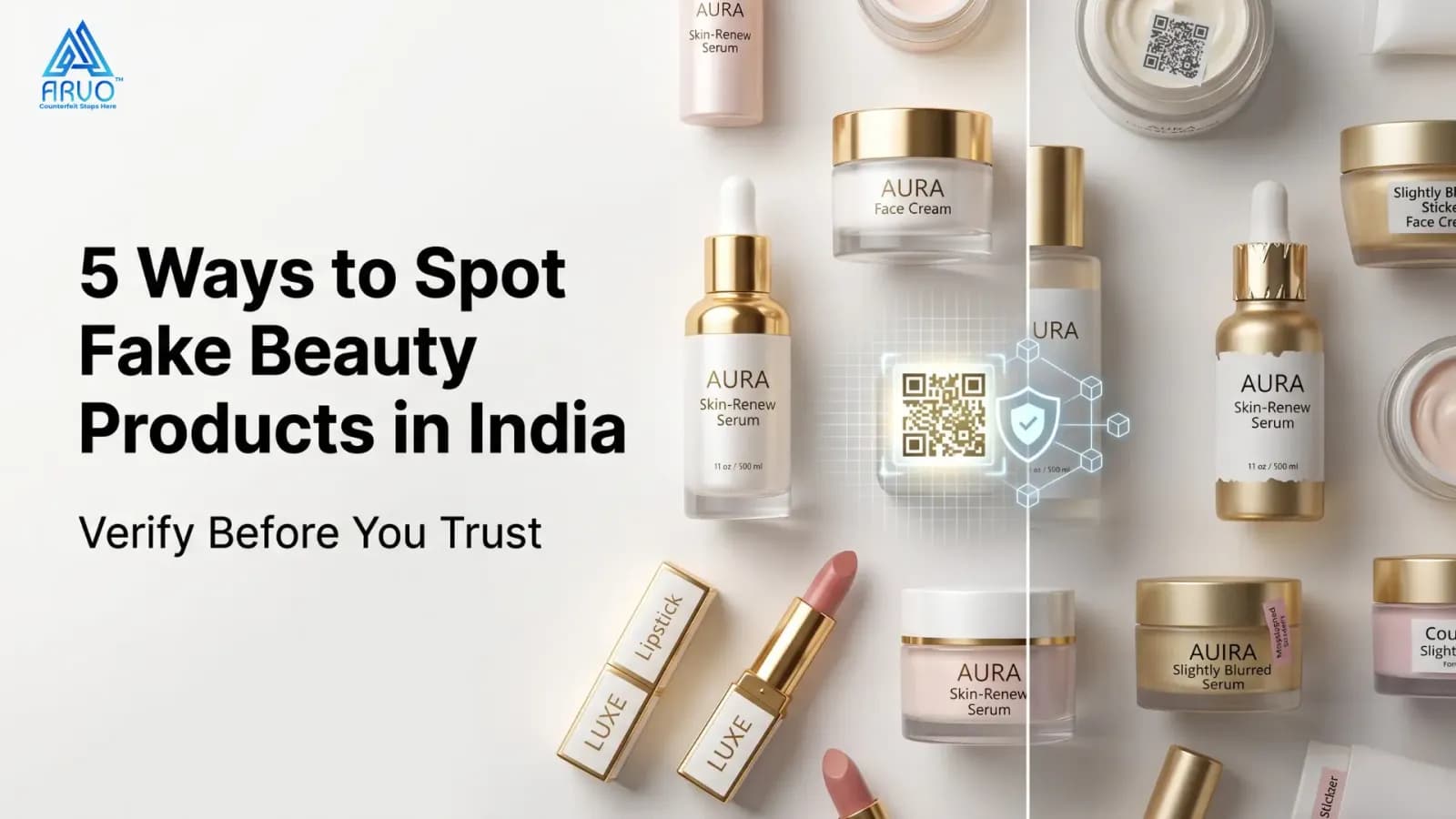
India’s beauty and personal care market is now valued at ₹1.3 Lakh Crore, making it one of the fastest-growing consumer segments in the country. But behind this growth lies a disturbing reality: 1 in 5 beauty products sold in India, whether online or offline, is fake. Secure QR codes are emerging as one of the most effective tools to combat this crisis, giving consumers instant power to verify product authenticity before a single drop touches their skin.
According to the Authentication Solution Providers’ Association (ASPA), counterfeiting incidents in India increased by 20% between 2018 and 2020, with beauty products among the fastest-growing categories. The Federation of Indian Chambers of Commerce and Industry (FICCI) reports that nearly 30% of FMCG products sold in India are counterfeit, and an alarming 80% of consumers believe they are purchasing genuine products when they are not.
The consequences extend far beyond wasted money. Counterfeit cosmetics seized across Indian cities have been found to contain lead, mercury, industrial-grade chemicals, and in some cases, adhesive substances. The health risks include skin burns, permanent scarring, hair loss, allergic reactions, and long-term neurological damage.
This guide covers five practical, evidence-backed methods that Indian consumers can use today to identify fake beauty products and protect themselves from harm.
1. Inspect the Packaging for Quality and Accuracy
Packaging inspection remains the first line of defence against counterfeit cosmetics in India. While counterfeiters have become increasingly sophisticated, most fake beauty products still exhibit subtle but identifiable differences from genuine products.
When examining packaging, consumers should look for the following indicators. Spelling errors or grammatical inconsistencies on labels are among the most common signs of a counterfeit product. Legitimate brands invest significantly in quality control for their packaging, and errors in product names, ingredient lists, or usage instructions almost always indicate a fake.
Print quality is another reliable indicator. Genuine products use high-resolution printing with consistent colour reproduction. Counterfeit products often display blurred text, faded colours, misaligned logos, or uneven ink distribution. In a 2021 enforcement operation, Delhi Police seized hundreds of counterfeit Beauty products, many of which were identifiable by their inferior print quality before any laboratory testing.
Consumers should also examine the packaging material itself. Genuine products use sturdy, well-constructed packaging with smooth edges, secure closures, and uniform surfaces. Counterfeit packaging tends to feel lighter, flimsier, or rougher to the touch.
It is important to note, however, that packaging inspection alone is no longer sufficient. ASPA has confirmed that counterfeiters in India now collect discarded genuine packaging and refill it with fake products. This is precisely why technology-driven solutions such as secure QR codes are becoming essential for reliable authentication.
2. Verify the MRP, Batch Number, and Manufacturing Details
Every legitimate beauty product sold in India is required by law to display specific information on its packaging: the Maximum Retail Price (MRP), batch or lot number, manufacturing date, expiry date, manufacturer’s name and address, and the FSSAI or BIS licence number where applicable.
Consumers should cross-reference the MRP printed on the product against the official price listed on the brand’s website or authorized retail platforms. A discount of 40% or more below the listed MRP is one of the strongest indicators that a product may be counterfeit. Counterfeiters operate on high volume and low cost, and pricing that appears too good to be true almost always is.
The batch number is equally important. Genuine brands assign unique batch numbers that can be traced back to specific production runs. Many Indian beauty brands now offer batch verification through their websites or customer helplines. If the batch number on the product does not return a valid result, the product should be treated as suspect.
Under the Drugs and Cosmetics Act, 1940, and the newly notified Cosmetics Amendment Rules 2025, cosmetics sold in India must meet stricter labelling and testing standards. Non-compliance with these standards now carries penalties including licence suspension and cancellation. Consumers who are aware of these requirements are better equipped to identify products that fail to meet them.
3. Scan Secure QR Codes to Confirm Authenticity Instantly
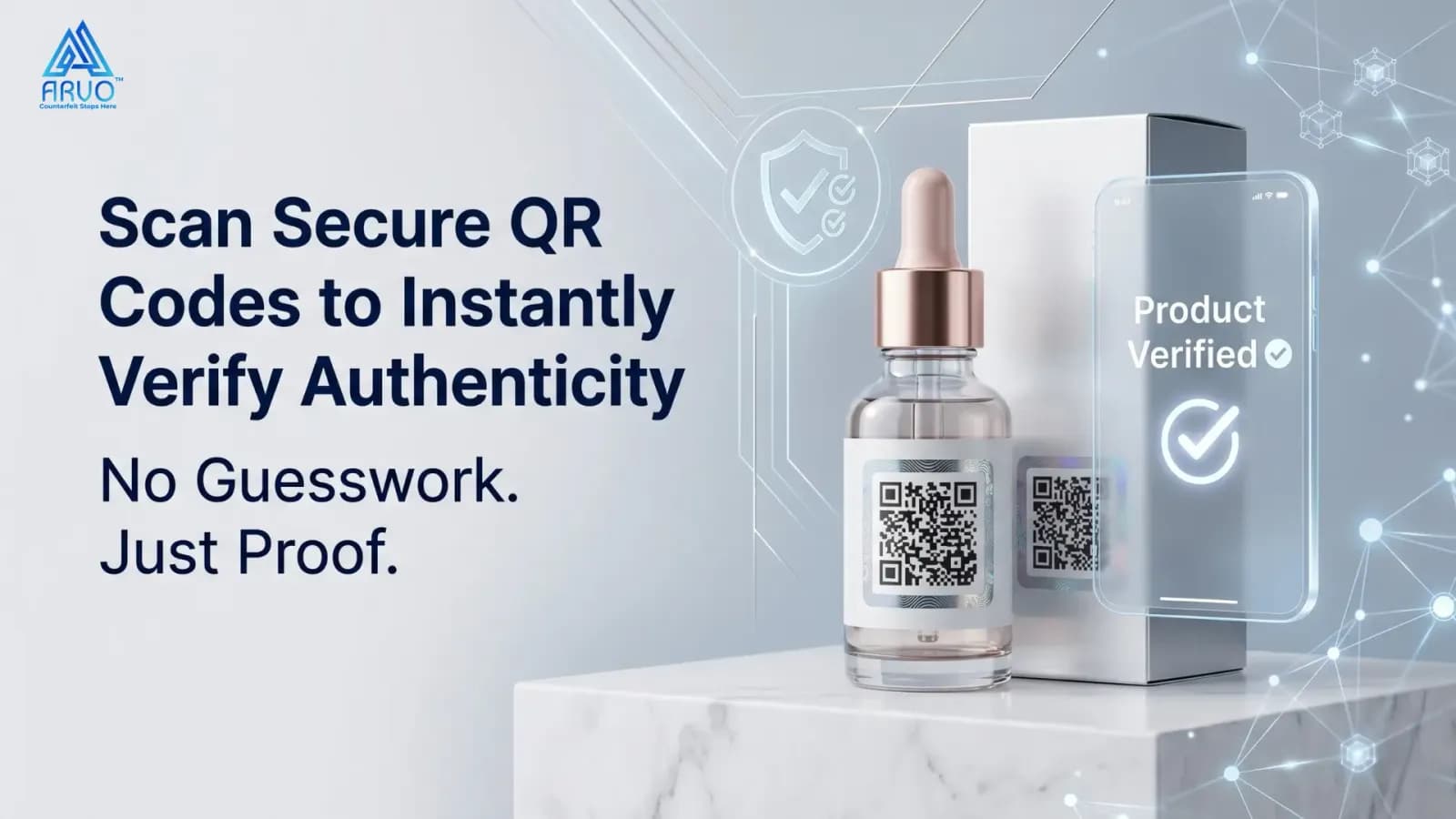
Of all five methods covered in this guide, scanning secure QR codes is the most reliable, fastest, and most difficult for counterfeiters to defeat. Unlike traditional QR codes, which can be easily photographed and reproduced, secure QR codes use advanced cryptographic data patterns that make each code mathematically unique and extremely difficult to clone.
When a consumer scans a secure QR code with their smartphone, the system instantly verifies the product against a blockchain-backed database. The result is delivered in seconds: the product is either confirmed as genuine or flagged as unverified. There is no ambiguity, no subjective judgment required, and no dependence on the consumer’s ability to detect visual differences.
This is the critical distinction between secure QR codes and standard QR codes. A standard QR code simply links to a URL, and any counterfeiter with a printer can duplicate it. Secure QR codes, such as ARVO’s Nova codes, are copy-proof. Each code carries a unique digital fingerprint that is tokenized on the blockchain, creating a permanent, tamper-proof record of the product’s authenticity.
The benefits for Indian consumers are substantial. In a market where ASPA data shows that 1 in 3 Indian consumers has unknowingly purchased a counterfeit beauty product, secure QR codes provide a definitive answer that no amount of packaging inspection or price comparison can match.
For beauty brands operating in India, secure QR codes also unlock additional value. The same scan that verifies authenticity can deliver product origin information, ingredient sourcing details, skincare recommendations, and direct brand-to-consumer communication. Authentication becomes an engagement channel, not merely a security measure.
Leading Indian beauty brands across both legacy and D2C categories are now adopting secure QR codes as a core component of their anti-counterfeiting solutions.
4. Test the Product’s Texture, Colour, and Fragrance
Physical product testing is a valuable secondary verification method, particularly when consumers are purchasing from unfamiliar retailers or when technology-based verification is not available.
Counterfeit beauty products frequently differ from their genuine counterparts in texture, colour, and scent. These differences arise because counterfeiters use inferior raw materials and lack the quality-controlled manufacturing processes that legitimate brands employ.
Genuine skincare creams and serums have a consistent, smooth texture. Counterfeit versions often feel grainier, thinner, or excessively oily. In investigations conducted by ASPA, counterfeit hair oils in India were found to be diluted with cheap industrial alternatives, and some contained adhesive substances. Fake face creams have been found laced with mercury, a neurotoxin that can cause permanent skin damage.
Colour consistency is another reliable indicator. Counterfeit lipsticks, foundations, and eyeshadows frequently display slight but noticeable colour variations from the genuine product. Side-by-side comparison with a known genuine product is the most effective way to detect these differences.
Fragrance is perhaps the most immediately detectable difference. Genuine perfumes and scented beauty products use precisely formulated fragrance compounds. Counterfeit products often have a noticeably stronger, weaker, or chemically different scent. While physical testing is useful, it has clear limitations. It requires the consumer to already know what the genuine product looks, feels, and smells like. This is another reason why secure QR codes are valuable: they allow verification before the product is opened.
5. Verify the Seller’s Credentials and Authorization Status
The final and frequently overlooked step is verifying the credentials of the seller. In India, counterfeit beauty products reach consumers through multiple channels: unregistered street vendors, unauthorized retail shops, third-party marketplace sellers, and social media accounts.
A 2022 survey found that 37% of Indian consumers aged 15 to 24 purchased counterfeit beauty products after seeing recommendations on social media platforms. Many of these sellers operate without GST registration, brand authorization, or return policies, all of which are indicators of potential counterfeit activity.
When purchasing beauty products online, consumers should verify that the seller displays a valid GST identification number, offers a clear return and refund policy, provides brand authorization or reseller documentation, and has a verifiable physical business address. The absence of any of these elements should be treated as a warning sign.
The Drugs Controller General of India (DCGI) has taken enforcement action against e-commerce platforms, directing them to remove unauthorized and counterfeit cosmetic listings. The Maharashtra FDA seized ₹2.5 Crore worth of fake L’Oreal, Lakme, and Nivea products from a single building in Mumbai. More recently, the Directorate of Revenue Intelligence in Mumbai seized counterfeit cosmetics worth ₹6.5 Crore in July 2025.
These enforcement actions underscore the scale of the problem and reinforce the importance of purchasing from verified, authorized channels. For brands looking to establish trust at every distribution point, implementing end-to-end traceability solutions ensures that every product in the supply chain can be verified from manufacturing to the consumer’s hands.
Why Secure QR Codes Are the Future of Beauty Product Authentication in India
Each of the five methods described above plays a role in protecting consumers from counterfeit beauty products. However, the reality of India’s beauty market, with its combination of rapid growth, fragmented distribution, tier 2 and tier 3 market expansion, and increasing e-commerce penetration, demands a solution that scales beyond manual inspection.
Secure QR codes meet this demand because they are technology-driven, consumer-friendly, and economically viable for brands at every price point, from ₹10 sachets to ₹5,000 premium serums.
India’s authentication and traceability market is projected to reach ₹16,575 Crore by FY2029, growing at 11.3% CAGR. The Cosmetics Amendment Rules 2025, notified on 29 July 2025, now mandate stricter testing and labelling standards for all cosmetics manufactured or imported in India. Brands that adopt secure QR codes and beauty product authentication technology today are not only protecting their consumers, but they are also positioning themselves for regulatory compliance and long-term competitive advantage.
The data is clear. One out of five beauty products in India is fake. Consumers deserve better. And with secure QR codes, they can verify authenticity with a single scan.
Protect Your Brand. Protect Your Consumers.
ARVO provides enterprise-grade anti-counterfeiting solutions for Indian beauty brands, including copy-proof Nova codes and blockchain-powered supply chain traceability through the AIC cloud platform.
Questions answered in this article
- How can I tell if a beauty product is fake in India?
- Check the packaging quality, verify the MRP and batch details, scan a secure QR code, test the texture and fragrance, and make sure the seller is authorised. Using several of these checks together gives the most reliable result.
- Are secure QR codes better than regular QR codes for product verification?
- Yes. A regular QR code can be copied by anyone with a printer, while a secure QR code uses a unique cryptographic pattern that cannot be duplicated. Scanning it tells you within seconds whether the product is genuine or unverified.
- What are the risks of using counterfeit beauty products?
- Fake beauty products seized in India have contained lead, mercury, industrial chemicals and adhesives. They can cause skin burns, scarring, hair loss, allergic reactions and long-term neurological damage.
- Is a heavily discounted beauty product always fake?
- Not always, but a deep discount below the official price is a major warning sign. Counterfeiters sell cheaply to attract buyers, so verify the product before you buy.
- Why does the seller matter when buying beauty products?
- Unauthorised sellers are a common source of fakes. Check for GST registration, a return policy and brand authorisation, and buy from trusted retailers or official platforms.
Sources
- Authentication Solution Providers’ Association (ASPA), ASPA
- Federation of Indian Chambers of Commerce and Industry, FICCI
- FSSAI, Food Safety and Standards Authority of India