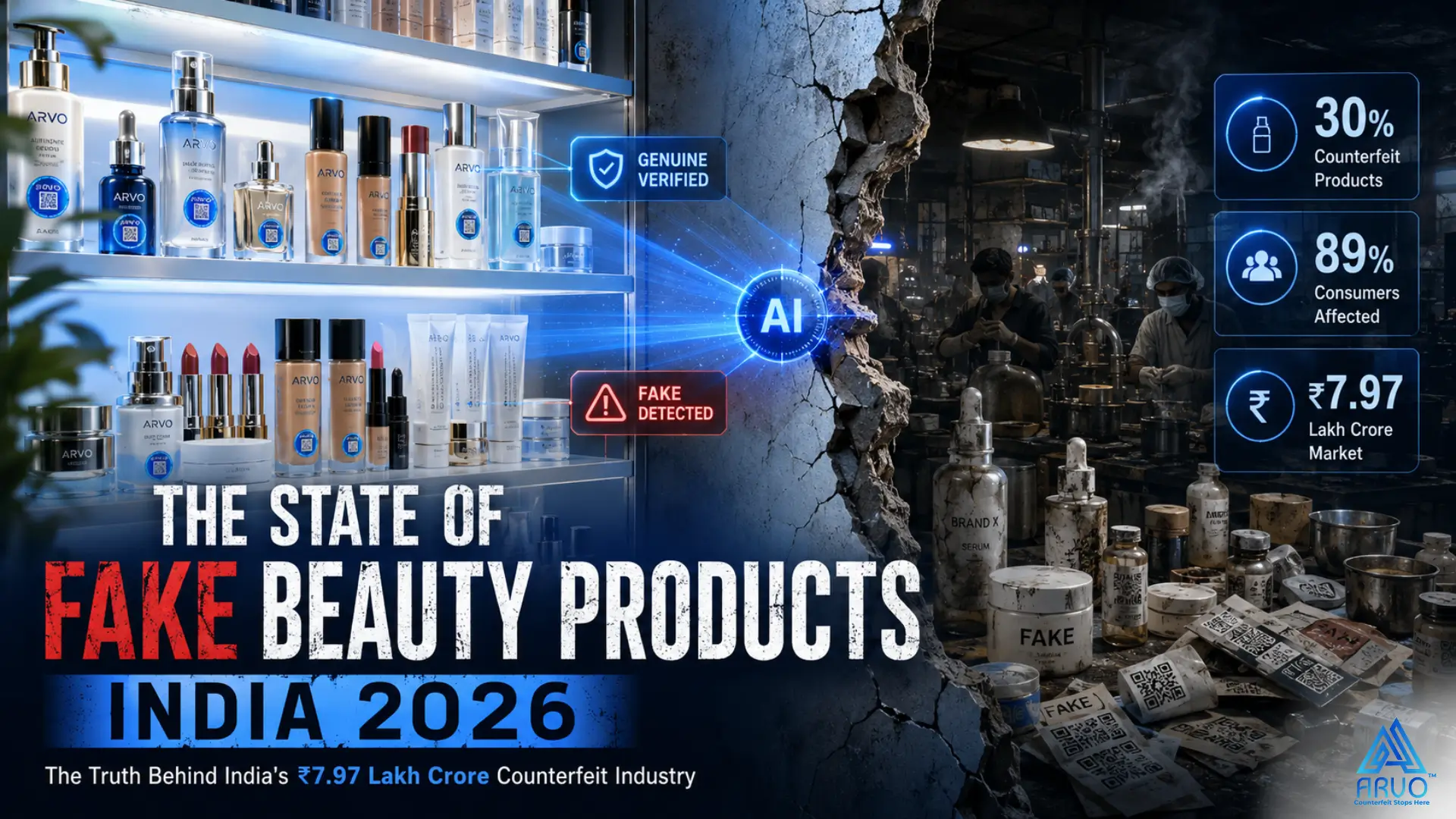
India’s beauty and personal care market surpassed $31 billion in 2025. It is projected to reach $48.72 billion by 2034. The D2C beauty segment is growing at 36.4% CAGR. Quick commerce beauty sales are growing 3x year-on-year. Over 800 D2C brands are active. Premium beauty segments are growing 50% annually on major platforms. Tier 2 and Tier 3 cities now drive over half of premium beauty demand. India is, by any measure, the fastest-growing major beauty market in the world.
But behind this growth lies a crisis of proportional scale. FICCI CASCADE reports that 30% of all FMCG products sold in India are counterfeit. The ASPA/CRISIL “State of Counterfeiting in India 2025” report found that 89% of urban Indian consumers have purchased a counterfeit product at least once in their lifetime. The total illicit market across five key Indian industries is valued at ₹7.97 Lakh Crore. And the problem of fake beauty products in India is not stabilising. Counterfeiting instances have grown 2.5x since 2018. The counterfeit FMCG market is expanding at 15% annually, faster than the legitimate market itself.
This report synthesises the most current data from FICCI CASCADE, ASPA/CRISIL Intelligence, the DCGI, DRI, Maharashtra FDA, and industry research to present a definitive picture of beauty counterfeiting in India as of mid-2026. It is designed as a reference document for beauty manufacturers, brand owners, investors, regulators, and industry bodies.
Table of Contents
Part 1: The Scale of the Crisis in Numbers
The data compiled from multiple authoritative sources paints a picture that no Indian beauty manufacturer can afford to dismiss.
| Metric | Data Point |
| India beauty and personal care market (2025) | $31.19 billion (IMARC Group) |
| Projected market value by 2034 | $48.72 billion at 5.08% CAGR |
| FMCG products that are counterfeit in India | 30% (FICCI CASCADE) |
| Consumers who believe they use genuine products | 80% (FICCI CASCADE) |
| Urban consumers who purchased a counterfeit at least once | 89% (ASPA/CRISIL 2025) |
| Consumers who encountered fakes in the past year | 35% (ASPA/CRISIL 2025) |
| Total illicit market across 5 key Indian sectors | ₹7,97,726 Crore (FICCI CASCADE) |
| FMCG Personal and Household Care illicit market | ₹73,813 Crore (FICCI CASCADE) |
| FMCG market share lost to counterfeits | 21.7% (FICCI CASCADE) |
| FMCG revenue loss from counterfeiting | ₹35,413 Crore (FICCI CASCADE) |
| Tax loss to the exchequer from illicit markets | ₹1,05,381 Crore (FICCI CASCADE) |
| Counterfeit FMCG annual growth rate | 15% (FICCI CASCADE) |
| FMCG counterfeiting instances (2018 to 2025) | 1,022 cases, 2.5x increase (ASPA) |
| Counterfeit purchases via online aggregators | 53% (ASPA/CRISIL 2025) |
| Youth (15 to 24) who bought fakes via social media | 37% (2022 Survey) |
| Counterfeit price discount vs genuine | ~19% cheaper (ASPA/CRISIL 2025) |
| Consumer willingness to pay a premium for genuine | 9% premium (ASPA/CRISIL 2025) |
The final row in the table above is perhaps the most strategically significant. Consumers are willing to pay a 9% premium for guaranteed genuine products. The demand for authentication exists. The question is whether manufacturers will supply it.
Part 2: The Health Dangers Documented by Enforcement Agencies
Fake beauty products in India are not merely an economic problem. They are a public health crisis. The substances found in counterfeit cosmetics by Indian enforcement agencies are documented toxins with established health consequences.
Mercury has been found in counterfeit skin-whitening creams sold across India. Mercury is a neurotoxin that causes kidney damage, neurological impairment, and skin discolouration. Lead has been detected in counterfeit lipsticks. Lead exposure causes cumulative neurological damage, which is particularly dangerous for women of reproductive age. Industrial adhesives have been found in counterfeit hair oils. Unregistered chemical compounds have been used in fake hair colour products as cheap substitutes for approved formulations.
The DCGI’s nationwide seizure included products containing stem cell-based serums, unregistered glutathione injections, and hyaluronic acid fillers being sold as cosmetic products. None of these ingredients were certified for human use as cosmetics. According to ASPA President Nakul Pasricha, the most frequently counterfeited beauty categories are hair oil, shampoo, cream, and face wash.
Research published in the International Journal of Science and Advanced Technology confirms that 20% to 25% of the Indian cosmetics market consists of counterfeit or smuggled goods. Cross-border counterfeiting networks, particularly linked to China and Bangladesh, supply a significant volume of fake cosmetics to India. 16% of consumers blame the legitimate brand when they encounter counterfeit products online. The reputational cost is borne entirely by the genuine manufacturer.
Part 3: The Enforcement Record (2024 to 2026)
The enforcement operations across India from 2024 to mid-2026 reveal a sustained counterfeiting infrastructure operating at industrial scale.
| Date | Agency | Location | Value Seized |
| July 2025 | DRI | Mumbai | ₹6.5 Crore |
| 2025 | Maharashtra FDA | South Mumbai | ₹2.5 Crore |
| 2025 | Maharashtra FDA | Thane | ₹88 Lakh |
| 2025 | DCGI | 30 locations nationwide | ₹4 Crore |
| 2025 | Delhi Police | Delhi | Factory dismantled; ₹50.16L materials |
| April 2025 | Maharashtra FDA | Bhiwandi, Thane | ₹3.47 Lakh |
| 2025 | Gujarat FDCA | Gujarat | Multiple operations |
| 2021 | Delhi Police | Delhi | Hundreds of counterfeit units |
Following the nationwide raids, the DCGI summoned representatives from major e-commerce platforms and issued formal directives requiring them to remove unauthorised listings, sign revised seller agreements, accept verification responsibility, and implement re-listing prevention systems. The Maharashtra FDA commissioner stated a zero-tolerance policy toward misleading, substandard, and unlicensed products.
Part 4: The Regulatory Landscape and What Has Changed
The Indian regulatory framework for cosmetics has undergone its most significant evolution in decades between 2024 and 2026.
The Cosmetics (Amendment) Rules, 2025, notified on 29 July 2025, introduced precise expiry date definitions, mandated digitised batch-level documentation retained for a minimum of three years, empowered State Licensing Authorities to suspend or cancel manufacturing licences under the newly inserted Rule 31A, and aligned definitions with the Drugs and Cosmetics Act, 1940.
The Drugs and Cosmetics (Compounding of Offences) Rules, 2025, established a legal mechanism to settle certain counterfeiting offences without full court prosecution, creating a multi-layered enforcement pathway.
Schedule M notification imposed a blanket ban on manufacturing non-drug products in facilities licensed for drug production, directly impacting contract manufacturers producing both pharmaceutical and cosmetic products.
BIS certification for cosmetics is under active consideration by the government as of mid-2026. The DCGI’s ₹4 Crore seizure of products failing BIS standards signals that compliance with BIS benchmarks is an emerging enforcement priority.
FICCI CASCADE organised an interactive session in Goa in April 2026, previewing a new KPMG study covering eight sectors, including FMCG and luxury goods, scheduled for release at MASCRADE in September 2026. In June 2026, FICCI CASCADE is conducting police capacity-building programmes in Punjab on tackling counterfeiting. The regulatory and enforcement infrastructure is scaling across legislative, institutional, and operational dimensions simultaneously.
Part 5: The Distribution Channels Where Counterfeits Thrive
Counterfeit beauty products in India enter the market through five distinct distribution channels, each requiring a different protection strategy.
Offline retail and kirana networks. India has approximately 13 million kirana stores accounting for over 90% of FMCG sales. Counterfeit products enter through unauthorised wholesalers and secondary distributors offering higher margins. An estimated ₹4,200 Crore is lost annually through offline retail counterfeits.
Online marketplace platforms. Online aggregators account for 53% of all counterfeit purchases (ASPA/CRISIL 2025). Third-party seller accounts create, operate, and abandon counterfeit listings in cycles faster than platform enforcement can respond. An estimated ₹2,800 Crore is lost annually through online fakes.
Social commerce. 37% of Indian youth aged 15 to 24 purchased fakes through social media recommendations. Social media advertisements are a rapidly growing counterfeit channel. 71% of beauty consumers discover products via social media. The speed of social commerce checkout eliminates the verification opportunity.
Quick commerce. Projected at $5.38 billion in 2025, growing at 17% annually. Beauty is one of the fastest-growing categories with 3x growth and 25% higher average selling prices. Rapid dark store onboarding creates sourcing verification gaps.
Grey market diversion. Over ₹1,000 Crore is lost annually when genuine products are diverted by authorised distributors to unauthorised channels at discounted prices. Without serialised tracking, manufacturers have no visibility into which distributors are diverting stock.
Part 6: The Technology That Solves It
The data presented in this report leads to a single conclusion: the scale of fake beauty products in India has exceeded the capacity of enforcement alone to contain. Regulations are tightening. Enforcement agencies are conducting operations. But with the counterfeit market growing at 15% annually and 53% of fakes entering through online channels, the solution must be embedded at the product level by the manufacturer.
Copy-Proof Nova Codes for Unit-Level Authentication
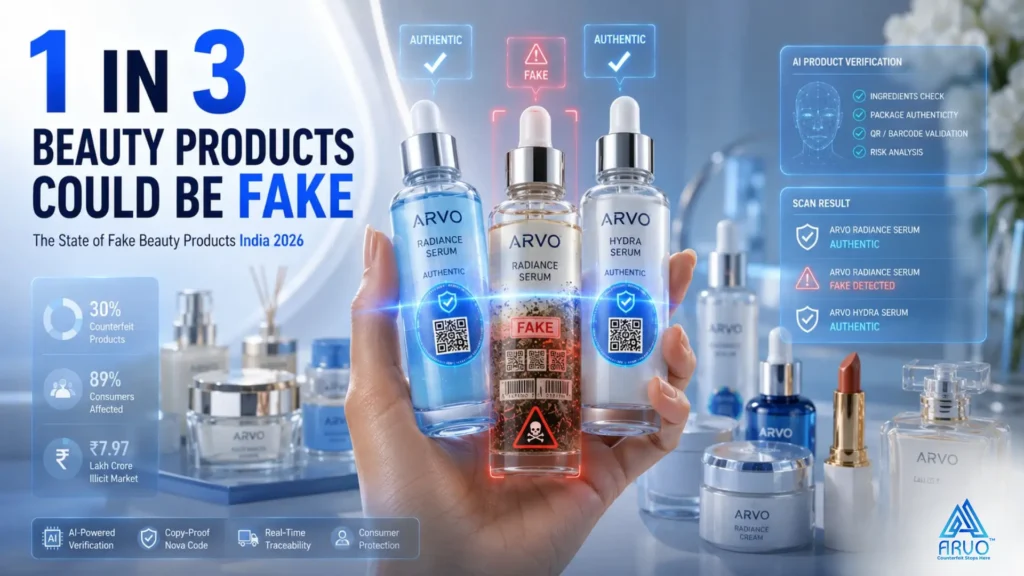
ARVO’s Nova codes use Cryptographic Data Pattern (CDP) encryption to create a unique, unclonable digital fingerprint for every product unit. Authentication accuracy is 99.97%. No app required. Browser-based verification delivers results in seconds. Every serum, cream, shampoo, and fragrance carries its own digital identity that cannot be copied, cloned, or reproduced.
Complete Supply Chain Visibility with Every Scan
Every Nova code scan captures geographic location, timestamp, and verification result in real time. Manufacturers gain direct visibility into where products are consumed versus where they are shipped. Grey market diversion is detected through geographic anomalies. Counterfeit infiltration is flagged through verification failure clustering. The system covers every channel: offline retail, marketplaces, quick commerce, social commerce, and direct-to-consumer.
AI-Powered Consumer Engagement and Loyalty
After verification, ARVO activates an AI chat interface trained on the brand’s product knowledge. Consumers receive personalised guidance, ingredient transparency, and usage recommendations. Loyalty programme integration rewards scanning and engagement, driving repeat purchases. Every interaction generates first-party consumer data.
The AIC Dashboard for Centralised Intelligence
The AIC (ARVO Integrated Cloud) dashboard consolidates scan analytics, counterfeit alerts, grey market detection, consumer engagement metrics, and loyalty data into a single command centre. Every scan is a data point. Every data point protects revenue, builds consumer trust, and informs business strategy.
The system deploys in 7 days. Per-unit cost is a few paise. No production downtime. No packaging redesign. 2x faster than the industry standard.
Frequently Asked Questions
1. How large is the counterfeit beauty market in India in 2026?
FICCI CASCADE reports that 30% of all FMCG products sold in India are counterfeit. The total illicit market across five key sectors is valued at ₹7.97 Lakh Crore, with FMCG Personal and Household Care accounting for ₹73,813 Crore. FMCG companies lose an estimated 21.7% of their total market share to counterfeits. The counterfeit FMCG market is growing at 15% annually, faster than the legitimate market. ASPA/CRISIL 2025 recorded 1,022 FMCG counterfeiting instances between 2018 and 2025, a 2.5-fold increase.
2. Which beauty product categories are most frequently counterfeited in India?
According to ASPA President Nakul Pasricha, the most counterfeited beauty products in India are hair oil, shampoo, cream, and face wash, in that order. These categories combine high consumer demand with relatively simple formulations that counterfeiters can replicate cheaply. Enforcement agencies have found mercury in fake creams, lead in counterfeit lipsticks, industrial adhesives in fake hair oils, and unregistered chemicals in counterfeit hair colour products.
3. What are the key regulatory changes that beauty manufacturers must comply with in 2026?
The Cosmetics (Amendment) Rules, 2025, effective from 29 July 2025, mandate digitized batch-level documentation retained for three years minimum, precise expiry date labelling, and empower authorities to suspend or cancel manufacturing licenses under Rule 31A. Schedule M bans non-drug manufacturing in drug-licensed facilities. BIS certification for cosmetics is under active government consideration. FICCI CASCADE and KPMG are preparing a comprehensive eight-sector study for release at MASCRADE in September 2026.
4. How quickly can product authentication be deployed by an Indian beauty manufacturer?
ARVO’s complete system deploys in 7 days. Days 1 to 2 cover brand onboarding and AI chat training. Days 2 to 4 cover NOVA code label design and printer integration. Days 4 to 6 cover the first serialised production run with blockchain records. Day 7 is go-live for consumer verification, AI engagement, loyalty, and the AIC dashboard. No production downtime, no packaging redesign, and no capital equipment procurement is required.
5. What return on investment can manufacturers expect from authentication?
The per-unit cost is a few paise. FICCI CASCADE estimates that FMCG companies lose 21.7% of their market share to counterfeits. For a brand with ₹10 Crore in annual revenue, that implies approximately ₹2.17 Crore captured by counterfeiters. Authentication also delivers consumer engagement, loyalty programe infrastructure, first-party data intelligence, and regulatory compliance readiness under the Cosmetics Amendment Rules 2025. The ASPA/CRISIL 2025 report confirms that consumers are willing to pay a 9% premium for guaranteed genuine products, meaning authentication can also unlock a pricing premium.
Download the Complete State of Fake Beauty in India 2026 Report
The data is unambiguous. 30% of the market is fake. 89% of consumers have been affected. ₹7.97 Lakh Crore in illicit trade. 1,022 documented cases in seven years. Toxic ingredients in products that consumers put on their skin every day. And a counterfeit market is growing faster than the legitimate one.
ARVO provides the complete solution: copy-proof Nova codes, AI-powered consumer engagement, loyalty integration, real-time supply chain visibility, and the AIC dashboard. Deployed in 7 days. A few paise per unit. 99.97% accuracy. No app required.
Download the full report and schedule a brand protection consultation.