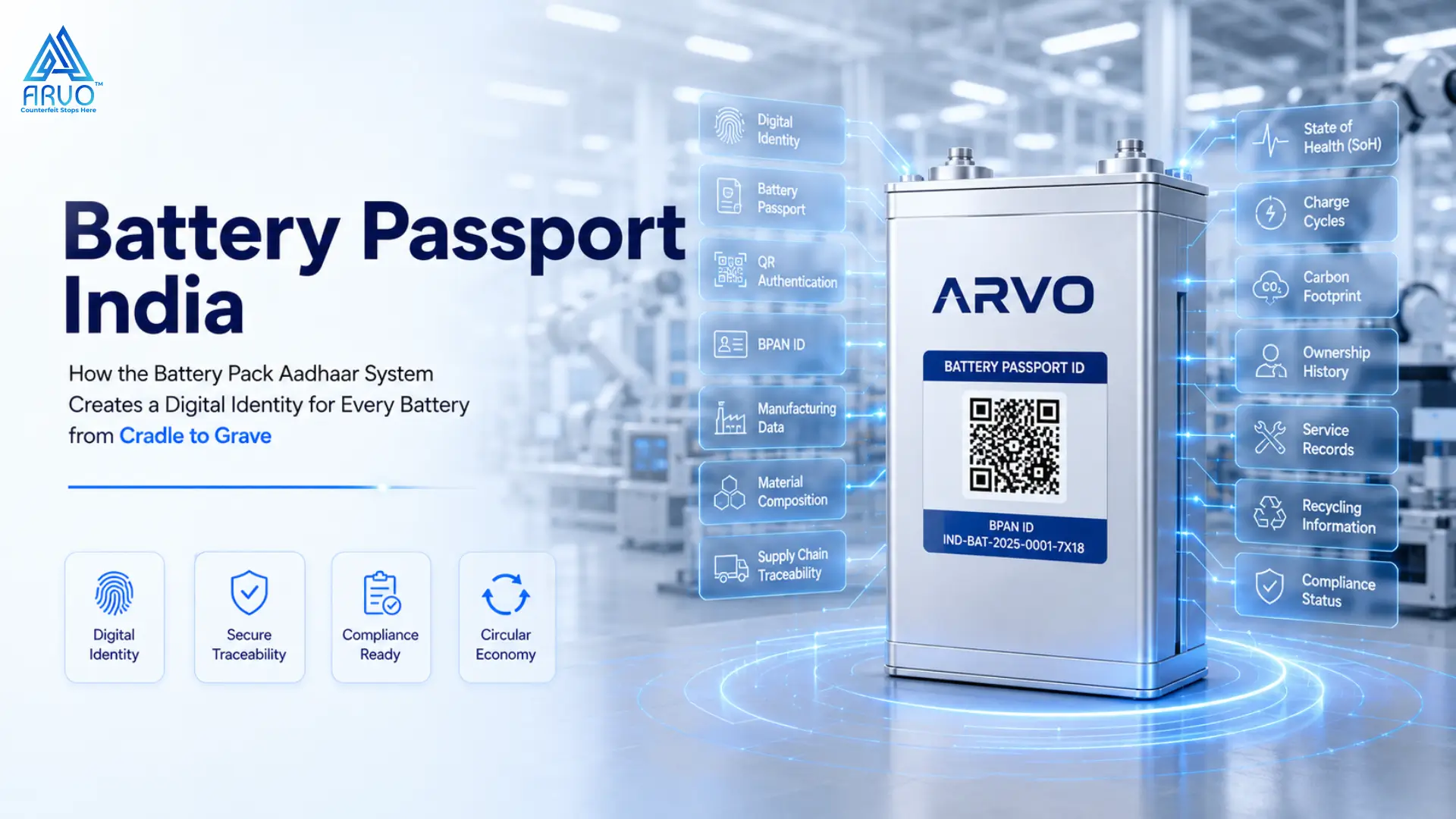
Imagine a battery that can speak.
Not literally, of course. But imagine a lithium-ion battery pack sitting on a factory floor in Gujarat that could tell you exactly where its lithium came from, which mine in which country, processed in which facility. It could tell you the precise chemistry of its cathode, the carbon footprint of its production, the date and shift it was assembled, and the name of the quality engineer who signed off on its final inspection.
Now imagine that same battery, three years later, powering a delivery vehicle in Pune. It could tell you how many charge cycles it has completed, its current state of health at 87%, the one thermal event it experienced during a summer heatwave in May 2028, and the fact that it was serviced once at an authorised facility in Bangalore.
Now imagine that battery at the end of its first life, eight years from now, arriving at a recycling facility in Chennai. Before a single tool touches it, the recycler scans a code on the pack and knows its exact chemical composition, the safest disassembly method, the materials that can be recovered, and the precise carbon footprint that recycling will offset.
This is not a future vision. This is what the Battery Passport India system is designed to deliver. And it is happening now.
Table of Contents
The Day India Decided Every Battery Deserves an Identity
In January 2026, the Ministry of Road Transport and Highways quietly published a document that will reshape the Indian battery industry for the next two decades. The document was titled “Draft Guidelines for Implementation of Battery Pack Aadhaar System.” Most headlines focused on the catchy Aadhaar analogy. But buried in those 49 pages was something far more consequential than a naming convention.
Source: MoRTH Draft Guidelines for Implementation of Battery Pack Aadhaar System, January 2026; PSA.gov.in, 49-page guideline
The government had created a framework that would give every single battery pack in India a unique, permanent, digital identity. Not just a serial number stamped during manufacturing. A living, breathing digital record that would follow the battery from the moment its raw materials were sourced, through every charge cycle, every repair, every ownership change, every thermal event, and ultimately to the recycling facility where its materials would be recovered and fed back into the supply chain.
The battery aadhaar system was born out of necessity. India’s battery market was valued at $7.82 billion in 2025 and is projected to reach $15.71 billion by 2034, growing at 8.06% CAGR. EV batteries account for 80% to 90% of the country’s total lithium-ion demand. The PLI scheme has committed ₹18,100 Crore to 11 cell makers. Gigafactory capacity exceeded 68 GWh in 2025. India was building a battery ecosystem at extraordinary speed. But it was building it without a way to track what it had built.
Source: IMARC Group, India Battery Market Report 2026-2034; MarketsandMarkets, India Li-ion Battery Market 2025-2030; MarqStats, EV Battery Pack Market 2026-2030
No one could tell you, with certainty, where a specific battery had been manufactured, what was inside it, how healthy it was, whether it had experienced safety incidents, or whether it was safe for second-life use. For an industry growing at this pace, with this much government investment, and with this many safety implications, that level of blindness was untenable.
What the Battery Passport Actually Contains: Three Layers of Truth
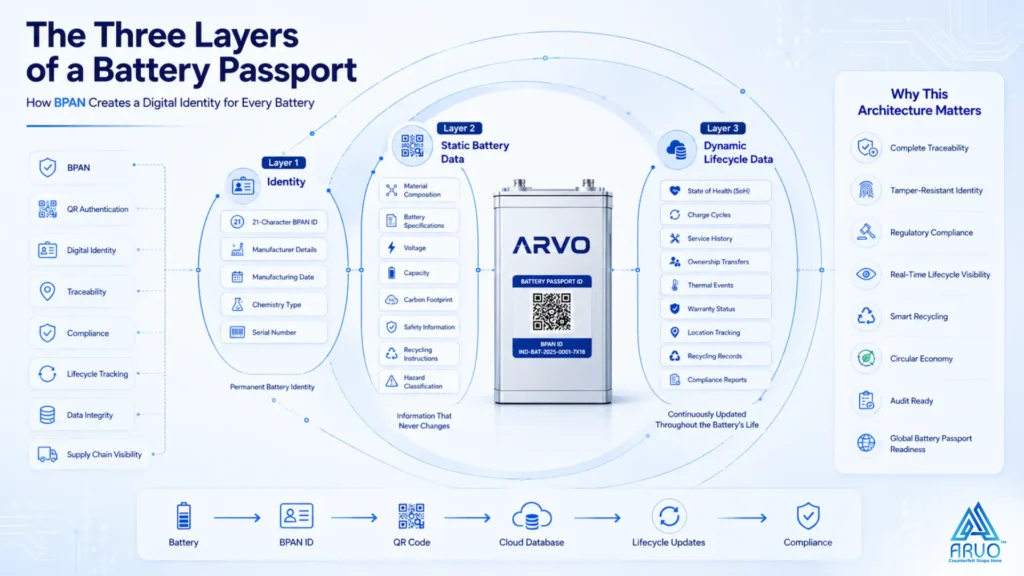
The battery passport India framework is not a single identifier. It is a three-layered system, each layer serving a different purpose, accessible to different stakeholders, and containing different categories of information. Think of it as a battery’s biography, written in three chapters that unfold over time.
Layer 1: The Name Tag (21-Character Alphanumeric Code)
The first layer is the battery’s name. A 21-character alphanumeric code physically marked on the battery pack. The first five characters identify the country and manufacturer. The remaining 16 encode chemistry type, capacity, cell origin, manufacturing date, and a unique serial number. This code is visible to anyone who looks at the battery. It provides basic identification without requiring any technology beyond human eyesight. Think of it as the battery’s face: recognisable, public, and permanent.
Source: PSA.gov.in BPAN Guideline, Table 3; SRM Technologies, BPAN: Backbone of India’s Battery Ecosystem, March 2026
Layer 2: The Medical Record (QR Code with Static Data)
The second layer is the battery’s medical record. A QR code linked to the BPAN stores detailed static information that does not change over the battery’s lifetime: material composition down to cathode and anode chemistry, nominal voltage and energy density, carbon footprint parameters calculated at the manufacturing stage, and recycling information including disassembly methods, hazardous material warnings, and recoverable materials. This layer is designed primarily for recyclers. When a battery arrives at a recycling facility at the end of its life, the recycler scans the QR code and knows exactly what is inside, how to safely disassemble it, and what materials can be recovered. No guesswork. No laboratory analysis. No risk of handling unknown chemical compositions.
Source: CoEZET, IIT Madras, Battery Pack Aadhaar System Platform Documentation
Layer 3: The Life Diary (Server-Based Dynamic Data)
The third layer is the battery’s autobiography, written in real time throughout its operational life. Stored on a central server with restricted access, this layer records State of Health (SoH) measurements, charge and discharge cycle counts, thermal events and safety incidents, ownership transfers, service and maintenance history, and ultimately, recycling outcomes and material recovery data. This is the layer that transforms a static product into a living digital asset. A battery with eight years of health data is not an unknown risk. It is a precisely valued asset whose remaining useful life can be calculated, whose safety history is documented, and whose suitability for second-life applications can be determined with data, not speculation.
Source: The Policy Edge, Guidelines for Battery Pack Aadhaar, January 12, 2026; Global South Policy Review
The Journey of a Battery: How BPAN Tracks a Lifecycle from Start to Finish
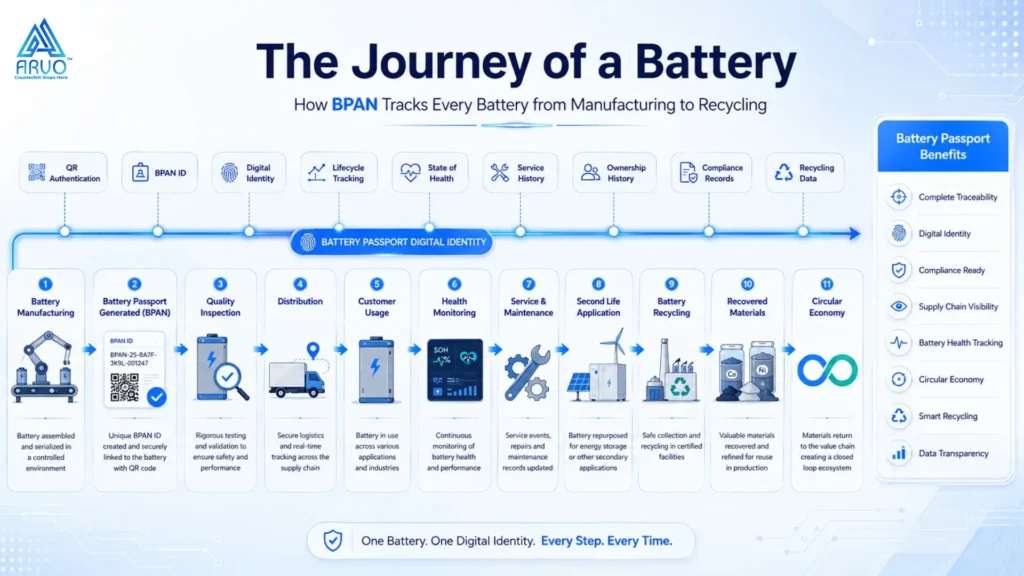
To understand why the battery passport matters, follow a single battery through its entire life.
Chapter 1: Birth (Manufacturing)
A lithium-ion battery pack is assembled at a facility in Tamil Nadu. The manufacturer generates a BPAN, assigning the battery its 21-character identity. The QR code is encoded with the battery’s material composition, specifications, and carbon footprint data. The code and QR are permanently affixed to the pack. The manufacturer uploads initial data to the BPAN portal. The battery now exists as a digital entity. It has a name, a medical record, and the first entry in its life diary. From this moment, every interaction with this battery will be recorded.
Chapter 2: First Life (In a Vehicle)
The battery is installed in an electric three-wheeler and enters service in Bengaluru. Over the next six years, the dynamic data layer captures 1,847 charge cycles, a State of Health that gradually decreases from 100% to 79%, two minor thermal events during summer months (both within safe parameters), and one service visit for a cell balancing adjustment. Every one of these data points is recorded against the battery’s BPAN. The battery’s digital identity grows richer with every passing day.
Chapter 3: Second Life (Repurposed)
At 79% SoH, the battery is removed from the vehicle. A decade ago, this would have been an unknown quantity. Is it safe? How much capacity does it have? Can it be used for anything? With the battery passport, the answers are immediate. A prospective buyer for a stationary energy storage application scans the QR code and accesses the battery’s complete history. The 1,847 cycles confirm moderate usage. The 79% SoH confirms viable second-life capacity. The two thermal events, both minor and resolved, confirm no safety disqualification. The battery is repurposed. A new BPAN is generated reflecting its new configuration and application. The previous BPAN is retained as historical record.
Source: MoRTH BPAN Guidelines (new BPAN on material alteration); Deccan Herald, A Green Mobility Push Through Battery Aadhaar
Chapter 4: End of Life (Recycling)
Seven years later, the battery’s SoH drops below the threshold for its stationary storage application. It arrives at a certified recycling facility. The recycler scans the QR code and accesses the complete material composition: cathode chemistry, anode type, electrolyte composition, hazardous materials present, and recommended disassembly method. The battery’s final chapter is written. Material recovery data is uploaded to the BPAN portal. The lifecycle is complete. From the lithium mine to the recycling plant, every moment has been documented.
Source: CoEZET, IIT Madras; Battery Waste Management Rules, 2022 (EPR compliance)
India and the EU: Two Continents, One Destination
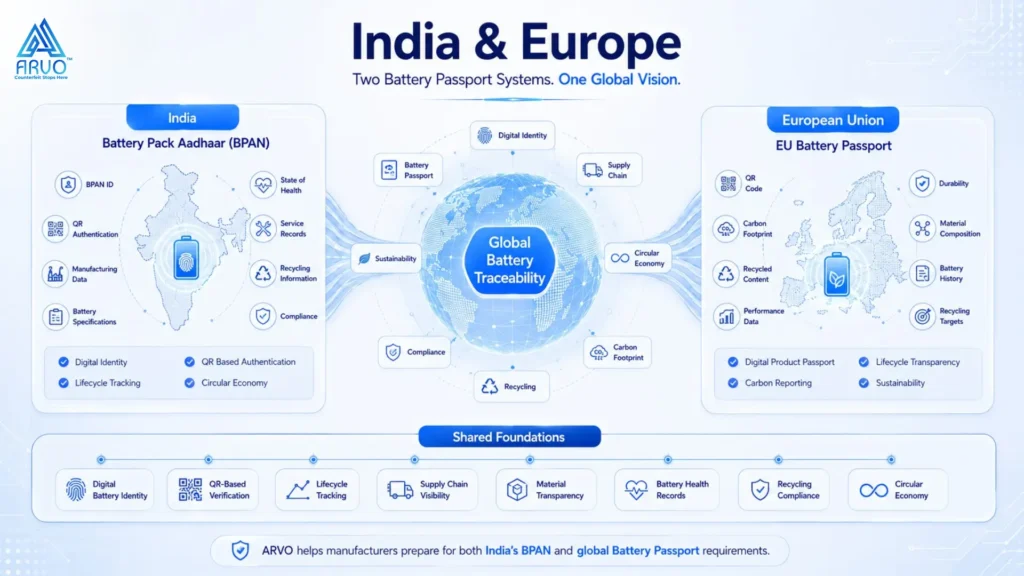
India is not building its battery passport system in isolation. Across the globe, the European Union has enacted the Battery Regulation 2023, which mandates digital passports for EV and industrial batteries entering the EU market by 2027. The regulation requires QR codes on every battery, detailed information about carbon footprint, recycled content declarations, performance and durability data, and a minimum 70% recycling efficiency target by 2030.
Source: EU Battery Regulation 2023 (2023/1542), Official Journal of the European Union
The parallels with India’s BPAN are striking. Both systems use QR codes as the primary data carrier. Both mandate lifecycle tracking from production to recycling. Both require carbon footprint disclosure. Both involve restricted-access dynamic data. The MoRTH guidelines explicitly describe the Indian system as “India-first but globally extensible,” meaning the data architecture is designed to accommodate international standards where harmonisation is required.
Source: The Policy Edge, January 12, 2026 (global interoperability analysis)
For Indian battery manufacturers who export or plan to export, this convergence is profoundly significant. A manufacturer who achieves BPAN compliance in India will be substantially prepared for EU Battery Passport compliance with minimal incremental effort. The data architecture, the QR infrastructure, the lifecycle tracking mechanisms, and the audit-ready documentation are aligned. One compliance investment serves two regulatory frameworks. One digital identity works across two continents.
Source: Deccan Herald; EVTech.News, India Introduces Battery Passport for EV Batteries from 2026, June 2026
Why This Changes Everything for Battery Manufacturers, OEMs, and Investors
The battery passport is not merely a compliance requirement. It is a structural shift in how batteries are valued, traded, financed, and recycled. Here is what changes for every stakeholder.
For Manufacturers: Provenance Becomes a Competitive Advantage
In a market growing at 17.65% CAGR with dozens of manufacturers entering every year, the ability to prove your battery’s provenance, quality history, and lifecycle compliance becomes a differentiator. BPAN compliance in India is not just about avoiding penalties. It is about establishing the manufacturing credibility that OEM procurement teams, government tenders, and international buyers will increasingly demand.
Source: Mordor Intelligence, India Li-ion Battery Market 2026-2031, 17.65% CAGR
For OEMs: Used Vehicle Financing Becomes Possible
One of the greatest barriers to EV adoption in India has been the uncertainty around used EV values. How do you finance a second-hand electric vehicle when nobody can objectively assess the battery’s remaining life? The battery passport solves this. A battery with a documented SoH of 82%, a complete charge cycle history, and zero safety incidents is not an unknown risk. It is a precisely valued asset. Lenders can underwrite it. Buyers can trust it. The used EV market can finally scale.
Source: Deccan Herald, A Green Mobility Push Through Battery Aadhaar (financing and valuation analysis)
For Investors: Transparency Reduces Risk
Investors in battery manufacturing, EV companies, and energy storage infrastructure gain access to verifiable data about the assets their capital is funding. Portfolio risk assessment moves from projections to documented performance data. The battery passport creates a layer of transparency that fundamentally changes the due diligence landscape for battery-related investments.
For the Nation: Recycling Becomes Efficient, Not Experimental
India has targeted 80% domestic recycling capacity by the end of the decade. The battery passport makes this target achievable. Recyclers who know the exact composition of every battery they process can optimise material recovery, reduce waste, and operate safely. Without the passport, recycling remains a process of opening unknown packages and hoping the chemistry inside matches expectations. Battery lifecycle tracking in India through BPAN transforms recycling from guesswork into precision engineering.
Source: The Policy Edge; Battery Waste Management Rules, 2022; India e-Mobility R&D Roadmap
How ARVO Brings the Battery Passport to Life
The battery passport is a framework. It describes what data must be captured, how it must be stored, and who must be able to access it. But the framework does not build itself. Manufacturers need technology partners who can implement the system on the factory floor, encode the QR codes, manage the data, and maintain the digital identity across the battery’s entire life. This is where ARVO operates.
Nova Codes: The QR Layer That Cannot Be Forged
The BPAN mandates that every battery carry a QR code encoding static technical data in an offline-accessible format. ARVO’s Nova codes are copy-proof QR codes with Cryptographic Data Pattern (CDP) encryption that fulfil this mandate while adding a security layer that standard QR codes fundamentally cannot provide. A standard QR code can be photographed and duplicated. A Nova code cannot. For a system designed to provide tamper-proof lifecycle traceability, the distinction is not a feature. It is a requirement.
The AIC Dashboard: Where the Battery’s Story Lives
ARVO’s AIC (ARVO Integrated Cloud) dashboard manages all three tiers of BPAN data through a single platform. The 21-character identity, the QR-encoded static data (composition, specifications, carbon footprint, recycler information), and the server-based dynamic data (SoH, charge cycles, thermal events, ownership changes, service records) are all stored, updated, and accessible through one interface. On-demand compliance reports can be generated for regulatory audits, PLI documentation, EPR submissions, and export certifications.
Supply Chain Visibility from Cell to Pack to Vehicle to Recycler
Every time a Nova code is scanned at any point in the battery’s lifecycle, the system captures the geographic location, timestamp, and scan context. Manufacturers can track where their batteries are, who is handling them, and what stage of the lifecycle they have reached. This visibility supports BPAN’s dynamic data requirements while simultaneously providing the supply chain intelligence that manufacturers need for operational planning.
7 Days from Decision to BPAN-Compliant Production
Day 1 to 2: Manufacturer onboarding and Nova code configuration for battery pack formats. Day 2 to 4: QR label design and integration with existing production lines. Day 4 to 6: First BPAN-compliant production run with lifecycle data capture activated. Day 7: AIC dashboard goes live with full visibility, data management, and compliance reporting. No production downtime. No redesign of battery packs. A few paise per unit. The battery passport comes to life in a week.
Frequently Asked Questions
1. What exactly is a battery passport, and how does India’s version differ from Europe’s?
A battery passport is a digital identity system that assigns each battery pack a unique identification code and QR code, enabling lifecycle tracking from production to recycling. India’s Battery Pack Aadhaar Number (BPAN) uses a 21-character alphanumeric code with a three-tier data architecture (public alphanumeric, authorised QR, restricted server). The EU Battery Regulation 2023 mandates a similar digital passport by 2027 with additional requirements around recycled content and recycling efficiency targets. India’s system is described as “India-first but globally extensible,” designed to accommodate EU harmonisation where required.
Source: MoRTH Guidelines; EU Battery Regulation 2023; The Policy Edge
2. Which batteries will need a battery passport in India?
Phase 1 covers EV batteries used in L category (two-wheelers, three-wheelers), M category (passenger vehicles), and N category (goods vehicles), which account for 80% to 90% of India’s lithium-ion demand. Phase 2 covers industrial batteries above 2 kWh capacity. Portable batteries and SLI (Starting, Lighting, Ignition) batteries are currently excluded.
Source: MoRTH Guidelines; InsightsOnIndia; Global South Policy Review
3. How does the battery passport help the used EV market?
The battery represents 40% to 50% of an EV’s total cost. Without objective battery health data, financing and valuing used EVs is speculative. The battery passport provides documented SoH, complete charge cycle history, safety incident records, and service history. Lenders can underwrite second-hand EV purchases based on verified battery performance data rather than assumptions. This enables the used EV market to scale, which is critical for mass EV adoption in India.
Source: Deccan Herald, A Green Mobility Push Through Battery Aadhaar
4. What data must battery manufacturers capture and maintain under BPAN?
Manufacturers must capture static data (material composition, specifications, carbon footprint, recycler information) encoded in the QR code, and dynamic data (SoH, charge cycles, thermal events, ownership changes, service history, recycling outcomes) stored on a central server. Data must be maintained throughout the battery’s lifecycle and must be accessible to authorised stakeholders including regulators, OEMs, service providers, and certified recyclers.
Source: PSA.gov.in BPAN Guideline; CoEZET, IIT Madras
5. How quickly can a manufacturer implement battery passport compliance with ARVO?
ARVO’s complete system deploys in 7 days. Copy-proof Nova codes serve as the BPAN QR layer. The AIC dashboard manages all three data tiers. Lifecycle tracking activates from the first production run. No production downtime or battery pack redesign is required. The per-unit cost is a few paise. For manufacturers producing thousands of battery packs monthly, BPAN compliance becomes operational within a single work week.
Give Every Battery a Story. Make ARVO the Author.
Every battery you manufacture will carry a story. The question is whether that story will be told by a system you control, with data you trust, through a digital identity that protects your brand, supports your compliance, and enables the circular economy that India is building. Or whether the story will be silence: an untraceable battery whose provenance is unknown, whose health is unverified, and whose end-of-life outcome is unaccountable.
ARVO provides the complete battery passport infrastructure: copy-proof Nova codes, three-tier data management, lifecycle tracking, supply chain visibility, and the AIC dashboard. Deployed in 7 days. A few paise per unit. 99.97% QR authentication accuracy. One system that serves BPAN compliance, PLI documentation, BWM Rules, and EU Battery Passport readiness simultaneously.