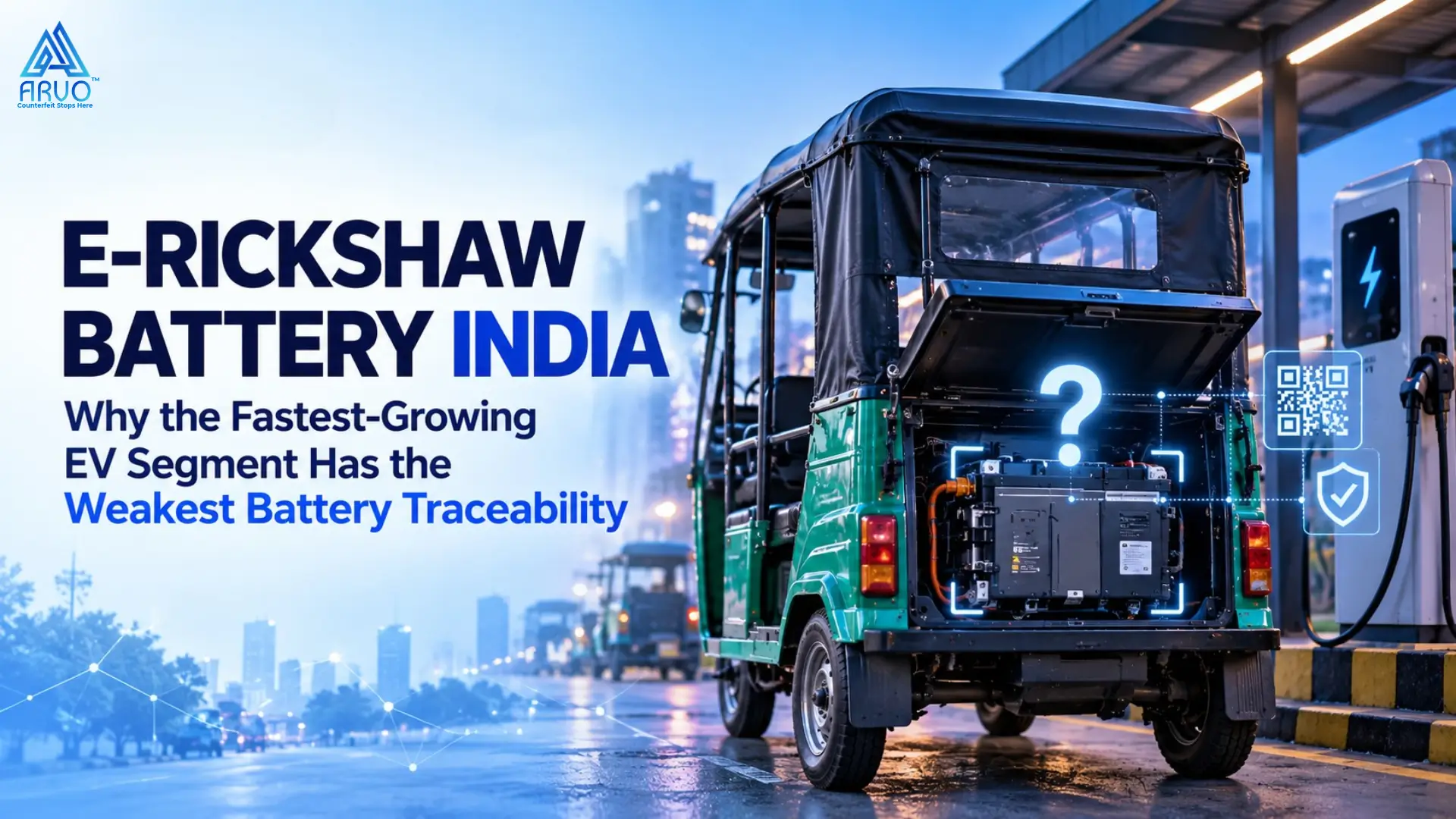
At 4:42 am on 17 August 2026, the Delhi Fire Service received a call from Raghubir Nagar in West Delhi. Two men had been charging e-rickshaw batteries inside a rented first-floor room when a suspected battery blast set the building alight. Both died. Four months earlier, across the city in Jaitpur, thieves broke into a charging station overnight and took 20 e-rickshaw batteries worth about ₹9 lakh. In both cases, the same question had no answer: where did these batteries come from, and who was responsible for them? That question sits at the heart of the e-rickshaw battery India market today.
E-rickshaws move millions of people every day and now make up a meaningful share of India’s electric vehicle registrations. Yet in the e-rickshaw battery supply chain in India, the battery, the most valuable and most dangerous part of the vehicle, usually has no identity of its own. It can be stolen, swapped, resold, or replaced without leaving a trace.
This guide is written for e-rickshaw and L5 three-wheeler OEMs, pack assemblers, and fleet operators. It covers the size of the e-rickshaw battery India market, how the shift to lithium is changing the risk, the theft and safety record, the five biggest traceability gaps, and what the draft Battery Pack Aadhaar rules and AIS 156 mean for L-category makers.
E-Rickshaw Battery India: A Segment Bigger Than It Looks
E-rickshaws, and the e-rickshaw battery India market behind them, are often treated as the informal end of electric mobility. The numbers say otherwise. In FY 2025-26, five states alone registered about 4.5 lakh e-rickshaws, close to 80% of the national total. In Assam, nearly one in ten vehicles registered that year was an e-rickshaw. Take e-rickshaws out of the count and India’s EV share of all new registrations falls from 8% to 7%.
| Indicator | Figure | Source |
| E-rickshaw registrations in the top 5 states, FY 2025-26 | About 4.5 lakh (close to 80% of national total) | Down To Earth analysis of VAHAN data, July 2026 |
| Uttar Pradesh e-rickshaw registrations, FY 2025-26 | Over 2 lakh | Down To Earth / VAHAN, July 2026 |
| E-rickshaws registered nationally, November 2024 | Over 18.1 lakh | WRI India / VAHAN, January 2025 |
| Estimated unregistered e-rickshaws operating in India | About 4.75 lakh | EVMS estimate, mid-2025 (via JMK Research) |
| Electric three-wheeler share of all EV registrations, 2017 to 2025 | 28.73% | JMK Research, February 2026 |
| E-rickshaw registrations in March 2026 alone | 28,942 | EVreporter / VAHAN, April 2026 |
| India e-rickshaw market, 2025 | $1.35 billion | MarkNtel Advisors, September 2026 |
| Forecast India e-rickshaw market, 2032 | $3.45 billion (14.33% CAGR) | MarkNtel Advisors, September 2026 |
| Battery share of an e-rickshaw’s upfront cost | 30% to 40% | WRI India, January 2025 |
Two figures stand out for anyone building or financing an e-rickshaw battery India fleet. The battery is 30% to 40% of the vehicle’s upfront cost, so it is the single most valuable component on the road. And roughly 4.75 lakh e-rickshaws were estimated to be running without registration in 2025, which means a large share of the e-rickshaw battery India fleet is invisible to any official system.
Sources: Down To Earth, “India on e-wheels” (20 July 2026); WRI India, “Powering Indian E-rickshaws” (January 2025); JMK Research, “Mandatory Registration of all Electric Rickshaws” (February 2026); EVreporter, India EV sales trend (April 2026); MarkNtel Advisors, India E-Rickshaw Market (September 2026).
The Lead-Acid to Lithium Shift Raises the Stakes
For years, the e-rickshaw battery India story was a lead-acid story. As recently as late 2024, about 90% of the market still ran on lead-acid batteries, which typically need replacing every year. That is changing quickly across the e-rickshaw battery India market. By value, lithium-ion variants held 55% of the e-rickshaw market in 2026, according to MarkNtel Advisors.
The shift is good for drivers. An e-rickshaw lithium battery charges faster, lasts more cycles and carries a battery management system that records voltage, temperature and charge history. But it also changes the e-rickshaw battery India risk picture for every OEM and fleet operator in three ways.
- Higher value per pack. A lithium pack is worth far more than the lead-acid battery it replaces, which makes it a far more attractive target for thieves and counterfeiters.
- Longer life, more owners. A pack that lasts several years may pass through more than one vehicle, owner or financier, and each handover is a point where its history can be lost.
- More to go wrong. Lithium cells that are poorly made, badly assembled or damaged can overheat and catch fire, and a fire leaves little behind to investigate.
In short, the e-rickshaw battery India market is moving from a cheap, replaceable part to a valuable, long-life asset, without yet building the identity and tracking systems that valuable assets need.
Sources: WRI India (January 2025), citing VAHAN data and a NITI Aayog report; MarkNtel Advisors (September 2026)
E-Rickshaw Battery Theft: An Organised Trade
E-rickshaw battery theft is no longer the work of the odd opportunist, and it now affects every part of the e-rickshaw battery India value chain. Police reports from 2026 show organised gangs working across cities and state lines.
- Delhi, April 2026. A six-member gang broke into a charging station in Jaitpur at night and stole 20 e-rickshaw batteries worth about ₹9 lakh. Police traced them through footage from more than 120 CCTV cameras.
- Noida, August 2026. Four men, some of them accused in the Jaitpur case, were arrested with 13 smart lithium batteries and 414 lithium cells. Police said they targeted e-rickshaws parked in quiet spots across Delhi-NCR and sold the batteries to scrap dealers one at a time.
- Azamgarh, July 2026. Police arrested six members of a gang and recovered 8 e-rickshaws and 36 batteries.
- Shahjahanpur and Hamirpur, 2026. Separate e-rickshaw battery theft gangs were busted in both districts.
- Nagpur, October 2026. Batteries left to charge outside a driver’s home were stolen overnight. Police recovered four of them.
Notice how these e-rickshaw battery India theft cases were solved: through CCTV footage, local intelligence and patrols. Not one was solved because the battery itself could prove who owned it. Once a pack reaches a scrap dealer or is broken down into cells, there is nothing on it to connect it to its maker, its financier or its owner. That is the core problem with stolen battery tracking in the e-rickshaw battery India market today.
Sources: Delhi News Live (17 April 2026); Royal Bulletin (11 August 2026); Amar Ujala (Azamgarh, July 2026; Shahjahanpur, August 2026; Hamirpur, April 2026); Nagpur Today (8 October 2026).
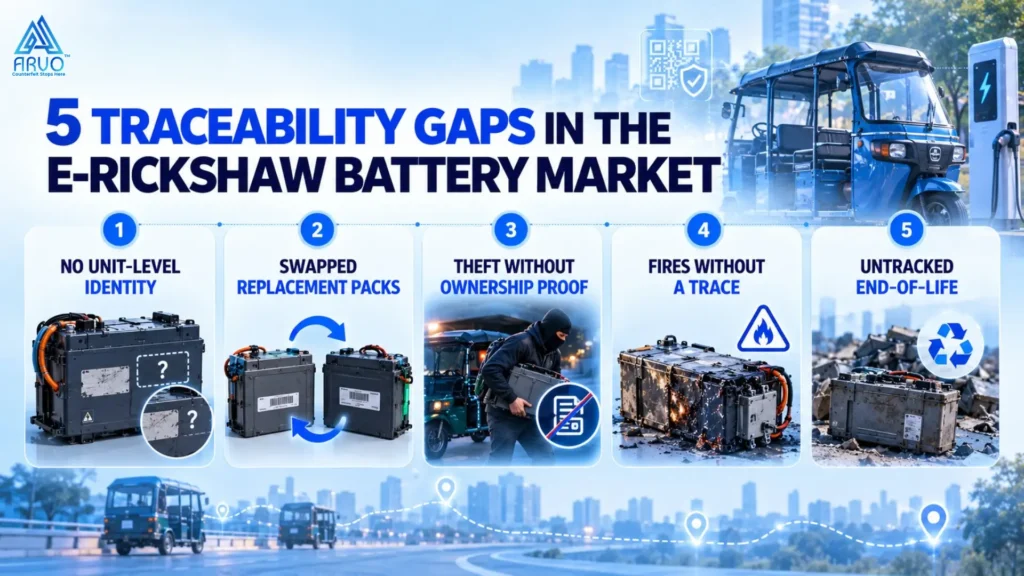
5 Traceability Gaps in the E-Rickshaw Battery India Market
Theft is only the most visible symptom. Behind it sit five gaps that affect every OEM, pack assembler, and fleet operator in the e-rickshaw battery India supply chain.
1. No Unit-Level Identity
Most e-rickshaw battery India packs leave the assembly line with a printed label and, at best, a batch number. Nothing on the pack proves which unit it is, who made it or when. For a segment where an estimated 4.75 lakh vehicles were running unregistered, the battery often has even less identity than the vehicle carrying it.
2. Swapped and Substandard Replacement Packs
Lead-acid batteries are typically replaced every year, so the average e-rickshaw goes through several battery changes in its life. Each e-rickshaw battery India replacement happens in a local workshop, where a pack of unknown origin can be fitted under a known brand’s name. When an e-rickshaw lithium battery is assembled from cells of unknown quality, neither the driver nor the fleet owner can tell.
3. No Proof of Ownership After Theft
When a stolen pack is recovered, police and owners have to rely on invoices and memory to prove whose it is. When it is sold to a scrap dealer or broken into cells, as the Noida case suggests, it disappears from every record. Without stolen battery tracking at unit level, recovery is luck, not process.
4. Fires Without a Trail
After a battery fire, investigators need to know who made the pack, which batch its cells came from, and how it was charged. In most e-rickshaw battery fires in India, that information simply does not exist. A manufacturer cannot recall what it cannot identify, and it cannot defend itself against blame for packs it never made.
5. End of Life Goes Off the Grid
According to a NITI Aayog report cited by WRI India, about 90% of end-of-life batteries were recycled informally, in ways described as inefficient and unsafe. Under the Battery Waste Management Rules 2022, producers carry responsibility for collection and recycling. An e-rickshaw battery pack in India that cannot be traced to the end of its life cannot be counted towards those obligations.
Battery systems that cannot be verified can also be tampered with. In July 2026, the Ministry of Electronics and Information Technology had battery management apps removed from app stores after videos showed people using them over Bluetooth to cut power to moving e-rickshaws. It was a reminder that the e-rickshaw battery India market has grown faster than the controls around it.
Sources: WRI India (January 2025); Business Today, “Apps enabling pranksters to stop vehicles remotely deleted, says MeitY” (3 July 2026); ETV Bharat, Raghubir Nagar fire report (17 August 2026).
What BPAN and AIS 156 Mean for L-Category Makers
Two regulatory frameworks are pulling the e-rickshaw battery India market towards unit-level traceability: the draft Battery Pack Aadhaar system and the AIS 156 battery safety standard.
The Draft Battery Pack Aadhaar System
In January 2026, the Ministry of Road Transport and Highways released draft guidelines for a Battery Pack Aadhaar Number (BPAN). Phase 1 covers EV batteries in the L, M and N vehicle categories, and the L category includes e-rickshaws and three-wheelers. Each pack would carry a 21-character identity and a QR code, physically marked on the pack, with lifecycle data held centrally.
The e-rickshaw battery India timeline under BPAN is not settled. In July 2026, the main vehicle industry body asked the government to push implementation to 2034 and to leave electric three-wheelers, especially e-rickshaws, out of the rules for now. The guidelines are still a draft, and the final scope may change. What will not change is the direction: every major battery market, including the EU, is moving to unit-level battery identity.
AIS 156 and L5 EV Battery Compliance
AIS 156 sets battery safety rules for L-category vehicles. It replaced the older AIS 048 standard, which covered e-rickshaws and e-carts. Its first phase, from December 2022, required pack traceability and a battery management system with full protections. The second phase, from March 2023, added thermal propagation testing, cell testing at accredited labs and audible and visual warnings for thermal events. For L5 EV battery compliance, traceability is therefore already a requirement, not a future idea.
Registration Is Tightening Too
States are also closing the gap on unregistered vehicles, which brings more of the e-rickshaw battery India fleet into view. In October 2025, West Bengal made registration mandatory for all e-rickshaws, which pushed a wave of new entries into VAHAN by early 2026. Delhi is considering a similar window. As more vehicles enter official records, the pressure to give their batteries an identity will only grow.
Sources: MoRTH, Draft Guidelines for Battery Pack Aadhaar System (January 2026); NewsBytes, “India auto industry urges delay of battery Aadhaar 21-digit rule” (12 July 2026); ARAI guide to battery safety standards via EVreporter; JMK Research (February 2026).
Why Stickers, Serial Numbers and Paper Records Fail Here
Most e-rickshaw and three-wheeler EV battery packs today carry some form of marking. None of the common methods hold up in the conditions these batteries live in: dust, heat, rough handling, frequent swaps, and a large informal repair market.
| Method | How It Is Meant to Work | Why It Fails in the E-Rickshaw Market |
| Painted or printed serial number | Identifies the pack | Scraped off, painted over, or copied; numbers are easy to guess |
| Paper warranty card | Proves purchase and ownership | Lost, damaged or never handed to the driver |
| Sticker or hologram | Shows the pack is genuine | Peeled off and reused; similar stickers are easy to source |
| Standard QR code | Links to product details | Photographed and reprinted, so a clone scans as genuine |
| Connected BMS or tracker | Reports location and health | Only on some lithium packs; can be removed, switched off, or tampered with |
| App-based verification | Driver or buyer checks the pack in an app | Few drivers or workshops will install and register on an app |
The common thread is that each method either comes off the pack or can be copied onto a fake one. A workable answer for the e-rickshaw battery India market needs an identity on every pack that cannot be cloned, survives hard use, and can be checked with any phone, with no app.
What Battery Traceability Gives OEMs and Fleet Operators
Unit-level identity is not only a compliance task. For businesses in the e-rickshaw battery India market, it pays back in five practical ways.
- Proof of ownership. A scannable, copy-proof identity lets an owner or financier prove a recovered pack is theirs, and makes stolen packs harder to resell openly.
- Cleaner warranty claims. Every claim can be matched to a real unit, its sale date and its owner, so claims on fake or swapped packs can be rejected with evidence.
- Better financing. Lenders are more willing to fund e-rickshaw battery India assets they can identify and track, which matters in a segment where many drivers buy on credit.
- Faster, narrower recalls. If a batch of cells proves faulty, a maker can find and recall exactly those packs instead of everything it sold.
- Readiness for BPAN and EPR. Packs that already carry a unique identity are far easier to bring into the Battery Pack Aadhaar system and to count towards recycling obligations.
How ARVO Helps E-Rickshaw Battery Makers
ARVO is dedicated to preventing counterfeiting and making every product traceable for Indian manufacturers. For e-rickshaw battery India makers and fleet operators, ARVO provides Nova codes: copy-proof QR codes that give every battery pack a unique identity that cannot be cloned.
Anyone can scan a Nova code with any QR scanner, with no app and no registration. The codes print on your existing printers, with no extra hardware. Every scan shows your team where and when a pack is checked, and the AIC dashboard brings that data together to flag fakes, unusual movements, and grey market stock. The same codes also help you get ready for Battery Pack Aadhaar requirements.
Deployment takes 15 days and costs only paise per pack. To see how it works for your product line, talk to the ARVO team.
Frequently Asked Questions
Is Battery Pack Aadhaar mandatory for e-rickshaw battery makers in India?
Not yet. The Battery Pack Aadhaar guidelines released by the Ministry of Road Transport and Highways in January 2026 are still a draft. Phase 1 covers EV batteries in the L, M and N categories, which includes e-rickshaws, but the industry has asked for a delay to 2034 and for e-rickshaws to be left out for now. Makers that build unit-level identity early will be ready whichever way the final rules go.
How can fleet operators reduce e-rickshaw battery theft?
Secure charging locations and CCTV help, but they only protect an e-rickshaw battery in an Indian fleet while packs are parked. Give every pack a unique, copy-proof identity so ownership can be proved after recovery, record which pack is fitted to which vehicle, and check identities at every swap or service. This turns stolen battery tracking from guesswork into a record.
Is an e-rickshaw lithium battery easier to trace than lead-acid?
An e-rickshaw battery in India usually has a battery management system that records health and charge data, which helps. But that data lives inside the pack and can be lost, reset or tampered with. A physical, copy-proof identity on the outside of the pack, linked to a central record, is what makes either chemistry traceable.
What does AIS 156 require for three-wheeler EV battery packs?
AIS 156 applies to L-category vehicles, including electric three-wheelers. Its first phase required pack traceability and a battery management system with full protections. Its second phase added thermal propagation testing, cell testing at accredited labs, and audible and visual warnings for thermal events. Makers should confirm the latest amendments with their testing agency.
How does ARVO help e-rickshaw battery makers?
ARVO gives each pack a copy-proof Nova code that anyone can scan with a normal QR scanner. Each scan feeds location and time data into the AIC dashboard, so makers and fleet operators can spot fakes, track movements, and prepare for Battery Pack Aadhaar. It works with existing printers and goes live in 15 days.
The Bottom Line for E-Rickshaw Battery India Makers
The e-rickshaw battery India market has grown into one of the biggest parts of the country’s EV story, with packs that are more valuable, longer-lived and more dangerous than ever. Today, most of those packs can be stolen, swapped or burned without leaving a trace. Regulation will close that gap eventually. The makers and fleet operators who close it first will win the trust of drivers, financiers and regulators. Give every battery pack an identity with ARVO.