The True Cost of Aftermarket Counterfeit Parts: Why One Fake Part Can Cost Crores
Aftermarket counterfeit parts drive warranty claims, wider recalls and liability for OEMs. Where the losses hide and how a part-level pilot measures them.
By Abhijeet Kumar, ARVOPublished Updated 5 min read
In short
One fake part can trigger warranty claims honoured by default, recalls widened just to be safe and liability that always lands on the brand. These losses hide in warranty accruals, dealer adjustments, recall buffers and legal reserves. The fix is part-level verification that travels with each part from factory to workshop, proven first in a focused pilot.
- Counterfeit parts often enter authorised channels through parallel sourcing, unauthorised substitutions at dealers or workshops, and unverified returns.
- When a failed part cannot be verified, warranty claims are usually honoured by default and recalls expand beyond the affected batches.
- Counterfeit losses are rarely labelled as such; they sit in warranty accruals, dealer adjustments, logistics write-offs, recall buffers and legal reserves.
- ERP systems confirm transactions, not authenticity, and serialized packaging stops protecting a part once it is unpacked.
- A pilot on one production line lets an OEM measure recall containment and warranty leakage before scaling.
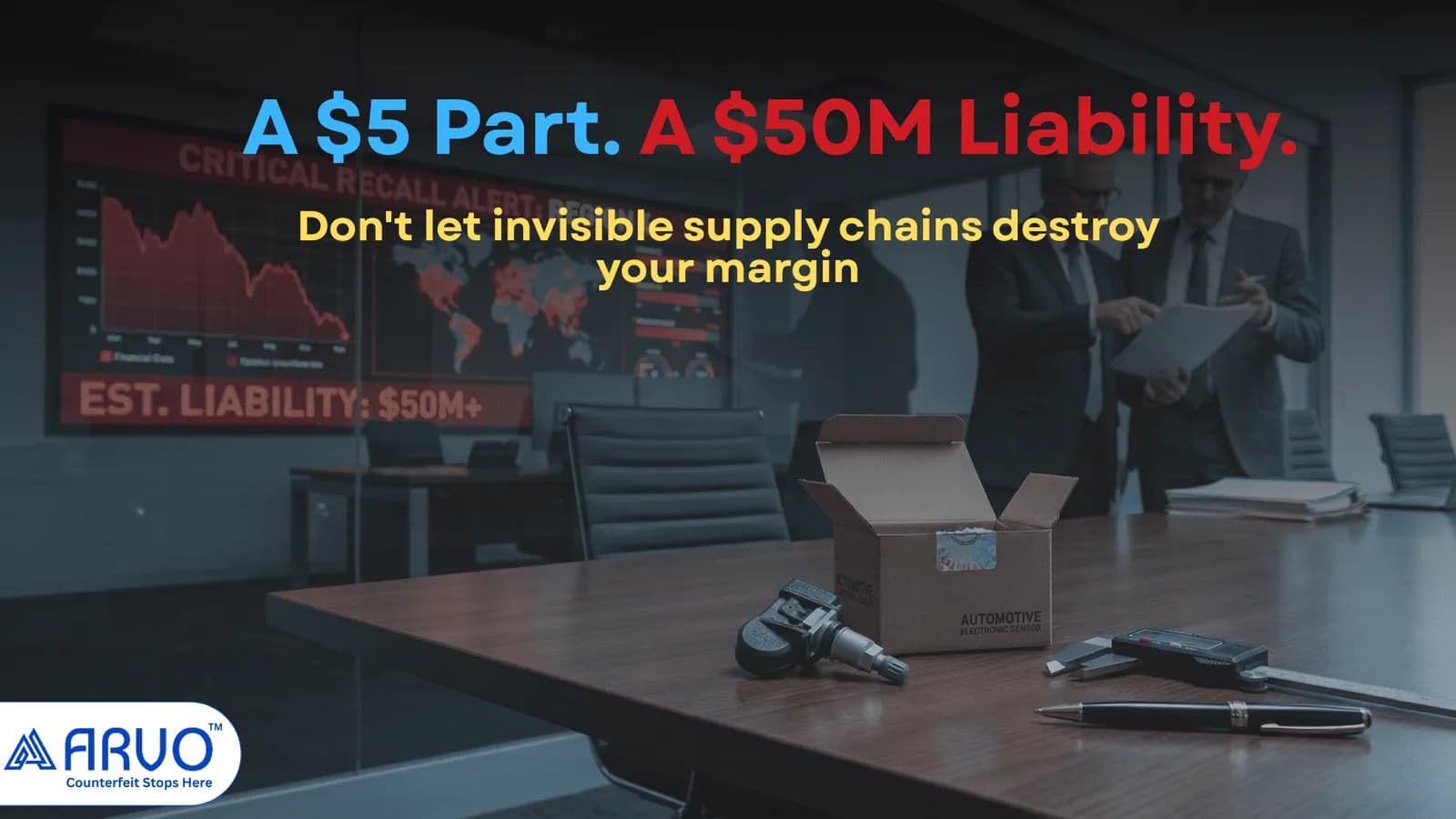
For automotive OEMs, the aftermarket is no longer just a revenue extension; it is a risk surface. Aftermarket Counterfeit Parts and unverified spare parts are quietly entering authorized channels, triggering warranty claims, expanding recall scope, and exposing brands to safety and liability risks. What makes this problem dangerous is not just the presence of fake parts, but the blind spots that prevent OEMs from detecting them early.
In many cases, one fake part is enough to trigger losses that run into crores.
This is not a theoretical issue. It is a measurable P&L problem.
How Counterfeit Parts Enter Authorized Channels
Most OEM leaders assume counterfeit spare parts are a grey-market issue. In reality, many enter through authorized-looking routes:
- Parallel sourcing by distributors under margin pressure
- Unauthorized substitutions at the dealer or workshop level
- Returned parts re-entering circulation without verification
- Lack of verification during secondary and tertiary distribution
Once a counterfeit part enters the authorized ecosystem, it becomes indistinguishable from genuine inventory unless part-level verification exists.
The aftermarket’s multi-tier nature, including manufacturers, distributors, dealers, and workshops, creates multiple handoffs. Each handoff without verification becomes a new entry point for risk.
Why Warranty, Recall, and Liability Exposure Escalates
The financial damage from counterfeit spare parts does not come from the part itself. It comes from what follows.
1. Warranty Costs Multiply
When a fake part fails:
- OEMs absorb warranty claims
- Failure analysis consumes engineering resources
- Root-cause investigations stall due to a lack of traceability
Since the part cannot be verified, claims are often honored by default, driving up warranty expenses.
2. Recall Scope Expands Unnecessarily
Without part-level visibility:
- OEMs cannot isolate affected batches
- Recalls expand “just to be safe.”
- Costs increase exponentially
Industry data consistently shows that recall costs increase 3–5× when traceability is incomplete.
3. Liability Always Falls on the Brand
Regardless of where the counterfeit originated:
- Regulators hold the OEM accountable
- Customer trust erodes
- Legal exposure escalates
In the eyes of the customer, a failure is a brand failure.
The Hidden Losses Most Reports Never Show
One of the biggest challenges with aftermarket counterfeit parts is that most losses never appear clearly in reports.
They are spread across:
- Warranty accruals
- Dealer adjustments
- Logistics write-offs
- Recall buffers
- Legal reserves
These costs are rarely labeled as “counterfeit-related.” Instead, they appear as operational inefficiencies or unavoidable overheads.
The result: leadership underestimates the true financial impact.
In many OEM environments, once these hidden costs are consolidated, the exposure often crosses ₹2–5 crore annually, sometimes more for high-volume or safety-critical components.
Why Traditional Controls Are No Longer Enough
Most OEMs rely on:
- Packaging-level authentication
- Distributor contracts
- ERP transaction records
These controls do not verify the physical part.
ERP systems confirm transactions, not authenticity. Serialized packaging does not protect parts once removed. Audits detect issues after damage is done.
What’s missing is part-level verification that travels with the product, from factory to workshop.
How OEMs Can Quantify Aftermarket Risk
The first step toward control is measurement.
OEMs can begin by asking:
- How many warranty claims cannot be traced to a verified part?
- How much of the recall cost comes from the overextended scope?
- Where are the verification gaps across dealer and workshop networks?
By mapping these gaps, many organizations uncover systemic leakage, not isolated incidents.
This is why leading OEMs are moving away from full-scale deployments upfront and instead adopting pilot-based validation.
Why a Pilot Is the Safest Way to Start
A focused pilot allows OEMs to:
- Establish part-level verification on one production line
- Track parts through selected aftermarket channels
- Measure recall containment speed
- Quantify warranty and leakage reduction
Most importantly, it enables teams to prove ROI before scaling.
With a pilot, OEMs can replace assumptions with data and blind spots with visibility.
How ARVO Helps OEMs Regain Aftermarket Control
ARVO helps automotive OEMs eliminate aftermarket blind spots by enabling part-level traceability and verification, not just packaging or transaction tracking.
With ARVO, OEMs can:
- Track parts from production through distribution and installation
- Verify authenticity at dealer and workshop touchpoints
- Identify counterfeit exposure early
- Contain recalls to only the affected parts
- Reduce warranty and liability risk
ARVO’s approach is designed to integrate with existing operations and ERP systems, allowing OEMs to start small, validate impact, and scale with confidence.
Start with a Pilot
A single-line, low-risk pilot helps you:
- Identify hidden aftermarket exposure
- Validate recall and warranty risk reduction
- Build a data-backed business case for scale
👉 Book a Pilot Discussion with ARVO
Because in today’s aftermarket, what you can’t see is what costs you the most.
Questions answered in this article
- How do counterfeit spare parts enter authorised aftermarket channels?
- Mostly through indirect routes: parallel sourcing by distributors, unauthorised substitutions at dealers or workshops, and unverified returns re-entering circulation. Without part-level verification at each handoff, a fake becomes indistinguishable from genuine inventory.
- Why do counterfeit parts drive up warranty and recall costs?
- When a counterfeit part fails, the OEM often cannot prove whether it was genuine, so warranty claims are honoured by default. Recalls are widened beyond the affected parts to stay safe, which raises payouts, recall scope and operating costs.
- Why don't counterfeit losses show up clearly in financial reports?
- They are spread across warranty accruals, logistics write-offs, recall buffers, dealer adjustments and legal reserves. Because none of these is tagged as a counterfeit cost, leadership tends to underestimate the real impact.
- Isn't ERP or serialization enough to control aftermarket risk?
- No. ERP systems track transactions, not the physical part, and serialized packaging or ordinary QR codes can be copied or lost once a part leaves its box. What is missing is verification that travels with the part itself.
- How can an OEM start reducing aftermarket counterfeit risk without disruption?
- Start with a focused pilot on a single production line. It establishes part-level verification, tracks parts through selected channels and measures recall and warranty impact, so the return is proven before a full rollout.