AI-Driven Authentication: The New Standard for Product Verification
How AI-driven authentication verifies products: computer vision spots label flaws the eye misses and scan analytics flag odd patterns and grey-market stock.
By Abhijeet Kumar, ARVOPublished Updated 5 min read
In short
AI-driven authentication replaces static marks like holograms, which counterfeiters copy once and reuse, with a system that keeps learning. Computer vision checks the product and label for anomalies the eye misses, such as pixel distortion, wrong fonts or an off-colour logo, while scan analytics flag suspicious patterns, like one code scanned in three countries in two hours.
- Static features such as holograms, security threads and special prints can be reused on any number of fakes once copied.
- Manual supply chain audits cannot keep up with the volume of products sold online.
- Visual AI trained on images of genuine products spots small anomalies such as pixel distortion, mismatched fonts or an off-colour logo.
- Scan context matters: one code scanned in three countries within two hours is treated as suspicious.
- Every scan adds data on fraud hotspots, unauthorised distribution and supply chain leaks.
The world loses billions of dollars to counterfeiting. It damages brand image, causes customers to lose confidence in products, and even jeopardises safety in critical regions. Companies have been employing fixed security marks like holograms and serial numbers for many years. But forgeries are now very well imitating those marks. Introduce AI-Driven Authentication. It goes beyond the fixed marks and transforms the process into a rapid, intelligent, and large-scale defence. AI is not merely an assistant; it is now the new must-have to demonstrate that a product is real.
Why Traditional Authentication Is Failing
Conventional interventions are not working for two reasons:
Static Vulnerability: A Static feature is a hologram, a security thread, or a unique print on a package. After a counterfeiter manages to copy it, he/she can use it on a million counterfeit products. These characteristics are usually created to deceive the human eye, but not the high-tech scanning and duplication.
Inability to Scale: Manual audits of the supply chain are a sluggish, costly, and ineffective means of auditing the vast amount of e-commerce in the world. A brand is not able to physically examine every product that a customer purchases online.
The answer is a self-learning system that is dynamic and runs at machine speed. That is the strength of Artificial Intelligence.
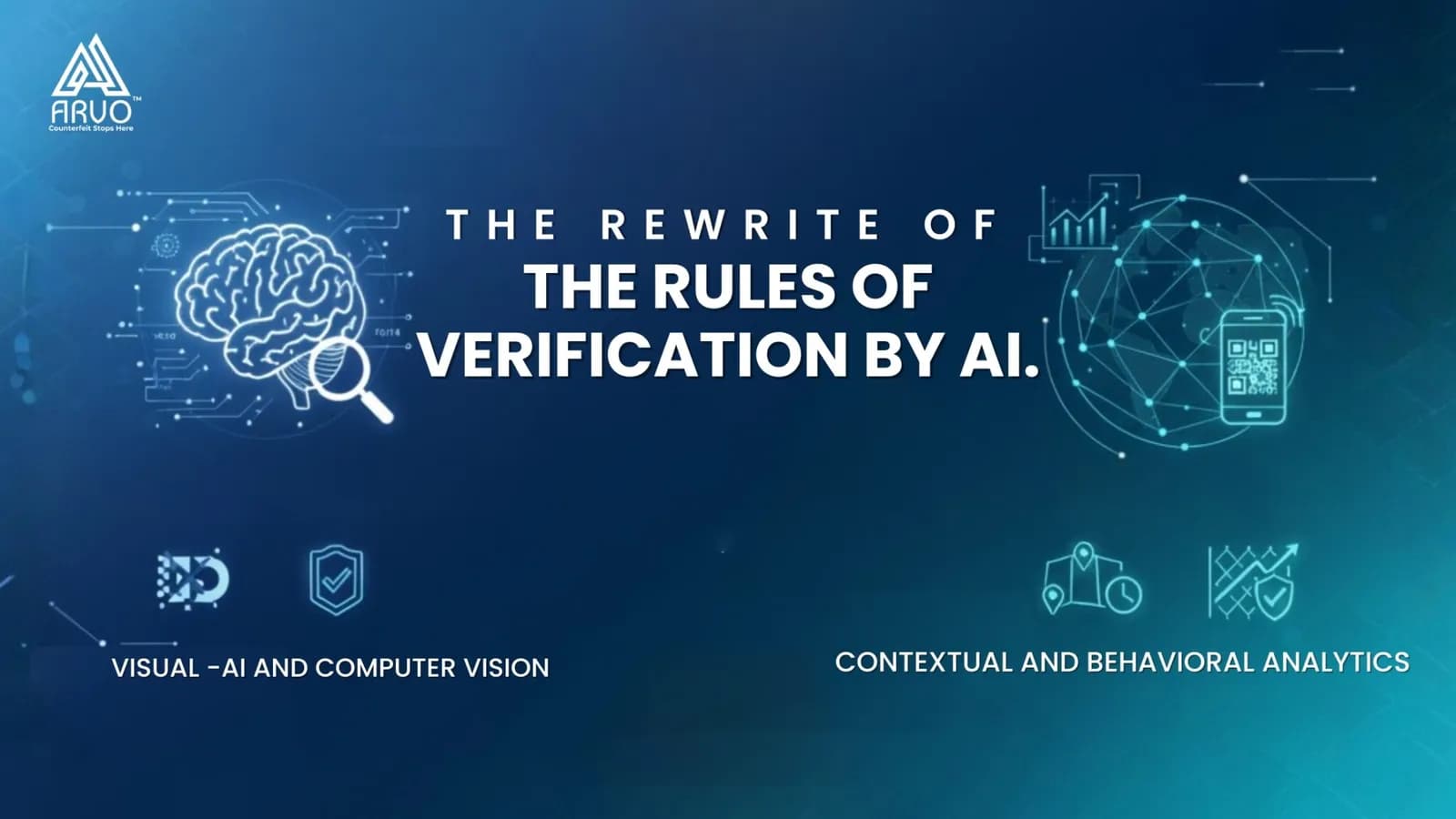
The Rewrite of the Rules of Verification by AI.
With the help of AI, authentication is performed with the help of Machine Learning and Computer Vision, which generates a digital fingerprint of each product, which is so distinctive that it is extremely difficult to duplicate.
1. Visual-AI and Computer Vision.
This is the initial line of defense. Instead of searching for a code, AI examines a product itself.
- Micro-Pattern Analysis: The system identifies minute anomalies, such as pixel distortion, incompatible fonts, or an off-colour logo, which a human eye cannot detect, by training on high-resolution images of real objects.
- Hologram and Label Check: Visual-AI can identify small differences in reflectivity, location, and sub-surface structure, but counterfeit holograms can appear to be similar. All one has to do is scan a product or a code with a smartphone application to confirm authenticity.
2. Contextual and Behavioural Analytics.
AI extends the product and looks at the context of each scan, a digital guardian that proves the who, what, where, and when.
- Anomaly Detection: When a unique product code is scanned in three countries in two hours, the AI will consider the activity suspicious.
- Supply Chain Monitoring: AI is trained on the normal path of a product by connecting it to tracking information provided by QR codes or NFC chips. When a product is found on a grey-market website prior to its official launch or in a location it is not supposed to be, the system generates a high-priority notification.
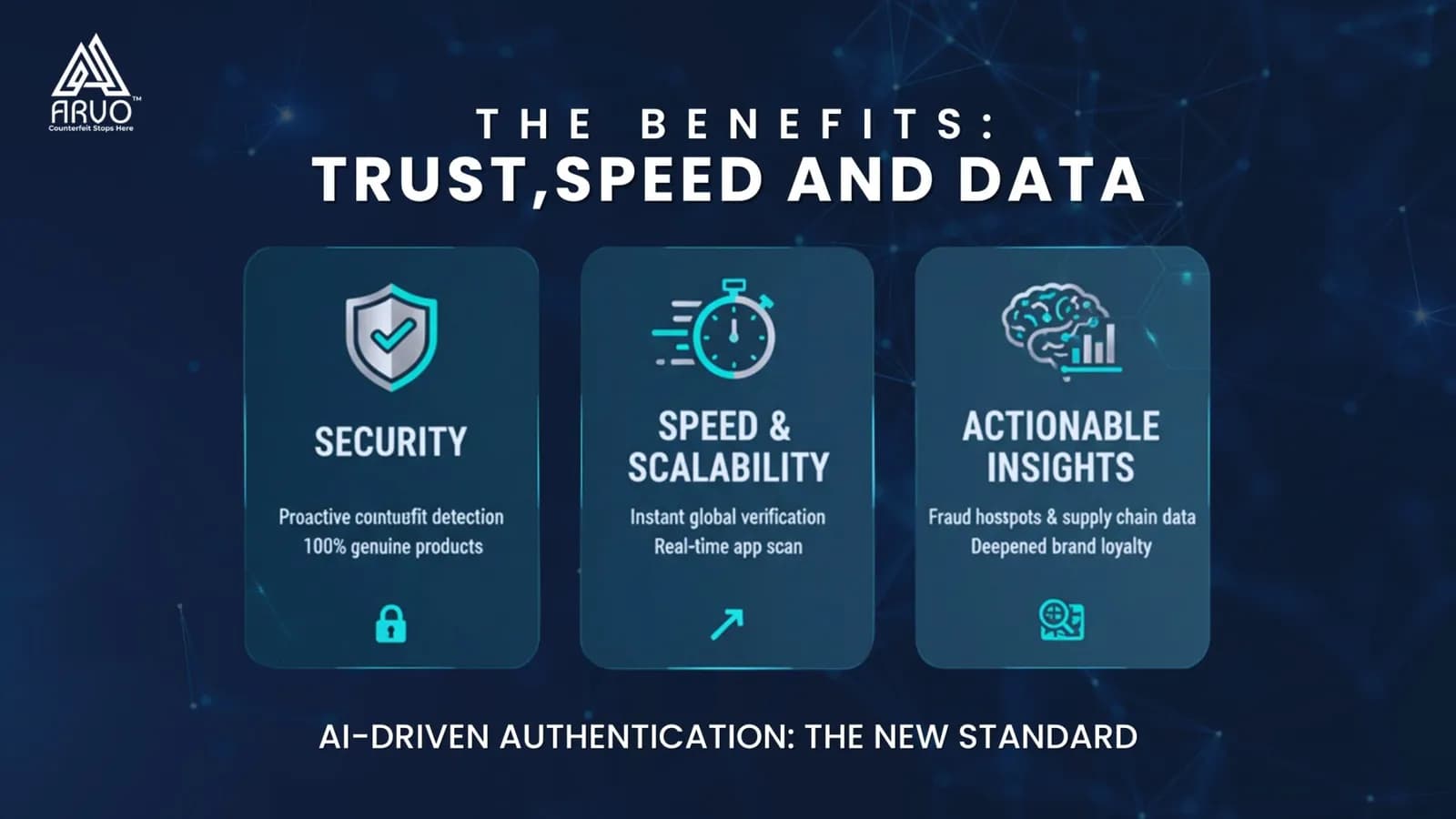
The Benefits: Trust, Speed, and Data
The adoption of AI-based authentication offers critical advantages for both businesses and consumers:
| Benefit | Impact for Brands | Impact for Consumers |
|---|---|---|
| Superior Security | Proactively identifies new, evolving counterfeiting techniques by constantly learning. | Confirms the product in hand is genuine and safe to use. |
| Scalability & Speed | Handles thousands of verification requests globally, instantly, without increasing operational costs. | Provides a real-time authentication result in seconds via a simple app scan. |
| Actionable Insights | Every scan is a data loop point, offering insights into fraud hotspots, unauthorized distribution, and supply chain leaks. | Fosters deepened trust and loyalty with the brand through transparency. |
Major brands, particularly in luxury and pharmaceuticals, are already deploying these systems, reporting significant reductions in online counterfeits and substantial gains in consumer confidence.
The Future is Adaptive
As technology advances, AI will not only mark real or fake, but it will assess risk in the present. A quick code scan suffices in low-risk (first time someone has been scanned). The AI might require a more thorough visual inspection or a human inspection in high-risk situations (a lot of scans of a warehouse where dubious goods are sold).
AI-based authentication is not a luxury; it’s a necessity. It is the only way to build a reliable, scalable, and future-proof defence against the sophistication of modern counterfeiters. For any brand that values its reputation and the safety of its customers, making this shift is no longer optional. It is the new, definitive standard for product verification.
Questions answered in this article
- Why is AI-based authentication more secure than holograms or regular QR codes?
- Holograms and regular codes are fixed features that can be duplicated once they are discovered. An AI system keeps learning from new verification requests and data, so it picks up new counterfeiting methods and fraud areas as they appear.
- How does AI authentication produce actionable insights?
- Every authentication is recorded as a data point. The system finds trends such as geographic fraud hotspots and illegal distribution channels, so the brand can plan legal and operational responses instead of reacting to single cases.
- Does AI authentication slow down production or the consumer's check?
- No. It handles thousands of verification requests in real time without extra operational cost, and the consumer gets a result from a simple smartphone scan in seconds.
- What does AI-driven authentication give the consumer?
- Confidence and speed: an instant answer from a scan at the point of purchase. That matters most for sensitive goods such as medicines and cosmetics.
Sources
- Hologram, Telefónica