Battery QR Code in India: Why a Copy-Proof Code Matters for BPAN
India's draft BPAN would put a QR code on every EV battery pack, but a standard code can be cloned. What the draft asks for and how copy-proof codes stop them.
By Abhijeet Kumar, ARVOPublished Updated 8 min read
In short
A standard battery QR code only encodes data, so a photo and a reprint produce a copy that scans exactly like the original. India's draft BPAN guidelines put a QR code on every in-scope pack but do not ask for copy protection. A copy-proof code checks the print itself, so cloned codes fail verification.
- The draft BPAN guidelines would have each in-scope pack carry its 21-character BPAN as text and as a QR code holding static material, descriptor and carbon footprint data.
- The draft asks for a mark that cannot be destroyed or deteriorate, but says nothing about preventing copies.
- A cloned standard QR code lets a counterfeit pack join the traceability chain as if it were genuine, which affects recyclers, second-life buyers, EPR records and recalls.
- A copy-proof code is verified on its print, not just its data, so a copy fails even when it carries the same data.
- The same battery QR code can serve BPAN, the EPR labelling option in the Battery Waste Management Rules and the EU battery passport from 18 February 2027.
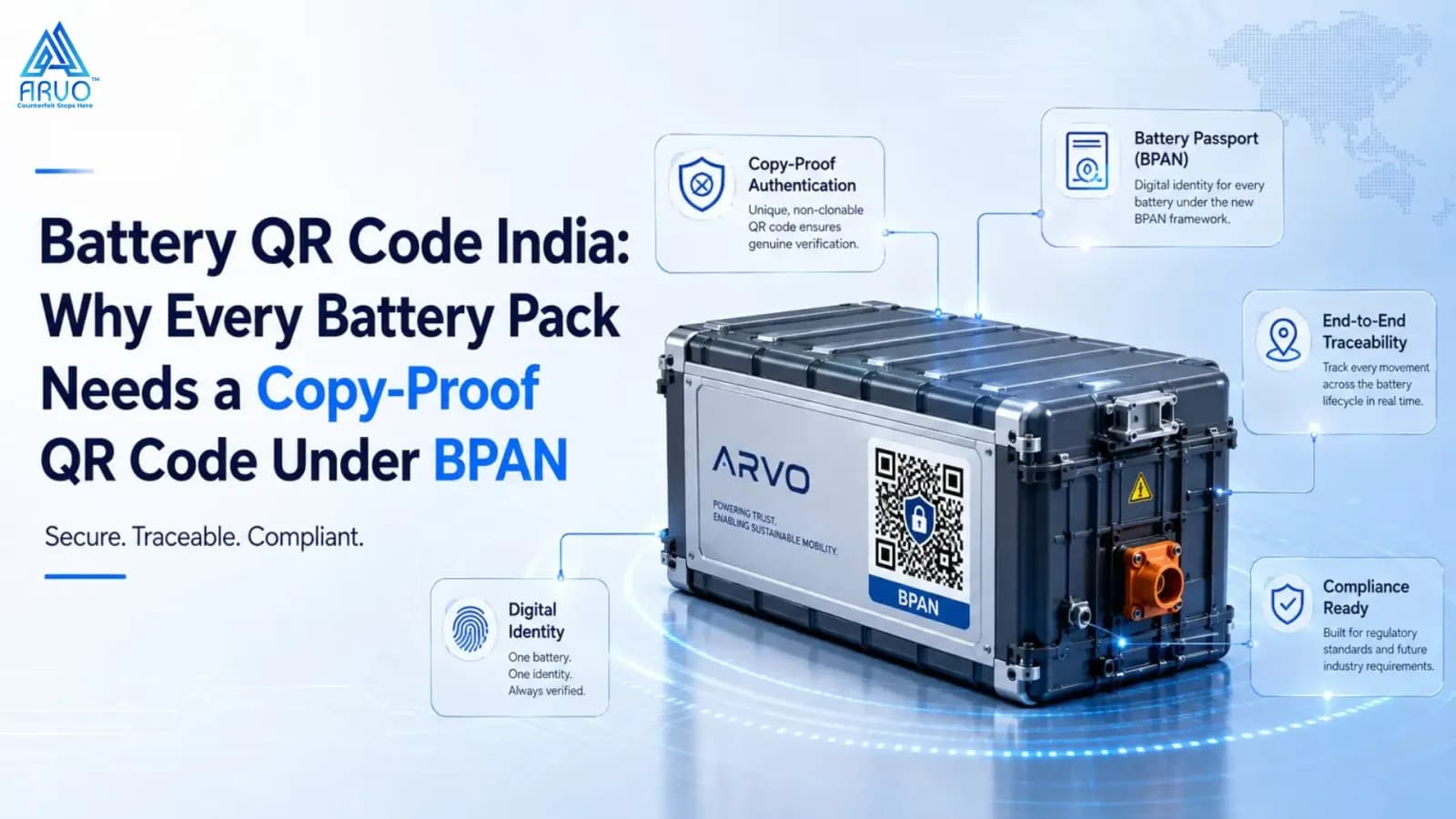
A QR code on a battery pack is about to carry a lot of weight. India's draft Battery Pack Aadhaar Number (BPAN) guidelines would have every in-scope pack carry its identity both as text and as a QR code. The 2025 amendment to the Battery Waste Management Rules lets producers show their EPR registration number through a barcode or QR code. And from 18 February 2027, under Article 77 of Regulation (EU) 2023/1542, the EU battery passport for EV, light means of transport and industrial batteries above 2 kWh is reached through a QR code on the battery.
There is a problem with that. A standard QR code is a data format, not a security feature. Photograph it, print it again, and the copy scans exactly like the original. If the code is the anchor of a battery's identity, a copied code lets a fake battery borrow a real one's identity.
This guide explains what the draft BPAN guidelines ask of the battery QR code, why a standard code can be cloned, what a copy-proof code does differently, and what to plan for before you change your labels.
What would BPAN require from the QR code on a battery?
BPAN is described in Draft Guidelines for Implementation of Battery Pack Aadhaar System, prepared by a committee set up by the Ministry of Road Transport & Highways (MoRTH). It is a draft: it has not been notified, sets no compliance dates and is not mandatory. Its scope is EV batteries for L, M and N category vehicles and industrial batteries above 2 kWh; SLI and portable batteries are outside it. Our BPAN compliance guide decodes the full 21-character number.
On the QR code specifically, the draft says:
- Both marks are required. The producer or importer marks each pack with the BPAN as an alphanumeric code and as a QR code, and uploads the dynamic data to the official BPAN portal.
- It must last. The BPAN must be in a clearly visible and accessible position, chosen so that it cannot be destroyed or deteriorate.
- The QR code works without the internet. The draft calls it a non-internet-based method for reaching essential static data, mainly to help recyclers.
- Access is limited. The QR data is available to a limited public through an authorised access system or an authorised QR code decoder.
- A changed pack gets a new identity. Any change in attributes due to recycling or repurposing results in a new BPAN.
The draft splits a pack's data across three layers:
| Layer (MoRTH draft guidelines) | Where it lives | Who can see it | What it holds |
|---|---|---|---|
| Alphanumeric code | Printed on the pack | Public | Manufacturer, descriptor (capacity, chemistry, voltage, cell origin, extinguisher class) and pack identifier |
| QR code | Printed on the pack | Limited, through authorised access | Static data: material composition, descriptor and carbon footprint |
| Server | The BPAN portal | Private | Dynamic data: battery status, state of health, disassembly and circularity outcomes, time stamps |
What the QR code holds
Under the draft guidelines, the QR code carries the battery's material, descriptor and carbon footprint parameters. The material composition section alone has 29 parameters, including the number of cells, battery weight, cell type and form factor, the disassembly method, recyclability, and the anode, cathode, electrolyte and separator materials with their content. The carbon footprint section has 5 parameters and is added in the draft's third phase.
That is useful data for a recycler, an inspector or a second-life buyer. It is also exactly the data a counterfeiter wants to borrow.
Why can a standard battery QR code be copied?
A standard QR code turns data into a pattern of black and white modules. It does not authenticate anything. Anyone with a phone camera and a label printer can decode it, re-encode the same data and print a new label. The copy is not an approximation: it carries the same data and scans the same way, so a reader has no way to tell the original from the copy.
On a battery, that has a specific consequence. A counterfeit pack carrying a cloned code does not break the traceability chain. It joins it. The system records the fake as genuine, because the code is genuine. Only the battery is not.
The draft BPAN guidelines do not ask for copy-proof codes. They set out what data the code holds and how long the mark must last, not how hard it is to reproduce. That choice is left to the manufacturer.
Standard QR code vs copy-proof code
| Question | Standard QR code | Copy-proof code |
|---|---|---|
| What is it? | A way to encode data | A code whose print is itself checked when scanned |
| Can it be copied? | Yes, a photo or reprint scans the same | A copy can be made, but it fails verification |
| Can you tell original from copy? | No | Yes, verification flags the copy |
| What does a scan confirm? | That the data was read | That the data was read and the code is the original print |
| Who can read it? | Any QR reader | Depends on the system; NOVA is read by any phone camera |
| Does it meet BPAN's data needs? | It can carry the data | It can carry the data and resist cloning |
Five ways a copied QR code breaks battery traceability
1. A counterfeit enters the supply chain
A counterfeiter copies the code from a genuine pack and puts it on packs built with substandard cells. They scan as genuine. When one fails, the trail leads to the real manufacturer, who faces the complaint, the recall cost and the damage to its name. Our article on counterfeit batteries in India looks at how fakes reach the market.
2. A recycler gets the wrong chemistry
A recycler reads the QR code to decide how to dismantle a pack. If the code was copied from a pack with a different chemistry, the recycler follows the wrong procedure, with safety risks and lower material recovery.
3. A second-life buyer pays for the wrong pack
A used pack is offered for repurposing. Its code says it is newer and healthier than it really is, because the code came from another pack. The buyer overpays for an asset that will underperform.
4. EPR records stop adding up
Under the Battery Waste Management Rules, 2022, producers answer for the collection and recycling of the batteries they place on the market. Counterfeits carrying a producer's cloned codes make it look as if more of its batteries are in circulation than it made, which corrupts collection and recycling records.
5. A recall cannot separate real from fake
If a safety issue triggers a recall of one batch, cloned codes from that batch sit on counterfeit packs too. The recall has to cover both, because the system cannot tell them apart, and the manufacturer pays for the counterfeiter's products.
How does a copy-proof code work?
A copy-proof code still encodes data like any other code, so the data can be read. The difference is that the verifier checks the printed code itself, not just its contents. Fine detail in the original print is lost or changed when the code is photographed, scanned or reprinted, so a copy that carries the same data still fails the check.
ARVO's NOVA code works this way. Any phone camera can read it, and a Vision AI model trained to detect even a minor variation in the code makes copies fail verification, with about 99% verification accuracy. Because each scan is a verification, a cloned code on a fake pack is caught at the point it is scanned rather than months later.
This matters most where the code is the only thing that ties a pack to its record: at a distributor's warehouse, a service centre or a recycler's intake. See our anti-counterfeiting solution for how verification fits into the wider flow.
What to plan for when you change your battery labels
Whether or not BPAN is adopted as drafted, these are the decisions that shape a battery QR code implementation:
- Space for both marks. Leave room for a 21-character BPAN in text next to the scannable code, as the draft asks for both.
- Placement and durability. The draft says the mark must not be destroyed or deteriorate. Test the label stock and position on your own pack housing, through heat, vibration and handling.
- What goes in the code and what goes on the server. The draft keeps static data in the QR code and dynamic data on the portal. Decide early which data you will encode and how authorised readers will access it.
- A link to the production record. The code is only as good as the record behind it. Capture each unit on the line, so the identity on the pack matches the identity in your system.
- A plan for repurposed and recycled packs. The draft gives a changed pack a new BPAN, so your record should link the old and new identities.
- More than one regulation. The same code can serve BPAN, the EPR labelling option in the Battery Waste Management Rules and, for exports, the EU battery passport under Regulation (EU) 2023/1542, whose Article 77 makes the passport accessible through the QR code on the battery.
How ARVO helps
ARVO (OneARVO Ventures Pvt. Ltd., Noida) prints a NOVA code on each pack, with room for the BPAN in text beside it. Vision Trace records each unit on the production line with a Vision AI model, and AIC holds every scan and journey with analytics, secured on a blockchain so the record can't be rewritten. Rollout takes about 15 days.
To replace a cloneable battery QR code with one that can't be copied, talk to our team.
Questions answered in this article
- Does BPAN require a copy-proof QR code?
- No. The draft guidelines require the BPAN to be marked as text and as a QR code, in a position where it cannot be destroyed or deteriorate, but they do not ask for copy protection. BPAN itself is still a draft and is not mandatory.
- What data does the BPAN QR code hold?
- Under the draft, the QR code holds static data: the material composition section, with 29 parameters such as cell type, weight, disassembly method and electrode and electrolyte materials, the descriptor, and a 5-parameter carbon footprint section. Dynamic data such as state of health stays on the BPAN portal.
- Why can't a standard QR code prove a battery is genuine?
- A standard QR code only encodes data. Anyone can photograph it and print an identical copy, and the copy scans the same way, so a reader cannot tell the original from the clone.
- Can a copy-proof code be read by an ordinary phone?
- It depends on the system. ARVO's NOVA code is read by any phone camera, and a Vision AI model checks the print so copies fail verification.
- Can one battery QR code serve BPAN, EPR and the EU battery passport?
- It can be designed to. The 2025 amendment to the Battery Waste Management Rules allows the EPR registration number to be shown through a barcode or QR code, and the EU battery passport is accessed through a QR code under Article 77 of Regulation (EU) 2023/1542.
Sources
- Draft Guidelines for Implementation of Battery Pack Aadhaar System, Ministry of Road Transport & Highways committee (hosted by the Office of the Principal Scientific Adviser)
- Regulation (EU) 2023/1542 concerning batteries and waste batteries, EUR-Lex
- Battery Waste Management (Amendment) Rules, 2025: summary, Corporate Professionals