Counterfeit Batteries in India: How Fakes Enter and How to Stop Them
Rewrapped cells, cloned packs and fake marks: how counterfeit batteries reach Indian buyers, why labels and standard QR codes fail, and what stops them.
By Abhijeet Kumar, ARVOPublished Updated 10 min read
In short
Counterfeit batteries reach Indian buyers as rewrapped old cells, packs labelled with more capacity than they hold, homemade cells, cloned brand packs and products with fake certification marks. They travel through online marketplaces, grey-market distributors and repair shops. Labels, holograms and standard QR codes can all be copied, so only a unique, copy-proof identity per unit stops them.
- ASPA and CRISIL found that almost nine in ten urban Indian consumers have bought a counterfeit at least once, and 53% of counterfeit purchases happen on online aggregator platforms.
- The most dangerous fakes look the most genuine: rewrapped cells and cloned packs copy labels down to the shade and markings.
- Counterfeit lithium cells often lack insulation, safety tape and current interrupt devices, so they are a fire risk, not just a sales loss.
- Printed labels, holograms, serial numbers and standard QR codes can all be copied exactly, so none of them proves a unit is genuine.
- A workable defence gives every unit a copy-proof identity that anyone can check with a phone camera and that reports each scan back to the brand.
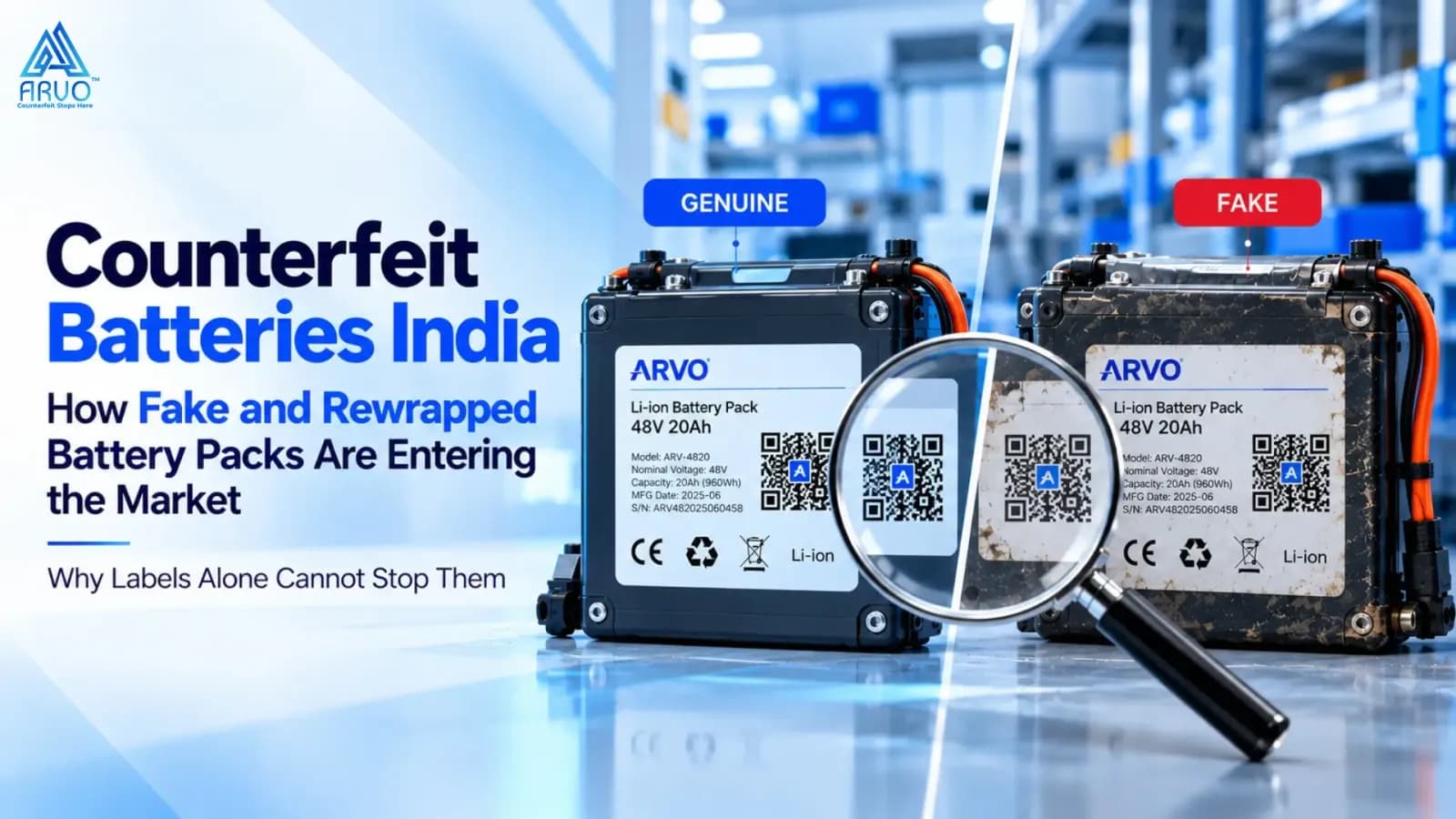
The label is the cheapest part of a battery to copy. It costs a counterfeiter almost nothing to reproduce your logo, your capacity rating and your certification marks. What it costs your brand is a very different number. The counterfeit batteries Indian manufacturers deal with today include fake lithium packs sold under trusted names, old cells rewrapped as new, and products carrying certification marks they never earned.
Batteries sit right in the path of this trade: high value, steady demand and almost impossible for a buyer to inspect. This guide is for brand protection heads, CEOs and sales leaders at EV, inverter and consumer battery companies. It explains what counts as a counterfeit battery, how fakes enter the Indian market, why printed labels and visual checks fail, what the problem costs genuine makers, and what a workable defence looks like.
How big is the counterfeit problem in India?
There is no official count of fake batteries in India, but the wider counterfeit picture is clear. The ASPA and CRISIL "State of Counterfeiting in India 2025" survey, reported by The Week in March 2026, found that almost nine in ten urban consumers have bought a counterfeit product at least once, and that online aggregator platforms account for 53% of counterfeit purchases.
| Indicator | Figure | Source |
|---|---|---|
| Urban consumers who have bought a counterfeit at least once | Almost nine in ten | ASPA and CRISIL, reported by The Week (March 2026) |
| Indians who encountered fake products in the past year | Around 35% | ASPA and CRISIL, reported by The Week (March 2026) |
| Share of counterfeit purchases made on online aggregator platforms | 53% | ASPA and CRISIL, reported by The Week (March 2026) |
| Respondents who encountered counterfeit automotive parts | Nearly 22% | ASPA and CRISIL, reported by The Week (March 2026) |
| Consumers who encountered counterfeit consumer durables | About 18% | ASPA and CRISIL, reported by The Week (March 2026) |
| Average premium consumers would pay for guaranteed genuine products | 9% | ASPA and CRISIL, reported by The Week (March 2026) |
| Illicit market across five industries (FMCG packaged goods, personal and household care, alcohol, tobacco, textiles and apparel) | About ₹7.97 lakh crore | FICCI CASCADE (February 2026) |
| India lithium-ion battery market, 2026 | $6.73 billion | Mordor Intelligence |
| Forecast India lithium-ion battery market, 2031 | $15.17 billion (17.65% CAGR) | Mordor Intelligence |
FICCI CASCADE's estimate does not include batteries, but it shows how large India's illicit trade already is. Two survey numbers matter most for battery brands. First, most counterfeit purchases happen online, where the buyer never touches the product before paying. Second, ASPA and CRISIL found that consumers would pay an average 9% premium for products guaranteed to be genuine. The demand for proof already exists. Most battery brands simply do not offer it yet.
What counts as a counterfeit battery?
"Counterfeit" covers far more than a crude copy. There are five common types, and the most dangerous ones look the most genuine.
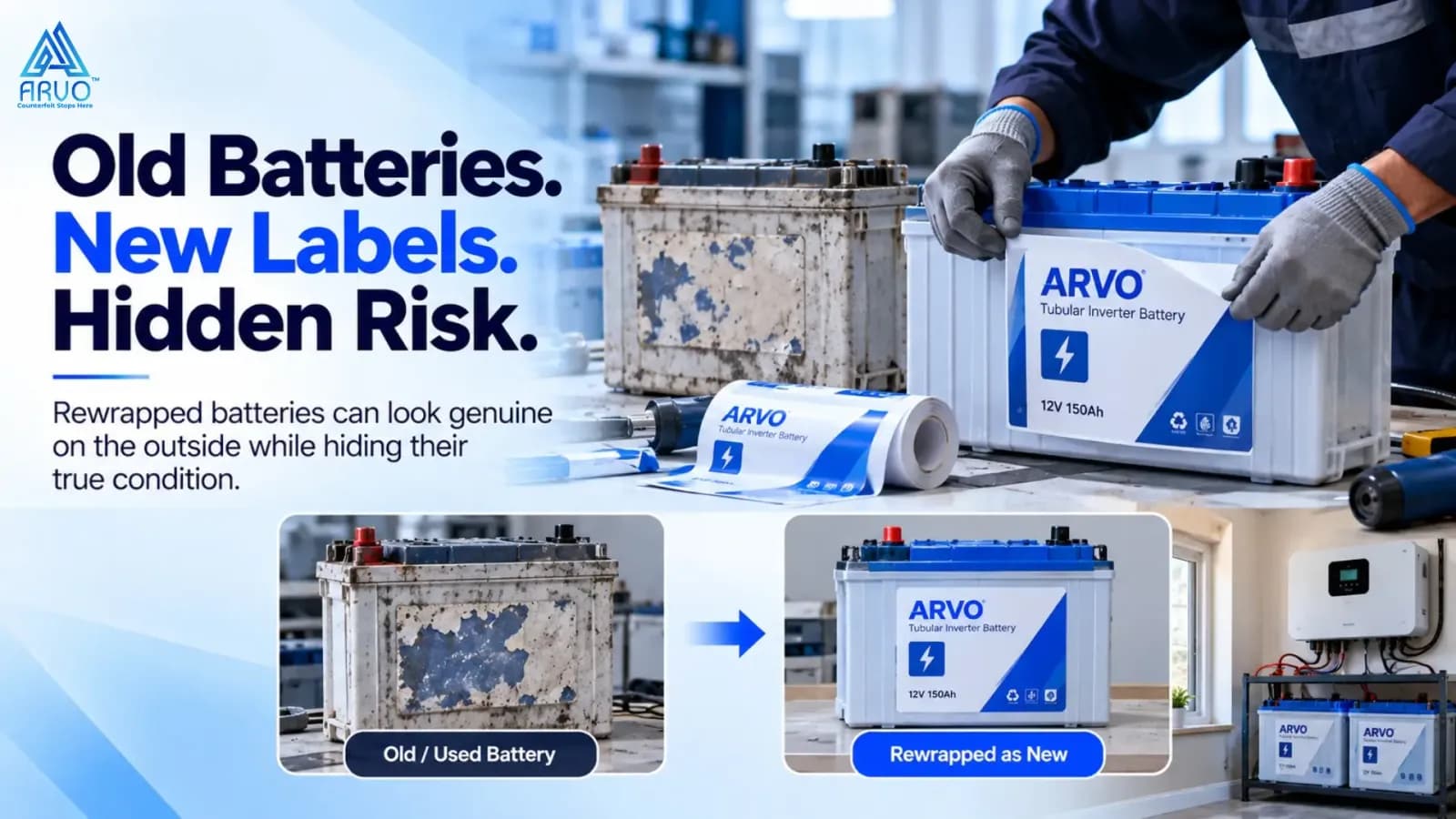
1. Rewrapped battery cells
Old or scrap cells are given a fresh sleeve printed with a known brand's design. They look new on the outside but may have many charge cycles behind them. IEEE Spectrum, reporting on counterfeit lithium-ion batteries in November 2025, describes counterfeiters taking old or scrap batteries built by legitimate manufacturers and relabelling them to sell as new.
2. Relabelled packs with overstated capacity
Genuine but lower-grade cells are labelled with a higher capacity than they can deliver. The buyer gets a battery that works but runs out early, fails sooner and gets blamed on the brand printed on it. Regulators have noticed: Mercom India reported in February 2026 that the Bureau of Indian Standards (BIS) issued guidelines to verify the rated capacity of portable sealed secondary lithium cells and batteries by testing their actual discharge capacity.
3. Homemade cells without safety engineering
IEEE Spectrum notes that building a lithium-ion cell is fairly straightforward. What is hard is the safety engineering inside it. Small workshops can make cells that work on day one but lack the insulation, safety tape and protective devices that stop a fault from turning into a fire.
4. Cloned brand packs
Complete packs are built to look exactly like a known brand's product, down to the casing, the labels, and serial numbers and QR codes copied from a genuine unit. They target the replacement market, where a buyer asks for a brand by name and accepts whatever carries that name.
5. Products with fake certification marks
Some products carry marks they never earned. In March 2025, News On AIR reported that BIS seized more than 3,500 products worth about ₹70 lakh from e-commerce warehouses in Delhi, some lacking the mandatory ISI mark and others carrying counterfeit ISI labels. That case involved appliances rather than batteries, but it shows how easily the marks buyers trust can be printed by anyone.
How do counterfeit batteries enter the Indian market?
Knowing the routes in is the first step in battery brand protection. These five channels carry most fakes, and each has a different weak point.
1. Online aggregator platforms
With 53% of counterfeit purchases happening on online aggregators, according to ASPA and CRISIL, this is the riskiest channel. The buyer sees a photo, a price and a star rating. They cannot check the weight, the build quality or the cell inside. Third-party sellers can list fakes next to genuine stock, and by the time a complaint reaches the brand, the seller has often moved on to a new listing.
2. Social media ads and direct sellers
The same survey flags social media advertising as an emerging channel for counterfeits. Ads promise branded batteries at prices no authorised dealer can match, often with cash on delivery and no proper invoice. The brand never sees these sales and only hears about them when a failed product comes back through its service network.
3. Unauthorised distributors and grey-market stock
Batteries pass through several hands between factory and buyer: distributors, sub-distributors, wholesalers and retailers. Every handover is a point where fakes can be mixed with genuine stock. Once a consignment is blended, neither the retailer nor the buyer can tell which units are real.
4. Replacement and repair markets
Inverter, e-rickshaw, two-wheeler and laptop owners usually replace batteries through local repair shops. The buyer asks for a brand and the shop fits whatever carries the right label. This is where cloned packs and rewrapped cells do most of their business, because the buyer rarely sees the original box and seldom checks the product.
5. Unverified cells inside genuine-looking packs
Not every counterfeit reaches the market as a finished fake. Pack assemblers that buy cells from unverified sources can end up building counterfeit cells into packs that carry their own brand. A 2022 study by Kong, Das and Pecht in the journal Energies found that even batteries of the same brand can have different internal structures, which is what happens when cell sourcing is not tracked unit by unit.
Why is a fake lithium battery a safety risk, not just a sales loss?
A fake shampoo disappoints. A fake lithium battery can catch fire. That is why counterfeit batteries have to be treated as a safety issue first and a revenue issue second.
IEEE Spectrum reports on a 2023 study led by UL Research Institutes that compared genuine and counterfeit cells. The fakes had thinner insulators or none at all and little or no safety tape, and only the genuine cell had a high-quality current interrupt device. These are the features that stop a fault escalating into thermal runaway, the chain reaction behind most lithium battery fires. University of Maryland researcher Michael Pecht told IEEE Spectrum he estimates the danger is an order of magnitude worse with counterfeits.
For a battery brand, every fire involving a product with its name on the label becomes its problem, whether or not it made that battery. Without unit-level proof of what it shipped, a brand cannot prove what it did not ship.
Why can't labels alone stop counterfeit batteries?
Most battery brands rely on some mix of printed labels, holograms, serial numbers and QR codes. Each was designed to inform the buyer, not to resist a determined counterfeiter.
The research is direct on this point. The Energies study found that simple external visual inspection of a battery is unreliable, and the UL-led study found that counterfeit labels copied the originals down to the same shade and markings. If trained engineers struggle to tell a fake from its label, a buyer standing in a repair shop has no chance.
| Method | How it is meant to work | Why it fails |
|---|---|---|
| Printed brand label | Shows brand, model and capacity | Copied with ordinary printing; rewrapped cells simply get new labels |
| Hologram sticker | Hard-to-copy visual mark | Similar holograms are easy to source; used stickers can be peeled and reused |
| Sequential serial number | One number per unit | Numbers follow a pattern and can be guessed or copied from a genuine unit |
| Standard QR code | Links to product information | Can be photographed and reprinted, so every clone scans as genuine |
| Certification marks | Shows the product passed testing | Marks can be printed on products that were never tested |
| App-based verification | Buyer downloads an app to check | Few buyers will install an app at the counter, so few products are ever checked |
The common flaw is that every one of these methods can be copied exactly. A standard QR code printed on a fake pack scans the same way as the genuine one. The more visible a security feature is, the more easily a counterfeiter can study and reproduce it. Our guide to copy-proof battery QR codes explains the difference between a code that links to information and a code that proves a unit is genuine.
What do counterfeit batteries cost genuine makers?
Lost sales are only the visible part of the damage. For battery makers, the hidden costs are often larger.
- Warranty claims on products you never made. Fakes fail early. Buyers return them to your dealers, and without proof of origin your service team has to honour or dispute every claim.
- Brand damage that spreads. A buyer whose battery failed or overheated blames the name on the label. Reviews and dealer word of mouth do not separate fakes from genuine units.
- Lost dealer trust. Authorised dealers undercut by cheaper fake stock lose margin, and over time they lose interest in pushing your brand.
- Wider recalls. A brand that cannot separate its own units from fakes has to recall broadly instead of precisely.
- Regulatory exposure. India's draft Battery Pack Aadhaar guidelines would give every in-scope EV and industrial battery pack a 21-character identity marked as text and as a QR code, and BIS now expects rated capacity to be verified for portable lithium cells and batteries. Brands without unit-level records will find both harder to meet. Our BPAN compliance page explains what the draft asks for.
On the other side of the ledger is the 9% average premium consumers told ASPA and CRISIL they would pay for guaranteed genuine products. For a brand that can prove authenticity at the point of sale, an original battery check becomes a reason to buy, not just a line of defence.
What does a workable defence against fake batteries need?
If labels cannot do the job, what can? Any system for duplicate battery detection has to pass five tests.
- A unique identity per unit. Every pack needs its own identity, not a batch number shared by thousands of units.
- Impossible to copy. The identity must stay unique even if someone photographs or reprints it.
- Easy for anyone to check. A buyer, dealer or service technician should be able to check a battery with the phone camera they already carry.
- Data back to the brand. Every check should tell the manufacturer where and when its product was scanned, so it can spot fakes and diverted stock early.
- Fits existing production. It should work with the lines the factory already runs, without slowing output.
Few traditional methods pass more than one of these tests. That is why battery brand protection is moving away from visual security features and towards digital, unit-level authentication, as our anti-counterfeiting solution describes.
How ARVO helps battery brands stop counterfeits
ARVO (OneARVO Ventures Pvt. Ltd., Noida) puts a NOVA copy-proof smart code on every battery pack, and any phone camera can read it. A Vision AI model trained to detect even a minor variation in the code makes copies fail verification, with about 99% verification accuracy. AIC holds every scan and each pack's journey with analytics, so your team can spot fakes and grey-market stock, and the records are secured on a blockchain so the journey can't be rewritten. Rollout takes about 15 days.
To see how it would work for your product line, talk to the ARVO team.
Questions answered in this article
- What are the most common types of counterfeit batteries in India?
- Rewrapped cells sold as new, packs labelled with more capacity than they deliver, homemade cells without proper safety engineering, cloned brand packs, and products with fake certification marks. Cloned and rewrapped packs are hardest to spot because they copy the genuine label.
- How can I check whether a lithium battery is original?
- Visual inspection is not reliable, because counterfeit labels closely match genuine ones. Buy from authorised dealers, insist on a proper invoice and warranty card, and check whether the brand offers a copy-proof code you can scan with your phone camera.
- Why can't holograms and standard QR codes stop fake batteries?
- Both can be copied exactly. Similar holograms are easy to source, and a standard QR code can be photographed and reprinted so that the clone scans just like the original. Protection only works when each unit carries an identity that cannot be reproduced.
- How do counterfeit batteries hurt manufacturers that never made them?
- Fakes fail early and come back through the genuine brand's dealers, which drives warranty disputes, bad reviews and lost dealer trust. In a safety incident the brand on the label takes the blame, and it may face a broader recall if it cannot separate its own units from fakes.
- How does ARVO help with duplicate battery detection?
- ARVO puts a copy-proof NOVA smart code on every pack. A Vision AI model detects even a minor variation in the code, so copies fail verification, and AIC holds every scan so brands can spot fakes and diverted stock.
Sources
- ASPA and CRISIL, State of Counterfeiting in India 2025, as reported on 16 March 2026, The Week
- FICCI-CASCADE workshop for Police Officers on Strengthening Enforcement against Illicit Trade and Economic Offences in Delhi, FICCI CASCADE
- India Lithium-ion Battery Market Size, Industry Growth and Trends Report 2031, Mordor Intelligence
- How to Spot a Counterfeit Lithium-Ion Battery, IEEE Spectrum
- The Distribution and Detection Issues of Counterfeit Lithium-Ion Batteries (Kong, Das and Pecht, Energies 15(10), 2022), MDPI Energies
- BIS Mandates Rated Capacity Verification Guidelines for Lithium Batteries, Mercom India
- BIS conducts search and seizure operation at warehouses of Amazon Sellers Pvt Ltd in Delhi, News On AIR (Akashvani)
- Draft Guidelines for Implementation of Battery Pack Aadhaar System, Ministry of Road Transport and Highways