Battery Waste Management Rules 2022: EPR Targets and the BPAN Link
What India's Battery Waste Management Rules 2022 require of producers, the EPR targets for FY 2026-27, the amendments, and how draft BPAN data can support them.
By Abhijeet Kumar, ARVOPublished Updated 9 min read
In short
The Battery Waste Management Rules, 2022 make every producer responsible for collecting and recycling the batteries it places on the Indian market, through CPCB registration, EPR plans, annual returns and EPR certificates. Recovery targets reach 90% for EV and portable batteries in FY 2026-27. A unit-level record, like the draft BPAN, makes those filings easier to prove.
- The Battery Waste Management Rules were notified by MoEFCC in August 2022 and amended several times since, including in 2023, 2024 and 2025; there is no separate 2026 rulebook.
- From FY 2026-27, the rules set material recovery at 90% of dry weight for portable and EV batteries and 60% for automotive and industrial batteries.
- Minimum recycled content starts in FY 2027-28: 5% rising to 20% for portable and EV batteries, 35% rising to 40% for automotive and industrial batteries.
- The draft BPAN guidelines call BPAN a common digital spine that supports EPR enforcement, but they cover only EV and industrial batteries above 2 kWh.
- BPAN would not replace CPCB registration or EPR certificates; it gives each in-scope pack one identity that production, sales and recycling records can share.
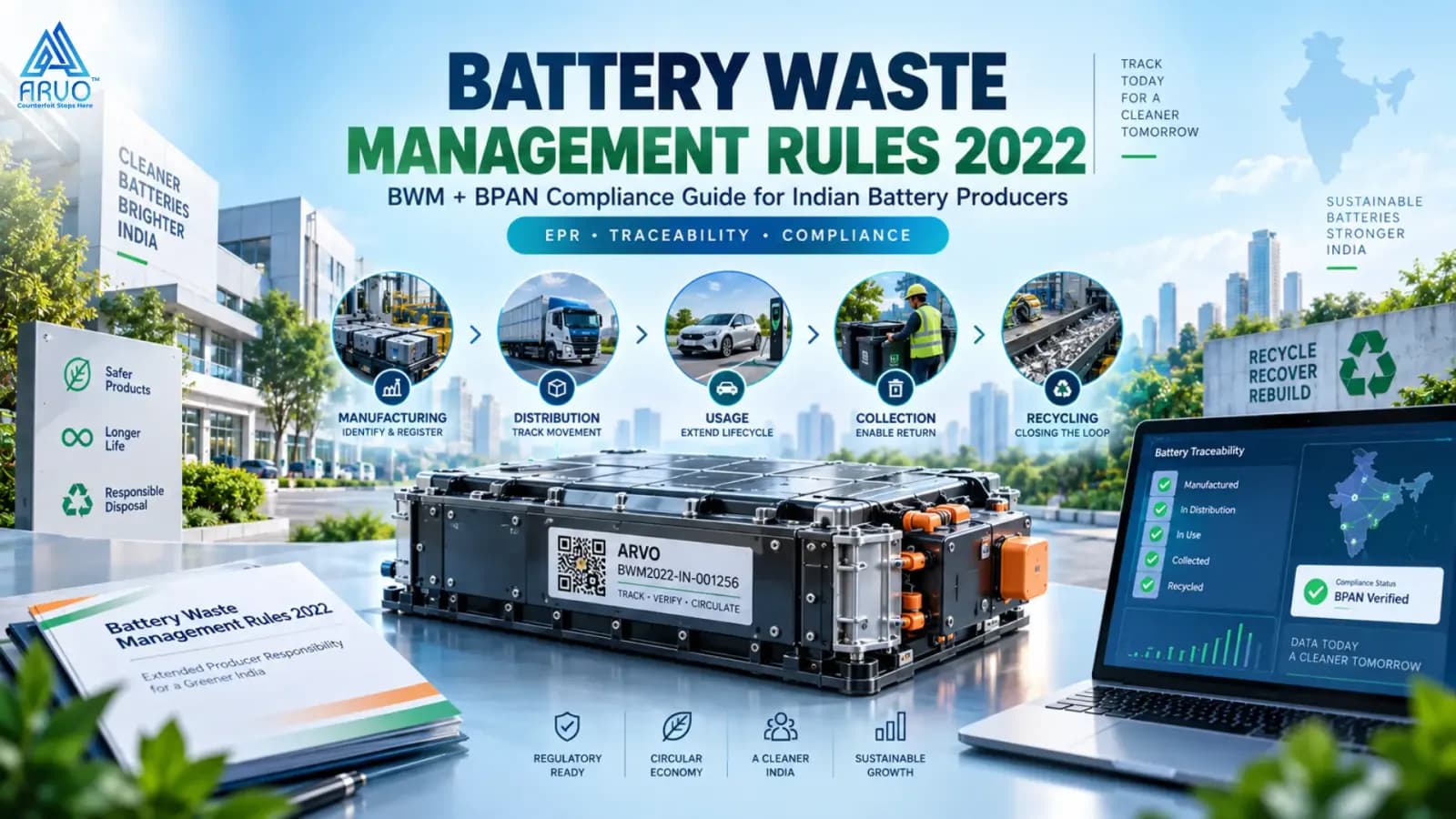
If you make, import or sell batteries under your brand in India, the Battery Waste Management Rules, 2022 make you responsible for those batteries at the end of their life. The Ministry of Environment, Forest and Climate Change (MoEFCC) notified the Rules in August 2022 (S.O. 3984(E)), and they have been amended several times since. They are sometimes referred to by a later year, but the instrument in force is still the 2022 Rules, as amended.
At the same time, a committee set up by the Ministry of Road Transport & Highways (MoRTH) has drafted guidelines for a Battery Pack Aadhaar System (BPAN), a unique identity and lifecycle record for each EV and industrial battery pack. The draft refers to the Battery Waste Management Rules repeatedly and describes BPAN as a "common digital spine" that other regulations can reference.
This guide covers what the Rules require, which targets apply now, what happens if you miss them, and how a unit-level record can serve both frameworks without building two compliance systems.
What are the Battery Waste Management Rules 2022?
The Rules set up Extended Producer Responsibility (EPR) for batteries. The producer, meaning whoever places a battery on the Indian market, has to make sure an equivalent quantity is collected and recycled or refurbished. They cover four types of battery: portable, automotive, industrial and electric vehicle batteries.
Under rule 4 of the Rules, a producer must:
- register as a producer through the Central Pollution Control Board's (CPCB) online centralised portal before placing batteries on the market
- file an EPR plan (Form 1(C)) by 30 June each year, with the quantity, weight and dry weight of battery materials for batteries made in the previous financial year
- meet the collection and recycling or refurbishment targets in Schedule II
- send collected waste batteries for recycling or refurbishment, never to landfill or incineration
- file annual returns (Form 3) by 30 June of the next financial year, with details of the registered recyclers whose EPR certificates were used
- follow the labelling rules in Schedule I and use a minimum share of domestically recycled material in new batteries
Under Schedule II, producers meet their obligation through EPR certificates from registered recyclers and refurbishers, and must collect batteries themselves if certificates are not available. CPCB generates those certificates on the portal based on the weight processed and how far the recycler met its recovery target.
How have the Rules been amended?
A June 2024 notification lists the earlier amendments: S.O. 4669(E) of 25 October 2023 and G.S.R. 190(E) of 14 March 2024. The same notification, the Battery Waste Management (Second Amendment) Rules, 2024 (S.O. 2374(E), 20 June 2024), replaced the recycled content table (see below). A further amendment took effect on 24 February 2025; according to a summary by Corporate Professionals, it lets producers meet the labelling requirement with a barcode or QR code carrying their EPR registration number, on the battery, the equipment or the packaging.
Which EPR targets apply in FY 2026-27?
Three sets of numbers matter: how much material recyclers must recover, how much recycled material producers must use, and how much producers must collect.
Material recovery targets
These are set in rule 10(4) of the Rules as a share of the battery's dry weight. They apply to recyclers, and they flow into producer compliance through the EPR certificates recyclers can issue.
| Battery type | FY 2024-25 | FY 2025-26 | FY 2026-27 onwards | Source |
|---|---|---|---|---|
| Portable | 70% | 80% | 90% | BWM Rules 2022, rule 10(4) |
| Automotive | 55% | 60% | 60% | BWM Rules 2022, rule 10(4) |
| Industrial | 55% | 60% | 60% | BWM Rules 2022, rule 10(4) |
| Electric vehicle | 70% | 80% | 90% | BWM Rules 2022, rule 10(4) |
So in FY 2026-27, under rule 10(4), a recycler processing 1,000 kg of EV or portable battery waste has to recover 900 kg of material. The Rules reduce the target by the share of non-recoverable hazardous material in the battery.
Minimum recycled content in new batteries
The Second Amendment Rules, 2024 set these minimums as a share of a battery's total dry weight. Producers of imported batteries can meet them by having the same quantity of recycled material used by other businesses or by exporting it.
| Battery type | FY 2027-28 | FY 2028-29 | FY 2029-30 | FY 2030-31 onwards | Source |
|---|---|---|---|---|---|
| Portable | 5% | 10% | 15% | 20% | BWM (Second Amendment) Rules, 2024 |
| Electric vehicle | 5% | 10% | 15% | 20% | BWM (Second Amendment) Rules, 2024 |
| Automotive | 35% | 35% | 40% | 40% | BWM (Second Amendment) Rules, 2024 |
| Industrial | 35% | 35% | 40% | 40% | BWM (Second Amendment) Rules, 2024 |
Collection targets for EV batteries
Schedule II sets collection targets by battery type, with 100% recycling or refurbishment of what is collected. For EV batteries the targets start at different times by vehicle type, each at a minimum of 70% of the quantity placed on the market in an earlier year:
- e-rickshaw (three-wheeler) batteries from FY 2024-25, for example 70% of the 2021-22 quantity
- two-wheeler batteries from FY 2026-27, starting with 70% of the 2022-23 quantity
- four-wheeler batteries from FY 2029-30, starting with 70% of the 2021-22 quantity
All of these come from Schedule II of the Battery Waste Management Rules, 2022. For a producer, the collection obligation depends on the exact category and the year the batteries were placed on the market, so the numbers you report have to be traceable to those batches.
What happens if a producer misses its EPR targets?
Rule 13 of the Rules provides for Environmental Compensation on the polluter-pays principle, including for operating without registration, giving false information and submitting forged or manipulated documents. CPCB can suspend or cancel a producer's registration and impose Environmental Compensation for non-compliance with Schedule II obligations. Non-fulfilment of obligations also attracts penal action under section 15 of the Environment (Protection) Act, 1986.
The centralised portal is built to show the material balance of each producer's EPR obligations, so a gap between what you placed on the market and what was collected and recycled shows up directly.
Why is battery EPR compliance really a data problem?
The Rules are clear about what to report. The hard part is that the numbers sit in different places. Sales and import volumes live in the ERP. Weights and material data live with engineering. Collection and recycling evidence arrives as certificates from third parties. Each filing becomes a reconciliation exercise, and mismatches surface late.
Three kinds of mismatch cause most of the trouble:
- reported quantities that do not match production or import records
- batteries that reach a recycler but cannot be traced to a producer's batch, which blurs attribution
- material data recorded one way at production and another way at the recycler
All three get easier when every unit has one identity from the day it is made, and every later event is recorded against that identity.
How does BPAN connect to the Battery Waste Management Rules?
The draft BPAN guidelines draw on the Battery Waste Management Rules for their definitions and battery categories. In their discussion of current legislation, they say BPAN is not meant to be a standalone compliance silo. It is meant to be a "common digital spine" that different regulatory workstreams can reference, reducing duplicate data capture, improving auditability and supporting enforcement under the EPR and battery waste rules.
Two points from the draft need to be kept in view:
- It is a draft. The guidelines have not been notified, carry no compliance dates and name the Automotive Industry Standards route as the next step. Nothing in BPAN is mandatory yet.
- The scope is narrower than the Rules. The draft covers EV batteries for L, M and N category vehicles and industrial batteries above 2 kWh. SLI and portable batteries are outside its scope, while the Battery Waste Management Rules cover all four battery types.
For the full structure of the 21-character number and its three data layers, see our BPAN compliance guide.
How do BWM obligations map to BPAN data?
The table below maps each obligation to the data the draft BPAN guidelines would hold, and to what still has to come from elsewhere. It applies only to batteries within the draft's scope.
| BWM Rules obligation | BPAN data that can support it (draft guidelines) | Still needed from elsewhere |
|---|---|---|
| Producer registration | Battery Manufacturer Identifier, registered once with a national agency | EPR registration on the CPCB portal is separate |
| Quantity placed on the market | One BPAN per pack, with date of manufacture, factory code and serial number | Import and sales records; batteries outside BPAN scope |
| Weight and material data in the EPR plan | Material composition section in the QR code, including weight and anode, cathode and electrolyte materials | Dry-weight figures for each battery type |
| Information for recyclers | Disassembly method, circularity method and recyclability in the QR code | Recycler's own processing records |
| Collection and recycling | Battery status and state of health on the portal; authorised recyclers can add treatment and material recovery outcomes | EPR certificates on the CPCB portal |
| Recycled content | Named in the draft as a workstream that can reuse BPAN identifiers and attributes | Material declarations and supplier evidence |
The pattern is consistent. BPAN, as drafted, would not replace the CPCB portal or EPR certificates. What it can do is give every in-scope pack one identity that production, sales, collection and recycling records all point to. When those records share an identity, the EPR plan and annual return can be built from data you already hold.
The same identity carries over to other frameworks. The draft says BPAN data can be mapped to European battery passport schemas, which matters for exporters facing the EU battery passport from 18 February 2027 under Regulation (EU) 2023/1542. For PLI beneficiaries, our guide to the PLI scheme for batteries shows how the same record supports evidence of domestic value addition.
A practical checklist for producers
- Confirm your CPCB registration covers every battery type and chemistry you place on the market.
- Give each unit or pack an identity at production, linked to its batch, weight and material data.
- Record each handover in distribution, so collection can be traced back to what you sold.
- Agree with your recyclers on how they will record receipt and processing against your identities.
- Keep EPR plans and annual returns as reports drawn from that record, not as separate spreadsheets.
- For EV and industrial packs above 2 kWh, design labels with space for a BPAN in text and as a scannable code, in case the draft is adopted.
How ARVO helps
ARVO (OneARVO Ventures Pvt. Ltd., Noida) gives each battery a NOVA code, a copy-proof smart code read by any phone camera, and Vision Trace records each unit on the production line with a Vision AI model. Spectre, a tamper-proof traceability label, records the location of every scan as batteries move through distribution and collection. AIC holds every scan and journey with analytics, secured on a blockchain so the record can't be rewritten, and rollout takes about 15 days.
To build one record for EPR and BPAN, contact our team.
Questions answered in this article
- Who do the Battery Waste Management Rules 2022 apply to?
- They apply to producers, which covers anyone who manufactures, imports or sells batteries under their brand in India, as well as recyclers and refurbishers. They cover portable, automotive, industrial and electric vehicle batteries, and producers must register through CPCB's centralised portal.
- What are the material recovery targets for FY 2026-27?
- Under rule 10(4), recyclers must recover 90% of dry weight for portable and EV batteries and 60% for automotive and industrial batteries from FY 2026-27. The target is reduced by the share of non-recoverable hazardous material in the battery.
- Is there a Battery Waste Management Rules 2026?
- No. The rules in force are the Battery Waste Management Rules, 2022, as amended, including in October 2023, March and June 2024, and February 2025.
- What happens if a producer misses its EPR targets?
- CPCB can suspend or cancel the producer's registration and impose Environmental Compensation. Non-fulfilment of obligations also attracts penal action under section 15 of the Environment (Protection) Act, 1986.
- Does BPAN replace EPR reporting on the CPCB portal?
- No. BPAN is still a draft guideline and covers only EV and industrial batteries above 2 kWh. If adopted, it would give each pack an identity and a lifecycle record that EPR filings can draw on, but registration, EPR plans, returns and certificates stay on the CPCB portal.
Sources
- Battery Waste Management Rules, 2022 (S.O. 3984(E), Gazette of India), Ministry of Environment, Forest and Climate Change
- Battery Waste Management (Second Amendment) Rules, 2024 (S.O. 2374(E), 20 June 2024), Ministry of Environment, Forest and Climate Change
- Battery Waste Management (Amendment) Rules, 2025: summary, Corporate Professionals
- Draft Guidelines for Implementation of Battery Pack Aadhaar System, Ministry of Road Transport & Highways committee (hosted by the Office of the Principal Scientific Adviser)
- Regulation (EU) 2023/1542 concerning batteries and waste batteries, EUR-Lex