PLI Scheme Battery India: Proving Domestic Value Addition
India's ACC PLI scheme pays on value addition achieved on actual sales. See what beneficiaries must prove and how unit-level traceability and BPAN data help.
By Abhijeet Kumar, ARVOPublished Updated 9 min read
In short
The ACC PLI scheme pays its incentive on value addition achieved on actual sales, so beneficiaries must prove where each cell was made, how much value was added in India and what was sold. Unit-level traceability, and the draft BPAN's cell-origin and manufacturer fields, give that proof a record to rest on.
- The ACC PLI scheme was approved in May 2021 with ₹18,100 crore to build 50 GWh of domestic cell capacity (PIB).
- Beneficiaries must reach 25% domestic value addition within two years and 60% within five, and the incentive is paid on value addition achieved on actual sales.
- As of 24 March 2026, 40 GWh had been awarded, 1 GWh installed and no incentive disbursed (Lok Sabha Unstarred Question 5186).
- The draft BPAN guidelines say the system will help the government verify whether cells in battery packs are made domestically, as ACC PLI requires.
- BPAN does not hold supplier, cost or lot data, so a DVA claim still needs those records linked to each unit's identity.
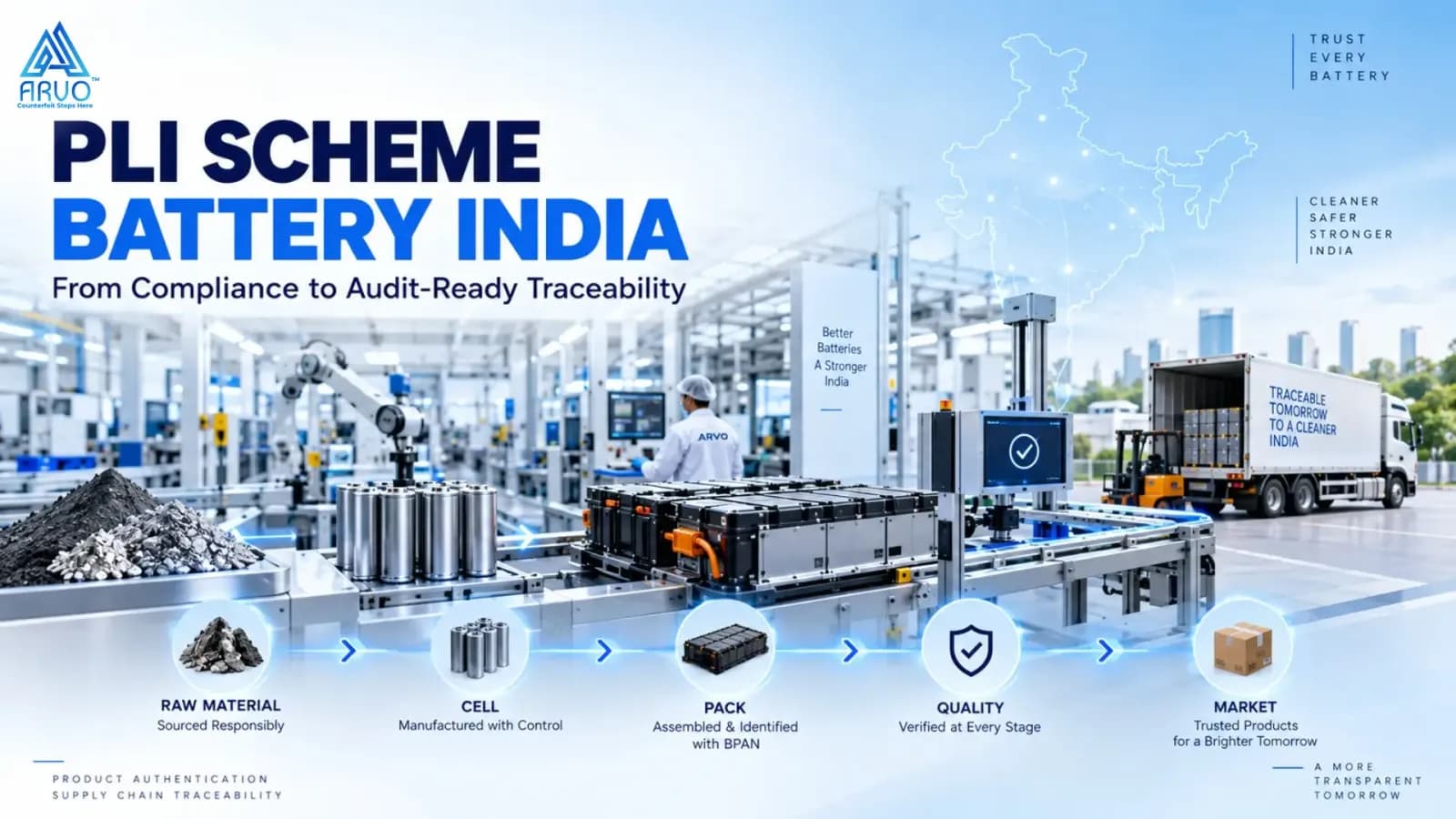
India's Production Linked Incentive scheme for battery cells, officially the National Programme on Advanced Chemistry Cell (ACC) Battery Storage, was approved by the Union Cabinet on 12 May 2021 with an outlay of ₹18,100 crore to build 50 GWh of domestic ACC manufacturing capacity (PIB, 12 May 2021). Five years on, progress is slow. In a Lok Sabha reply on 24 March 2026, the Ministry of Heavy Industries said 40 GWh had been awarded to four beneficiary firms, 1 GWh was installed and no incentive had been disbursed (Lok Sabha Unstarred Question 5186).
The reasons are partly physical: factories, equipment and specialists. But the incentive itself is paid against something a manufacturer has to prove, unit by unit: how much of each cell's value was added in India, and how many of those cells were actually sold. This guide explains what the PLI scheme for batteries asks for, why evidence of domestic value addition matters so much, and how unit-level traceability and India's draft Battery Pack Aadhaar Number (BPAN) can help.
What does the ACC PLI scheme require from beneficiaries?
The scheme's core conditions come from the Cabinet approval and later replies from the Ministry of Heavy Industries (MHI).
| Condition | What the scheme says | Source |
|---|---|---|
| Minimum capacity | Each selected manufacturer commits to an ACC facility of at least 5 GWh | PIB, 12 May 2021 |
| Investment | Mandatory investment of ₹225 crore per GWh within two years, at the mother unit level | PIB, 12 May 2021 |
| Domestic value addition | At least 25% within two years, rising to 60% within five years | PIB, 12 May 2021; PIB, 6 February 2026 |
| Timeline | Facility commissioned within two years, incentive disbursed over the following five years | PIB, 12 May 2021 |
| How the incentive is paid | Based on the subsidy per kWh quoted by the firm and the value addition achieved on actual sales | PIB, 6 February 2026 |
| Technology | Technology agnostic; the incentive rises with higher specific energy density, more cycles and more local value addition | PIB, 12 May 2021 |
The Cabinet note also expected direct investment of around ₹45,000 crore across the programme (PIB, 12 May 2021). Under Round 2, Reliance New Energy Battery Ltd. signed its programme agreement for 10 GWh on 17 February 2025, with a seven-year scheme period from 1 July 2025 that includes a two-year gestation period (PIB, 6 February 2026).
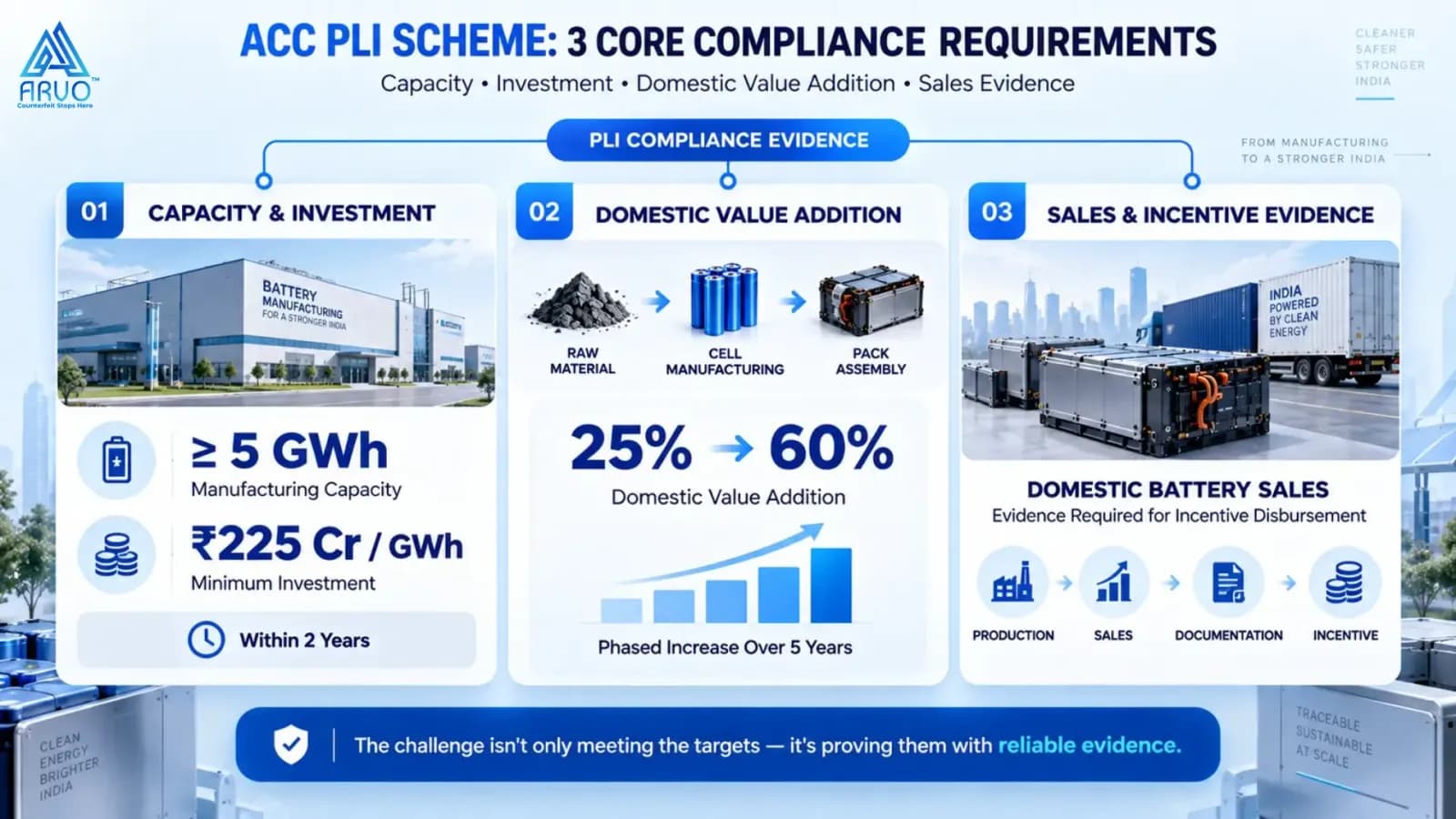
Read together, these terms make one point clear. Building a gigafactory is necessary but not sufficient. The money follows value addition achieved on sales, so a beneficiary needs records that connect each cell sold to where it was made and what went into it.
Why is the PLI scheme for batteries behind target?
An assessment by IEEFA and JMK Research, published on 22 January 2026, found that as of October 2025 only 1.4 GWh, or 2.8% of the 50 GWh target, had been commissioned within the stipulated timeline, all of it by Ola Electric. It also found that this capacity had yet to meet the domestic value addition (DVA) requirements needed to claim incentives, and that no incentive had been paid to any beneficiary by October 2025.
The same report named the bottlenecks beneficiaries described:
- delays in visa approvals for the Chinese technical specialists needed to install equipment
- an aggressive two-year installation timeline
- stringent DVA requirements that have proven difficult for first-time battery manufacturers
- a near-total dependence on imported critical minerals and cell components
The government's own figure is slightly different because it was counted later and in a different way: the March 2026 Lok Sabha reply lists 1 GWh installed against 40 GWh awarded (Lok Sabha Unstarred Question 5186).
Most of these bottlenecks are outside a manufacturer's control. DVA is different. Meeting the threshold depends on sourcing, but showing that you met it depends on records. For a first-time cell maker, the question "can we prove our value addition, cell by cell, on what we actually sold?" is one that can be answered in advance.
What evidence does a PLI beneficiary need to show?
The programme agreement and MHI's verification process set the exact method. But the incentive terms above imply five kinds of evidence that any beneficiary should be able to produce without a scramble.
1. Where each cell was made
The incentive applies to ACCs manufactured at the beneficiary's facility. A record that ties each unit to the registered manufacturer and factory, with a date of manufacture, is the starting point for everything else.
2. How much value was added in India
DVA is a share of value, so it needs inputs: which materials and components went into a batch, where they came from and what they cost. That data usually lives in procurement and ERP systems. The gap is the link between those records and the individual units that leave the line.
3. How many units were produced
Production counts that come from a unit-level record, one identity per cell or pack, are harder to dispute than totals reconciled from separate logs at the end of a quarter.
4. What each unit's specification is
Because the incentive rises with specific energy density and cycles, the specification recorded for each production lot matters. It should match what was tested and what was sold.
5. What was sold, and to whom
The payout is calculated on actual sales. Each unit that moves to an OEM, a pack assembler or a distributor should leave a record of that movement, so sales evidence is a by-product of operations rather than a separate exercise.
Where does BPAN fit into PLI compliance?
India's Battery Pack Aadhaar System is described in Draft Guidelines for Implementation of Battery Pack Aadhaar System, prepared by a committee set up by the Ministry of Road Transport & Highways (MoRTH). It is still a draft: it has not been notified, and it sets no compliance dates. For a full explainer, decoder and readiness checklist, see our BPAN compliance guide.
What makes the draft relevant here is that it names the PLI scheme directly. It says the Battery Pack Aadhaar system will help the government verify whether the cells used in battery packs are produced domestically, as mandated under ACC PLI.
The draft covers EV batteries for L, M and N category vehicles and industrial batteries above 2 kWh. Under the draft, each pack would carry a 21-character BPAN as text and as a QR code, with dynamic data held on a government portal. The parts most useful for PLI evidence are these:
| BPAN data (MoRTH draft guidelines) | What it records (MoRTH draft guidelines) | Why it matters for PLI |
|---|---|---|
| Battery Manufacturer Identifier (5 characters) | Country or region code and a manufacturer code | Ties each pack to a registered manufacturer |
| Battery Descriptor Section (8 characters) | Capacity, chemistry, nominal voltage, cell origin and extinguisher class | Cell origin is a country code, so imported and domestic cells are told apart on every pack |
| Battery Identifier (8 characters) | Date of manufacture, factory code and a sequential number | Gives a unit-level count and a factory for each pack |
| Material composition section (QR code) | 29 parameters, including cell type, weight, anode, cathode and electrolyte materials and material content | Records what the pack is made of |
| Carbon footprint section (QR code) | 5 parameters, added in the draft's third phase | Supports later carbon reporting |
It is also worth being clear about what BPAN does not hold. The draft does not record supplier names, purchase lots, costs or test certificates. A DVA calculation still needs those from your own systems. What a unit-level identity does is give those records something to attach to, so a value-addition figure can be traced to the units it covers. Our guide to battery serialisation in India covers how to structure those identities.
How unit-level records support DVA, stage by stage
- Materials: batch records of cathode, anode and electrolyte inputs, with their origin, are linked to the production lots that consumed them.
- Cells: each cell or cell lot gets an identity at manufacture, with the factory and date, so domestically made cells are distinguishable from imported ones.
- Packs: at pack assembly the BPAN, if adopted as drafted, records the cell origin and the pack's descriptor, and the pack identity links back to the cell lots inside it.
- Market: each handover to an OEM, assembler or distributor is recorded against the same identities, which gives the sales side of the incentive calculation.
Capturing the identity on the production line itself, rather than in a separate step, keeps the count honest. That is the job of a line-level system such as Vision Trace, which records each unit on the production line with a Vision AI model.
One record for PLI, BPAN and battery waste rules
Battery makers in India face several frameworks at once: the PLI scheme for those in it, Extended Producer Responsibility under the Battery Waste Management Rules, 2022, and, if it is adopted, BPAN. The draft BPAN guidelines describe themselves as a "common digital spine" that different regulatory workstreams can reference, to reduce duplicate data capture and improve auditability.
That design principle is the practical takeaway. Production counts, material data, sales movements and end-of-life events are needed by more than one regulator. If they all hang off one identity per unit, each filing becomes a query rather than a reconciliation. Our guide to the Battery Waste Management Rules 2022 maps the EPR obligations onto the same record.
How ARVO helps PLI beneficiaries build the evidence
ARVO (OneARVO Ventures Pvt. Ltd., Noida) gives each unit a NOVA code, a copy-proof smart code that any phone camera can read; a Vision AI model trained to detect even a minor variation in the code makes copies fail verification, with about 99% verification accuracy. Vision Trace records each unit as it is made, and AIC holds every scan and journey with analytics, secured on a blockchain so the record can't be rewritten. Rollout takes about 15 days.
If you are preparing for PLI verification or for BPAN, talk to our team about building the unit-level record first.
Questions answered in this article
- What is the PLI scheme for battery cells in India?
- It is the National Programme on Advanced Chemistry Cell (ACC) Battery Storage, approved by the Union Cabinet on 12 May 2021 with an outlay of ₹18,100 crore to build 50 GWh of domestic ACC manufacturing capacity (PIB). It is administered by the Ministry of Heavy Industries.
- What is the domestic value addition requirement under the ACC PLI scheme?
- Beneficiaries must achieve at least 25% domestic value addition within two years and raise it to 60% within five years (PIB). The incentive is based on the value addition achieved on actual sales, so the figure has to be backed by records.
- How much ACC capacity has been commissioned under PLI?
- IEEFA and JMK Research found 1.4 GWh commissioned as of October 2025, all by Ola Electric. The Ministry of Heavy Industries told the Lok Sabha on 24 March 2026 that 40 GWh had been awarded, 1 GWh was installed and no incentive had been disbursed.
- Is BPAN required for PLI beneficiaries?
- No. BPAN is a draft guideline from a MoRTH committee and has not been notified, so it is not mandatory and has no deadlines. The draft does say the system will help the government verify domestic cell production under ACC PLI.
- Can BPAN data alone prove domestic value addition?
- Not on its own. The draft records the manufacturer, factory, date and cell origin for each pack, but not supplier, cost or lot data. Those records still come from your own systems, linked to each unit's identity.
Sources
- Cabinet approves Production Linked Incentive scheme National Programme on Advanced Chemistry Cell Battery Storage (12 May 2021), Press Information Bureau
- Production-Linked Incentive for ACC Battery Manufacturing (6 February 2026), Press Information Bureau
- Lok Sabha Unstarred Question No. 5186, Beneficiaries under ACC-PLI (answered 24 March 2026), Ministry of Heavy Industries
- Assessing India's incentive scheme to enhance the battery manufacturing ecosystem (22 January 2026), IEEFA and JMK Research
- Draft Guidelines for Implementation of Battery Pack Aadhaar System, Ministry of Road Transport & Highways committee (hosted by the Office of the Principal Scientific Adviser)