Battery Serialization in India: Why Every Pack Needs a Unique ID
What battery serialization means, how India's draft 21-character BPAN is built, why batch tracking falls short, and how to serialize a running battery line.
By Abhijeet Kumar, ARVOPublished Updated 10 min read
In short
Battery serialization gives every individual battery pack its own permanent, machine-readable identity at the point of manufacture. India's draft Battery Pack Aadhaar guidelines propose a 21-character BPAN per pack, marked as text and as a QR code. Unit-level identity makes targeted recalls, second-life valuation, EPR reconciliation and grey-market detection possible.
- Serialization means one identity per pack, not per batch, model or SKU.
- The draft BPAN has 21 characters in three parts: who made the pack, what it is and which pack it is.
- The draft asks for a new BPAN after recycling or repurposing, and records pack replacements against the vehicle in VAHAN.
- Batch tracking shows what was produced; serialization shows what happened to every unit afterwards.
- India's draft BPAN, the Battery Waste Management Rules 2022 and the EU battery passport from 18 February 2027 all point to unit-level identity.
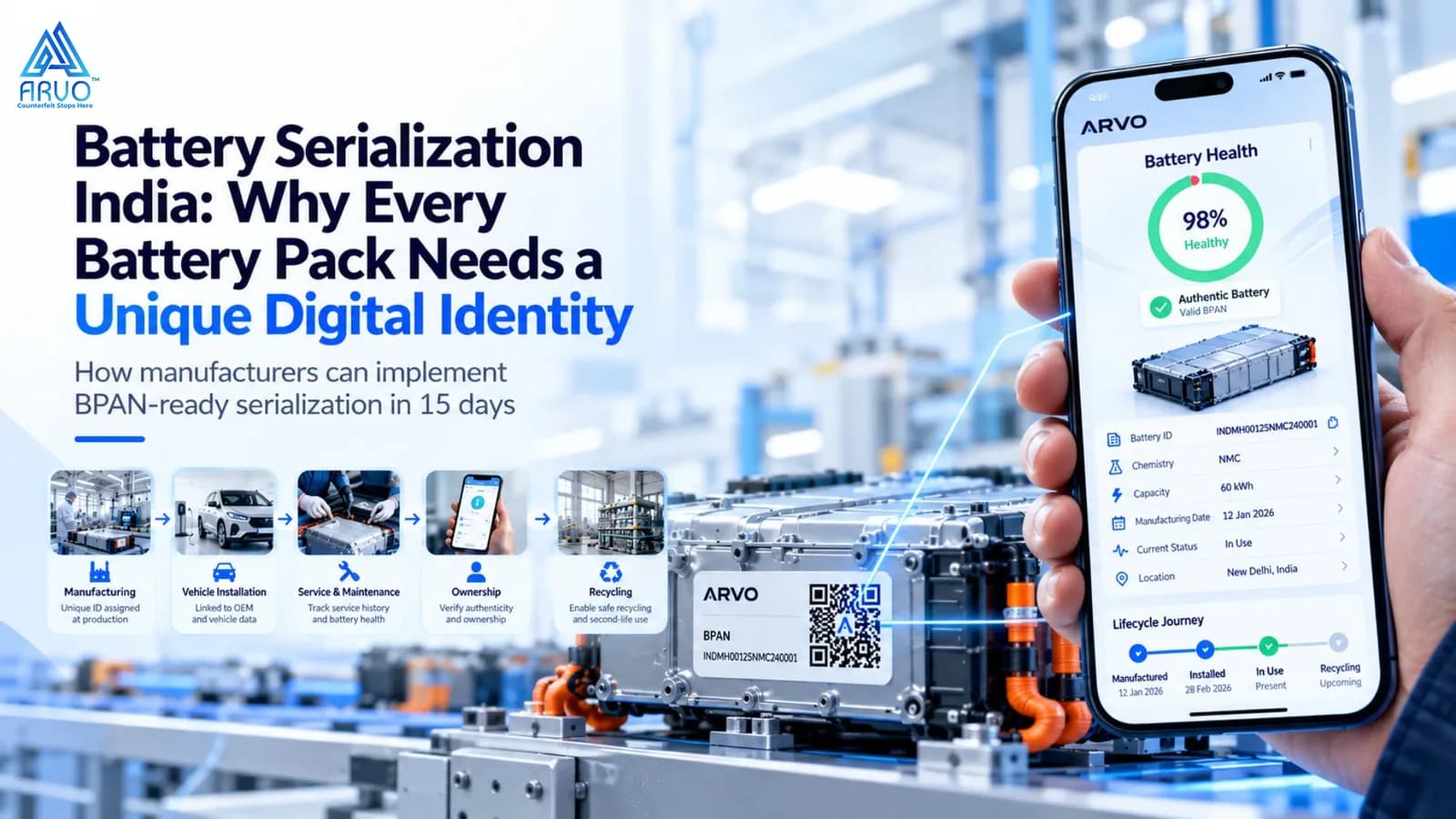
How many batteries did your factory produce last month? You probably know the number. Now answer a harder question about any one of them. Where is it right now? What is its state of health? Has it had a thermal event? Who owns it, which vehicle is it in, and was it ever serviced?
If you make thousands of packs a month and cannot answer those questions for an individual unit, your products go into a black box the moment they leave the factory. Battery serialization is how manufacturers open that box. It is also the idea at the heart of India's draft Battery Pack Aadhaar System, which would give every in-scope battery pack a 21-character identity that follows it from the factory floor to the recycler.
This guide explains what battery serialization means, how the draft BPAN code is built, what breaks without unit-level identity, why batch tracking is not enough, which rules point the same way, and how to put serialization onto a running production line.
What does battery serialization actually mean?
Battery serialization is assigning a unique, permanent, machine-readable identity to every individual battery pack at the point of manufacture. The key word is individual. Not batch level, not model level, not SKU level. Each pack that leaves your line carries an identity that no other battery shares.
Serialization is not a barcode on a carton, a batch number in your ERP system or a model number in a catalogue. It is an identity tied to one physical object and kept from the day it is made until it is recycled. Everything else depends on it: lifecycle tracking, safety investigations, targeted recalls, second-life valuation, extended producer responsibility (EPR) reporting and audit evidence for incentive schemes.
How is a BPAN built?
At the end of December 2025, the Ministry of Road Transport and Highways (MoRTH) published draft guidelines for a Battery Pack Aadhaar System. The draft covers EV batteries for L, M and N category vehicles and may also be referenced for industrial batteries above 2 kWh. It proposes a 21-character Battery Pack Aadhaar Number (BPAN) in three parts.
| Part | Characters | What it says | What it contains |
|---|---|---|---|
| Battery Manufacturer Identifier (BMI) | 1 to 5 | Who made the pack | A two-character country or region code and a three-character manufacturer code, pre-assigned by a national organisation |
| Battery Descriptor Section (BDS) | 6 to 13 | What the pack is | Capacity, chemistry, nominal voltage, cell origin and extinguisher class |
| Battery Identifier (BI) | 14 to 21 | Which pack it is | Manufacturing date, factory code and a four-digit sequential number |
The draft's own worked example is MY008A6FKKKLC1DH80001. Read in order, it describes a pack from manufacturer 008 in India (MY), with a capacity of 30 kWh (A6), NMC chemistry (F), a nominal voltage of 307 V (KK), cells from Korea (KL) and extinguisher class C, made on 17 April 2025 (1DH) in factory 8, with serial number 0001. You can take it apart character by character in the decoder on our BPAN compliance page.
Four other rules in the draft shape how serialization has to work in practice:
- Text and code. The producer or importer marks the BPAN on the pack both as an alphanumeric code and as a QR code, and uploads the pack's dynamic data to an official BPAN portal.
- Durable marking. The BPAN must sit in a clearly visible and accessible position, chosen so that it cannot be destroyed or deteriorate.
- A new identity after material change. Any change in a battery's attributes due to recycling or repurposing results in a new BPAN.
- Vehicle records. The vehicle maker records the BPAN in Form 20 so that it feeds the VAHAN database, and when a pack in a vehicle is replaced with a new one, the new BPAN is recorded.
What becomes impossible without unit-level serialization?
The cost of operating without serialization is not an abstract compliance risk. It shows up as operational failures.
1. Targeted recalls
When a safety incident involves an unserialized battery, the maker cannot tell which other units share its cells, its production run or its line. The safe choice becomes a broad recall across a whole model or period, which costs more, takes longer and damages the brand across products that were never at fault.
2. Second-life valuation
A used battery's value depends on its documented history: state of health, cycle count, thermal events and service records. RMI wrote in September 2026 that buyers, financiers, repurposers, insurers and recyclers often lack reliable information about a battery's condition, so financiers struggle to price risk and repurposers spend extra time testing and sorting packs. Without an individual identity there is no individual history, and the pack is priced as an unknown.
3. Incentive audit evidence
India's production-linked incentive (PLI) scheme for advanced chemistry cells pays out against capacity and domestic value addition (DVA). A January 2026 assessment by IEEFA and JMK Research found that only 1.4 GWh of the 50 GWh target had been commissioned by October 2025, and that this capacity did not yet meet the DVA requirements needed to claim incentives. When incentives depend on proving what went into each product, unit-level records turn DVA evidence from a manual compilation into something a system produces. Our post on PLI scheme audits covers this in depth.
4. EPR reconciliation
The Battery Waste Management Rules, 2022 make producers responsible for collecting and recycling the batteries they place on the market. Without serialization, matching a recycled battery to the producer that sold it means cross-checking sales records, distribution logs and recycler registers by hand. At the scale India's battery market is growing, that is hard to sustain. Our guide to the Battery Waste Management Rules 2022 explains the obligations.
5. Grey-market detection
Without serialization, a maker cannot tell whether a battery turning up in an unauthorised market was diverted from its own channels or is a counterfeit. A serialized pack is linked to the channel it was shipped to, so when it surfaces somewhere else, the diversion shows up straight away.
Why is batch tracking not serialization?
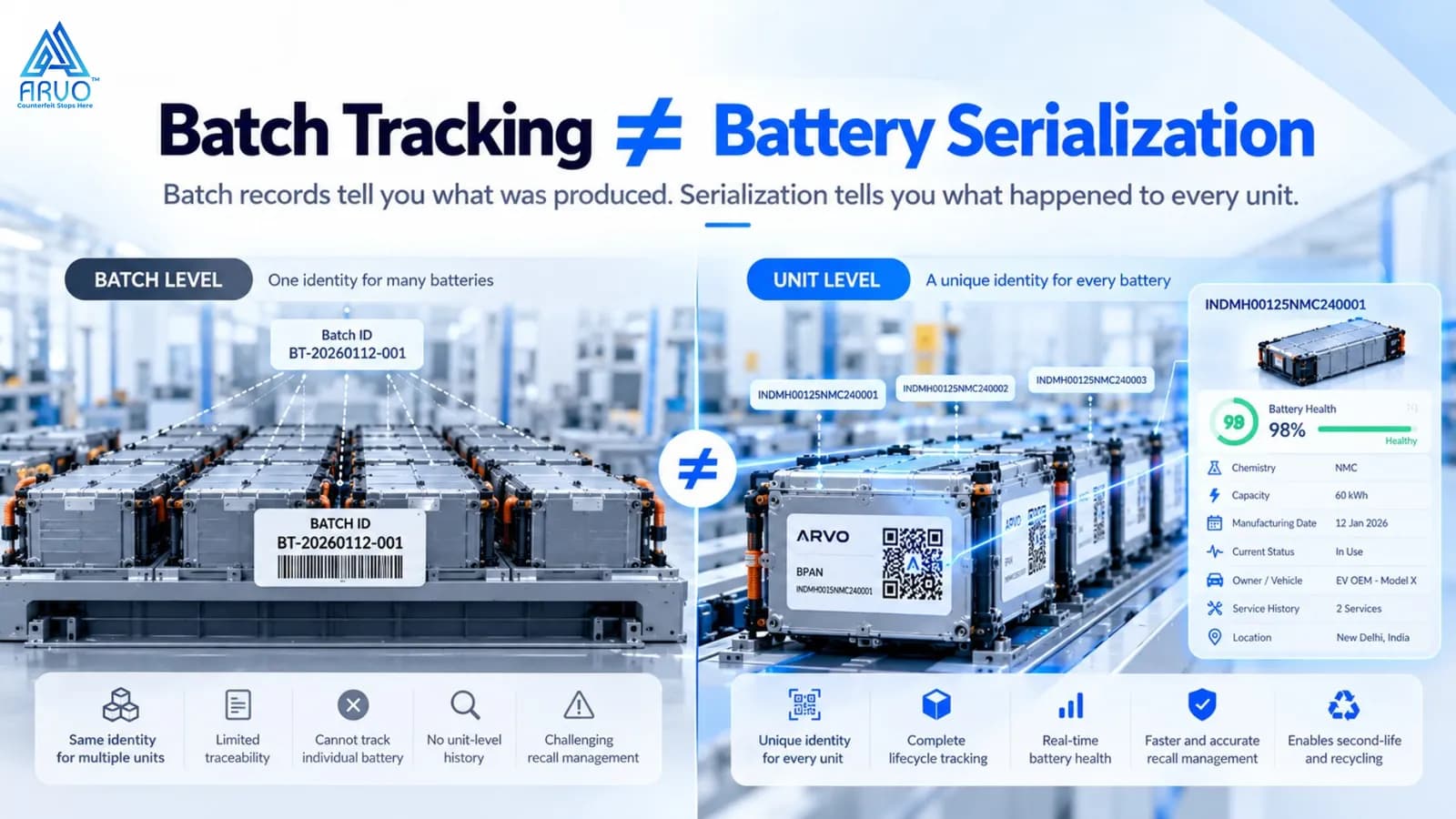
Many Indian battery makers believe they already have traceability because they track production by batch. A batch record links a production run to a date, a raw-material lot and a quality check. That is necessary, but it is not serialization.
| Capability | Batch tracking | Unit-level serialization |
|---|---|---|
| Granularity | Identifies a production run | Identifies each individual pack |
| Recall precision | Recalls the whole batch | Recalls only the units linked to the issue |
| Lifecycle tracking | Loses sight of units after dispatch | Follows each pack from production to recycling |
| Second-life valuation | Cannot tell packs within a batch apart | Each pack carries its own history |
| EPR attribution | Matches recycled volume to a producer in aggregate | Matches each recycled pack to its producer and sale |
| Grey-market detection | Cannot say which units were diverted | Flags specific units in unauthorised locations |
| Draft BPAN | Does not give each pack its own identity | Gives each pack the unique identity the draft describes |
| Incentive audits | Value addition shown at batch level | Value addition traceable to individual packs |
Batch tracking tells you what was produced. Serialization tells you what happened to every unit that was produced.
Which rules are pushing battery makers towards serialization?
Three regulatory forces converge on the same requirement: every battery needs a unique, traceable digital identity.
India's draft Battery Pack Aadhaar guidelines
The draft is explicit that each in-scope pack gets its own 21-character BPAN. It also proposes phasing the data: identification first (the BMI, BDS and BI), then material composition and dynamic data, then carbon footprint. The draft has not been formally notified and gives no compliance dates. It recommends taking the framework forward through the Automotive Industry Standards route and giving electric vehicle batteries priority.
The Battery Waste Management Rules, 2022
The Rules do not require unit-level serialization in so many words. But producers have to account for collection and recycling against what they sold, and reconciling that at scale is far easier when each pack can be identified.
The EU Battery Regulation
Regulation (EU) 2023/1542 requires a battery passport, reached through a QR code, for light means of transport batteries, industrial batteries above 2 kWh and EV batteries placed on the EU market from 18 February 2027 (Article 77). An Indian exporter without unit-level serialization will struggle to produce passport data for each battery. Our digital product passport page explains the EU requirements.
How do you put serialization onto a running production line?
Serialization does not need a factory overhaul. It needs a phased approach that fits into the workflow you already run.
- Assess and plan. Review your production line, labelling set-up and data systems. Choose where the identity will sit on each pack format, and map the data you capture at production against the draft BPAN fields.
- Configure and design. Set up code generation, data encoding and label design. Labels have to survive heat, vibration, moisture and chemical exposure for the life of the pack.
- Integrate and test. Connect the serialization step to the line and run test batches. Check print quality, scan reliability, data accuracy and label adhesion on your actual pack materials, and confirm that every unit receives a unique identity.
- Pilot and go live. Run a first fully serialized batch and verify it end to end, from code generation and marking to data capture and dashboard visibility. Fix what the pilot reveals, then switch the whole line over.
Once the BPAN is notified, the manufacturer identifier and factory code will be registered once with a national agency, as the draft describes. Building the identity, marking and data habits now means that step slots into a system that already works.
How ARVO helps manufacturers serialize every pack
ARVO (OneARVO Ventures Pvt. Ltd., Noida) gives every pack a NOVA copy-proof smart code that any phone camera can read, and a Vision AI model trained to detect even a minor variation in the code makes copies fail verification. Vision Trace records each unit on the production line with a Vision AI model, and AIC holds every scan and each pack's journey with analytics, secured on a blockchain so the record can't be rewritten. Rollout takes about 15 days.
To plan serialization for your line, talk to the ARVO team.
Questions answered in this article
- Is battery serialization mandatory in India right now?
- Not yet. MoRTH's Battery Pack Aadhaar guidelines, which propose a unique 21-character identity per pack, are still a draft: they have not been formally notified and give no compliance dates. EPR reporting under the Battery Waste Management Rules 2022 and exports to the EU already reward unit-level identity.
- How is a BPAN different from the serial number in our ERP system?
- An ERP serial number is an internal reference in whatever format your company chooses. The draft BPAN is a standard 21-character code: 5 characters identify the manufacturer, 8 describe the pack and 8 identify the individual unit. It is marked on the pack as text and as a QR code and linked to a national portal.
- Does a battery keep the same BPAN when it is recycled or repurposed?
- No. The draft says any change in a battery's attributes due to recycling or repurposing results in a new BPAN, issued by the same or a new producer or importer.
- Can a standard QR code be used for battery serialization?
- The draft asks for a QR code but does not specify copy protection. A standard QR code can be photographed and reprinted, so a clone scans like the original; a copy-proof code keeps each identity unique.
- How long does it take to add serialization to an existing battery line?
- It depends on the line, but it does not need a factory overhaul: assess, configure, integrate and test, then pilot and go live. ARVO's NOVA rollout takes about 15 days.
Sources
- Draft Guidelines for Implementation of Battery Pack Aadhaar System, Ministry of Road Transport and Highways
- India's used EV battery market needs trust. Battery Aadhaar can help, RMI
- Assessing India's incentive scheme to enhance the battery manufacturing ecosystem, IEEFA and JMK Research
- Regulation (EU) 2023/1542 concerning batteries and waste batteries, EUR-Lex