BPAN vs EU Battery Passport: What Indian Battery Exporters Need to Know
India's draft BPAN and the EU battery passport compared: scope, identifier, data, access, timelines and what an exporter selling into both should prepare.
By ARVO teamPublished Updated 10 min read
In short
BPAN is a 21-character battery identity proposed in India's draft MoRTH guidelines, with no start date. The EU battery passport is an electronic record required by Regulation (EU) 2023/1542 from 18 February 2027. Both cover EV and industrial batteries above 2 kWh, but the EU asks for more data and sets audience-based access rules.
- The EU battery passport is mandatory from 18 February 2027, while BPAN is in draft guidelines with no dates or penalties.
- The EU also covers LMT batteries of 25 kg or less, so many small e-scooter and e-bike packs need a passport in Europe.
- BPAN is a structured 21-character number; the EU uses a unique identifier under ISO/IEC 15459 reached through a QR code.
- Both use the same five battery statuses and both give a repurposed battery a new identity, so one record can feed both.
- Exporters should keep one master record per pack, collected to the EU's depth, with BPAN as a subset.
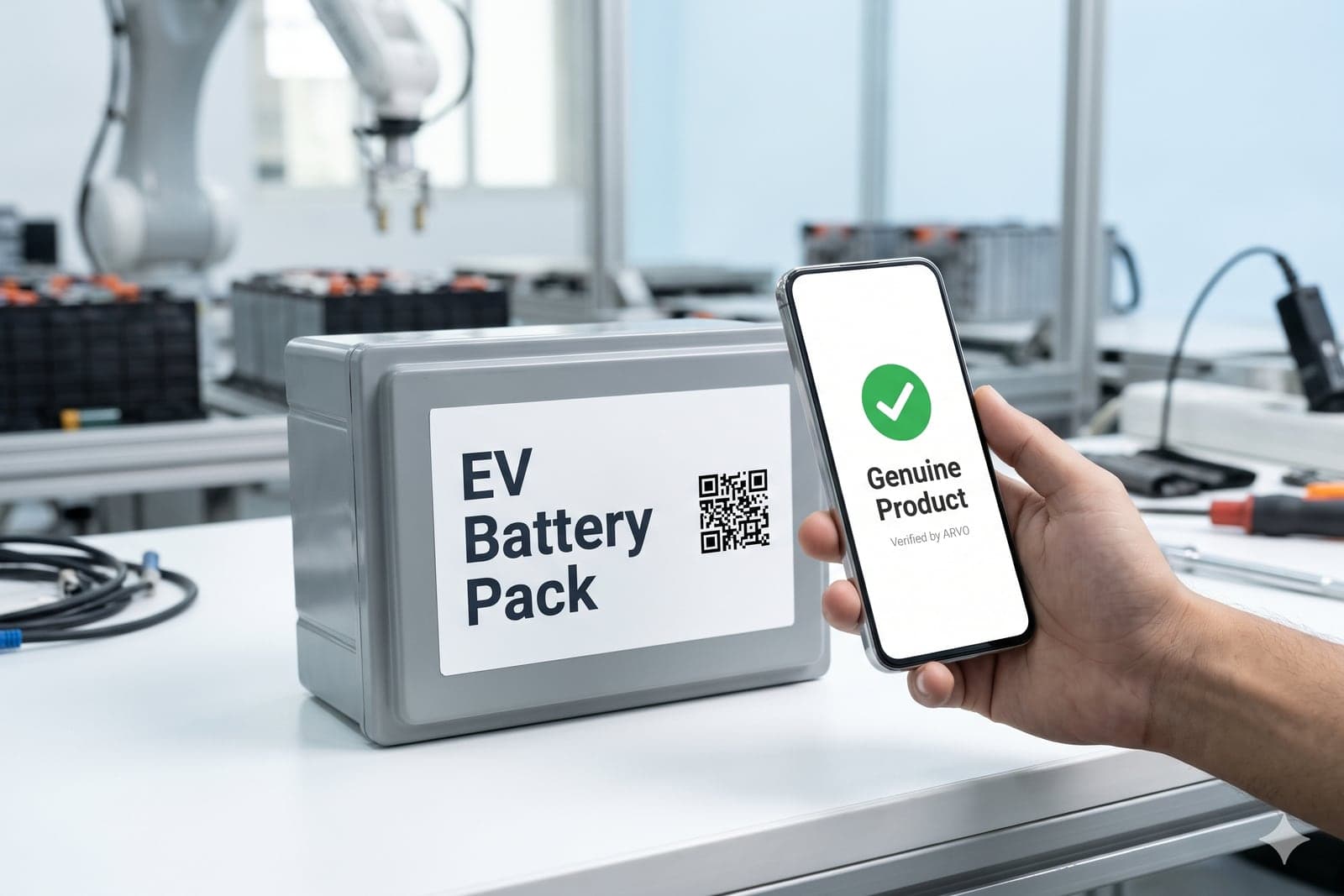
India and the European Union are both giving battery packs a digital identity, but they are at very different stages. The EU battery passport is law: Regulation (EU) 2023/1542 requires one from 18 February 2027. India's Battery Pack Aadhaar Number (BPAN) is set out in draft guidelines from a Ministry of Road Transport and Highways (MoRTH) committee that have not been notified.
For an Indian pack maker that sells at home and exports to Europe, the question is practical: how much of the work overlaps, and what has to be done twice? This guide compares the two side by side, using the text of the EU Regulation and India's draft guidelines.
What is BPAN and what is the EU battery passport?
Both are a unique identity for a battery that links the physical pack to a data record. BPAN is a 21-character code proposed in Indian draft guidelines; the EU battery passport is an electronic record required by Article 77 of the EU Battery Regulation.
BPAN. The draft Battery Pack Aadhaar guidelines were prepared by a committee MoRTH constituted in September 2025 and are published by the Office of the Principal Scientific Adviser. Each in-scope pack would carry a 21-character number, written as text and marked as a QR code, linked to a record on a government BPAN portal. The draft calls BPAN a common digital spine that other rules, such as the Battery Waste Management Rules, 2022 and the PLI scheme for advanced chemistry cells, can reference.
EU battery passport. Article 77 of Regulation (EU) 2023/1542 says that from 18 February 2027 each in-scope battery placed on the market or put into service "shall have an electronic record". The passport holds information on the battery model and on the individual battery, including data from its use, as listed in Annex XIII. It is reached through a QR code on the battery.
For a fuller introduction to each, see our guide to the Battery Pack Aadhaar Number and our page on the EU battery passport and digital product passports.
Is either one mandatory, and when?
The EU battery passport is mandatory from 18 February 2027 under Article 77(1) of Regulation (EU) 2023/1542. BPAN is not mandatory: the draft has not been formally notified, and it gives no compliance dates and no penalties.
| India: BPAN | EU: battery passport | |
|---|---|---|
| Legal basis | Draft Guidelines for Implementation of Battery Pack Aadhaar System (MoRTH committee) | Regulation (EU) 2023/1542, Articles 77 and 78, Annex XIII |
| Status | Draft, not notified | In force |
| Start date | None in the draft | 18 February 2027 (Article 77(1)) |
| Phasing | Three phases with no dates: identity, then material and dynamic data, then carbon footprint | One start date for the passport; some data, such as the carbon footprint declaration, follows its own timetable under Article 7 |
| Next step | The draft recommends the Automotive Industry Standard route under the Automotive Industry Standards Committee (AISC) | Implementing and delegated acts fill in detail, such as who has a legitimate interest (Article 77(9)) |
The certainty gap matters for planning. The EU date is written into the Regulation. India's details may still change before final rules are notified, so treat the draft as a strong signal of direction, not as a specification to build against line by line.
Which batteries does each one cover?
Both cover EV and industrial batteries above 2 kWh. The EU also covers LMT batteries, which catches many small e-scooter and e-bike packs, while the BPAN draft covers EV batteries for L, M and N category vehicles and leaves out SLI and portable batteries.
| Battery type | BPAN draft | EU passport (Article 77(1)) |
|---|---|---|
| EV batteries, L category (two- and three-wheelers, quadricycles) | In scope | In scope as an EV battery if over 25 kg; a sealed traction battery of 25 kg or less is an LMT battery, also in scope |
| EV batteries, M and N category (cars, buses, goods vehicles) | In scope | In scope (the EU definition also includes O category trailers) |
| Industrial batteries above 2 kWh | In scope | In scope |
| SLI (starting, lighting and ignition) batteries | Out of scope | No passport, but a QR code with other information from 18 February 2027 (Article 13(6)) |
| Portable batteries | Out of scope | No passport, but a QR code with other information from 18 February 2027 (Article 13(6)) |
The weight line is the one exporters miss. Under Article 3 of the EU Regulation, an LMT battery is sealed, weighs 25 kg or less and powers wheeled vehicles such as type-approved L category vehicles, while an L category traction battery over 25 kg counts as an EV battery. Either way it needs a passport, but the category changes which Annex XIII fields apply, such as the capacity threshold for exhaustion, which Annex XIII lists for EV batteries only.
How do the identifiers differ?
BPAN is a structured number whose characters carry meaning. The EU unique identifier is attributed by the economic operator and must comply with the ISO/IEC 15459 series, but the Regulation does not fix what its characters mean.
BPAN: 21 characters in three sections. Under the draft, every BPAN is 5 + 8 + 8 characters:
| Section | Characters | What it encodes |
|---|---|---|
| Battery Manufacturer Identifier (BMI) | 5 | Country or region code and a manufacturer code pre-assigned by a national organisation |
| Battery Descriptor Section (BDS) | 8 | Capacity, chemistry, nominal voltage, cell origin and extinguisher class |
| Battery Identifier (BI) | 8 | Manufacturing date, factory code and a four-digit serial number |
Anyone can read the 21 characters and decode who made the pack and what it is, without a network. You can take the draft's own worked example apart in our interactive BPAN decoder.
EU: a unique identifier behind a QR code. Article 77(3) says the passport is accessible through the QR code required by Article 13(6), "which links to a unique identifier" that the economic operator placing the battery on the market attributes to it. The QR code and identifier must comply with ISO/IEC 15459 parts 1 to 6 or their equivalent, the standards family behind registered, globally unique identifiers.
So a pack sold in both markets will usually carry two identities: a BPAN with fixed meaning, and an EU unique identifier issued under a registered scheme. Nothing in either text stops both from pointing at the same internal record.
What data does each one carry?
The BPAN draft keeps the data lean: a public code, static data in the QR code and ten dynamic fields on a server. The EU passport asks for considerably more, including carbon footprint, recycled content, responsible sourcing and detailed performance and durability data.
| Data area | BPAN draft | EU passport (Annex XIII) |
|---|---|---|
| Identity and basics | Manufacturer, capacity, chemistry, voltage, cell origin, extinguisher class, date, factory, serial | General information from Annex VI Part A, the EU declaration of conformity and required markings |
| Materials | Material composition and construction (29 parameters in the QR code), such as anode, cathode, electrolyte and separator materials | Chemistry, hazardous substances and critical raw materials (public); detailed cathode, anode and electrolyte composition (restricted) |
| Carbon footprint | 5 parameters, in Phase 3 | Carbon footprint information under Article 7 |
| Sourcing and circularity | Disassembly and circularity methods, recyclability | Responsible sourcing from the due diligence report, recycled content, share of renewable content, dismantling information and safety measures |
| Performance | Not a separate block | Rated capacity, voltages, power capability, expected lifetime in cycles, round-trip efficiency, internal resistance and more |
| Status | Original, re-used, repurposed, remanufactured or waste | Original, repurposed, re-used, remanufactured or waste |
| Health and use | State of health, in bands set out in the draft's Annexure III | State of health, cycles, negative events such as accidents, temperature and state of charge records |
Two details stand out. First, the status values are the same five words in both texts, which makes mapping one record to the other simpler. Second, the draft says BPAN data can be mapped to European battery passport schemas through standard interfaces and field mapping, without changing anything on the physical pack. That is a statement about compatibility, not equivalence: the EU fields form a much larger set.
Who can see which data?
Both use tiered access. BPAN splits data by carrier: a public code, a QR code for authorised users and a server for authorised online access. The EU splits by audience: public, persons with a legitimate interest, and notified bodies, market surveillance authorities and the Commission.
BPAN draft: three tiers by carrier.
| Tier | Carrier | Access in the draft |
|---|---|---|
| Identity | The 21 characters on the pack | Public, readable offline |
| Static data | The QR code: material composition and construction, carbon footprint | Authorised users, offline; mainly so recyclers can dismantle safely and recover materials |
| Dynamic data | The BPAN portal: status, state of health, end-of-life methods | Authorised users, online; service providers and recyclers add their results |
EU passport: three audiences.
| Audience | What they see (Article 77(2), Annex XIII) |
|---|---|
| General public | Point 1: model information such as composition, carbon footprint, recycled content and performance data |
| Persons with a legitimate interest, such as repairers, remanufacturers, second-life operators and recyclers | Points 2 and 4: detailed composition, part numbers, dismantling information, safety measures and data on the individual battery |
| Notified bodies, market surveillance authorities and the Commission | Point 3: test reports proving compliance, plus the restricted model information in point 2 |
The EU also sets rules for how the passport is run. Article 78 says access must be free of charge according to each party's rights, the passport must stay available if the responsible operator stops trading, data authentication and integrity must be ensured, and any operator storing data on someone's behalf may not sell or re-use it. Article 77(9) asked the Commission to adopt implementing acts by 18 August 2026 specifying who counts as a person with a legitimate interest; check the current status of those acts before you finalise access rules.
What happens when a battery is repurposed or recycled?
Both give a changed battery a new identity, but they handle history differently. Under the BPAN draft, any change in a pack's attributes through recycling or repurposing results in a new BPAN. Under Article 77(7), a re-used, repurposed or remanufactured battery gets a new passport linked to the passport or passports of the original batteries.
The EU text adds two points. Responsibility for keeping the passport accurate moves to the operator that places the repurposed battery on the market, or, once the battery becomes waste, to the producer, producer responsibility organisation or waste management operator. And Article 77(8) says the passport ceases to exist after the battery has been recycled.
For your records, the practical point is the same in both: design the data model so a pack's history survives a change of identity, with the old identifier linked to the new one.
Who is responsible?
In both, the business that puts the battery on the market answers for it. Under the BPAN draft, the producer or importer assigns the number, marks it on the pack and uploads data to the portal. Under Article 77(4), the economic operator placing the battery on the EU market must keep the passport accurate, complete and up to date, and may authorise another operator in writing to act for it.
For an Indian exporter, that EU operator is often your importer or your EU entity, not your factory. Either way, the data has to come from you: the materials, the test results, the production records and, through suppliers, the cell and sourcing data. The BPAN draft likewise obliges cell and module suppliers to give the pack maker the information it needs.
What should an exporter selling into both markets prepare?
Build one record per pack that can serve both, and treat BPAN as a subset of what the EU needs. The marking, the identifiers and the access rules differ, but the underlying data overlaps heavily.
- Classify each product for both markets. Check every pack against the BPAN draft's categories and against the EU definitions, including the 25 kg line between LMT and EV batteries.
- Keep one master record per pack. Store the BPAN fields, the EU fields and the lifecycle events in one place, keyed to the unit, so each output is a view of the same data.
- Plan both identifiers. Prepare to register a manufacturer identifier and factory code for BPAN once the national process opens, and choose an ISO/IEC 15459-compliant scheme for the EU unique identifier.
- Design the label for two codes. A pack may need the BPAN as text and a QR code, and a separate EU passport QR code. Agree space, materials and print durability with your packaging team now. The BPAN draft says the mark must not deteriorate, and Article 13(7) of the EU Regulation says the QR code must be printed or engraved visibly, legibly and indelibly on the battery.
- Collect supplier data to the EU depth. Detailed cathode, anode and electrolyte composition, critical raw materials, recycled content and responsible sourcing information are EU requirements that BPAN does not fully cover. Ask cell and module suppliers for them per lot.
- Map access tiers. Decide which fields are public, which go to legitimate-interest parties and which go only to authorities, and make sure your system can enforce that.
- Capture use and health data. Both texts want state of health and status; the EU also wants cycles, negative events, temperature and state of charge. Agree with vehicle and BMS partners how that data reaches the record.
- Write the repurposing rule. Define when a pack gets a new BPAN and a new linked EU passport, and who updates the record at each step.
If you are mapping product data for the EU more broadly, our digital product passport page includes a readiness checklist.
What are the common misconceptions?
Most mistakes come from treating the two as the same thing, or from assuming the draft is final. These are the ones we hear most.
- "BPAN is already mandatory." It is not. The guidelines are a draft, with no dates and no penalties, and the draft names the AIS route as the next step.
- "If we are BPAN-ready, we are EU-ready." BPAN work is a head start. The EU asks for more data, a different identifier scheme and audience-based access control.
- "The EU passport is just a QR code." The QR code is the way in. The obligation is the record behind it, kept accurate and up to date for the battery's life.
- "Small e-scooter packs are exempt in Europe." Sealed traction batteries of 25 kg or less are LMT batteries, which need a passport from 18 February 2027.
- "Everything in the passport is public." Both systems restrict detailed composition, dismantling and individual battery data to defined users.
- "A battery keeps one identity for life." Both give repurposed or remanufactured batteries a new identity; the EU links it to the original passport.
How ARVO helps
ARVO helps battery makers keep one record per pack that can serve BPAN and EU passport requirements. A copy-proof NOVA code on the pack is read by any phone camera, and a Vision AI model is trained to detect even a minor variation in the code, so copies fail verification, with about 99% verification accuracy. Vision Trace records each pack on the production line with a Vision AI model, and AIC holds scans, journeys and analytics, with records secured on a blockchain so the journey can't be rewritten.
See how this fits your packs on our EV and battery industry page, or talk to our team.
Questions answered in this article
- Is BPAN the same as the EU battery passport?
- No. Both give a battery pack a digital identity, but BPAN is a draft Indian framework built around a 21-character code, while the EU battery passport is a legal requirement under Regulation (EU) 2023/1542 with a larger data set and audience-based access rules.
- When does the EU battery passport apply?
- From 18 February 2027, under Article 77(1) of Regulation (EU) 2023/1542, for LMT batteries, industrial batteries above 2 kWh and electric vehicle batteries placed on the EU market or put into service.
- Does a BPAN-ready battery meet EU passport rules?
- Not on its own. BPAN work gives you a head start on identity, materials, status and state of health, but the EU also requires carbon footprint, recycled content, responsible sourcing, performance data, an ISO/IEC 15459 identifier and tiered access.
- Do e-scooter batteries need an EU battery passport?
- Usually yes. A sealed traction battery of 25 kg or less for light vehicles is an LMT battery under the EU Regulation, and LMT batteries need a passport from 18 February 2027. Heavier L category traction batteries count as EV batteries, which also need one.
- Who is responsible for the EU battery passport when an Indian company exports?
- The economic operator that places the battery on the EU market, often the importer or an EU entity. It must keep the passport accurate, complete and up to date, and it will need the underlying data from the manufacturer.
Sources
- Regulation (EU) 2023/1542 concerning batteries and waste batteries, Official Journal of the European Union
- Draft Guidelines for Implementation of Battery Pack Aadhaar System, Ministry of Road Transport & Highways committee, published by the Office of the Principal Scientific Adviser