Battery Pack Aadhaar Number (BPAN): A Guide for Battery Makers
What India's draft Battery Pack Aadhaar Number asks of battery makers: the 21-character code, the three data tiers, scope, who does what and how to prepare now.
By Abhijeet Kumar, ARVOPublished Updated 9 min read
In short
The Battery Pack Aadhaar Number (BPAN) is a 21-character identity for each battery pack, proposed in draft MoRTH guidelines. Producers and importers would assign it, mark it on the pack as text and a QR code, and upload data to a government portal. It covers EV and industrial batteries above 2 kWh and is not yet notified.
- BPAN is set out in draft guidelines that have not been formally notified, with no compliance dates or penalties yet.
- Every BPAN has 21 characters in three sections: 5 for the manufacturer, 8 describing the pack and 8 identifying the individual pack.
- Data sits in three tiers: the public code, static material and carbon footprint data on a QR code, and a ten-field dynamic record on the BPAN portal.
- Producers and importers carry most duties, but cell suppliers, vehicle makers, service providers and recyclers all have a role.
- Registering identifiers, durable marking, supplier data and a lifecycle record all take time, so preparing now pays off when final rules arrive.
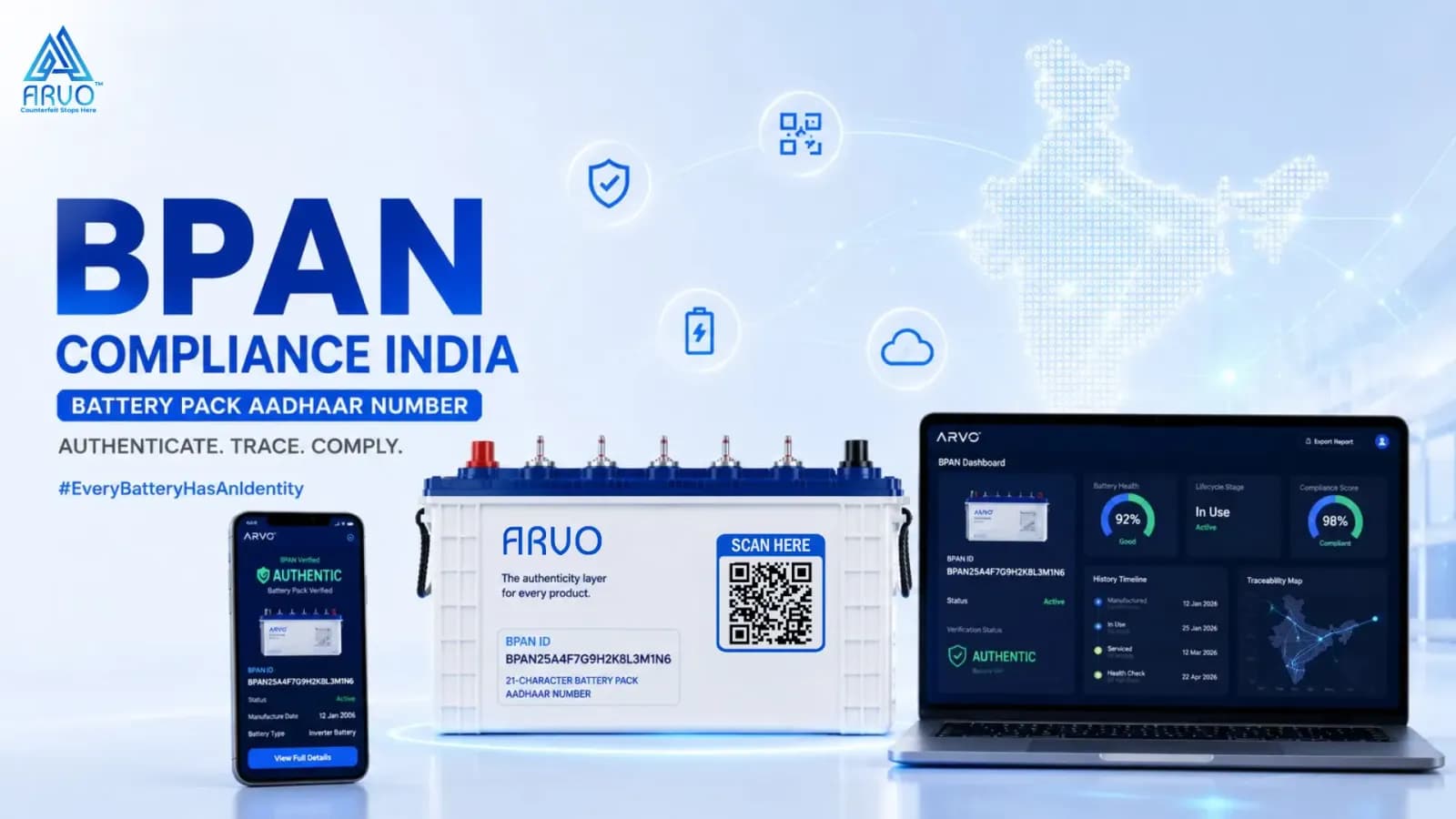
India's Ministry of Road Transport and Highways (MoRTH) has drafted guidelines for a Battery Pack Aadhaar System. Under the draft, every in-scope battery pack made in or imported into India would carry a unique 21-character Battery Pack Aadhaar Number (BPAN), marked on the pack as text and as a QR code and linked to a record on a government portal. The aim is end-to-end traceability, from raw material and manufacturing through use, repurposing, recycling and disposal.
This guide explains what the draft asks of battery manufacturers and importers: how the 21-character code is built, what data sits behind it, which batteries are in scope, who is responsible for what, and how to prepare while the rules are still being finalised.
Is BPAN mandatory yet?
No. The Battery Pack Aadhaar System is set out in draft guidelines and has not been formally notified. The draft gives no compliance dates and no penalties. It recommends taking the framework forward through the Automotive Industry Standard (AIS) route under the Automotive Industry Standards Committee (AISC), with stakeholder consultation and technical validation along the way. pv magazine India reported the draft's release on 5 January 2026.
So BPAN is not yet a legal duty, and the details may change. But the direction is clear, and much of what the draft asks for takes time to build: registered identifiers, durable marking, supplier data and a lifecycle record. Manufacturers who start now will be ready when final rules are notified, instead of scrambling after.
What is the Battery Pack Aadhaar Number?
The BPAN is a unique 21-character identity for a battery pack, named after India's Aadhaar identity for citizens. It comes with a QR code that carries static technical data, and a record on a central server that is updated as the pack moves through its life.
The guidelines were drafted by a committee that MoRTH constituted by an office memorandum of 17 September 2025, and the 49-page draft is published by the Office of the Principal Scientific Adviser. It describes BPAN as a "common digital spine" that different regulations can reference, so the same data does not have to be captured again for each one. The draft links it to:
- The Battery Waste Management Rules, 2022, by supporting Extended Producer Responsibility (EPR) and battery waste compliance.
- The PLI scheme for advanced chemistry cells, by letting the government verify whether the cells in a pack were made in India, as the scheme requires.
- Second-hand use, by letting a buyer check a pack's condition before buying or reusing it.
- The EU Battery Regulation (EU) 2023/1542, which the draft uses as a benchmark while keeping India's data load lighter.
How is the 21-character BPAN structured?
Every BPAN is 21 characters in three sections: 5 + 8 + 8. Producers are responsible for generating the code correctly and marking it permanently on every pack.
| Section | Characters | What it encodes |
|---|---|---|
| Battery Manufacturer Identifier (BMI) | 1 to 5 | Country or region code (2), manufacturer code (3), pre-assigned by a national organisation |
| Battery Descriptor Section (BDS) | 6 to 13 | Capacity (2), chemistry (1), nominal voltage (2), cell origin (2), extinguisher class (1) |
| Battery Identifier (BI) | 14 to 21 | Manufacturing date (3), factory code (1), four-digit serial number (4) |
A worked example from the draft
The draft decodes its own pilot BPAN, MY008 A6FKKKLC 1DH80001, like this:
- MY008: an Indian manufacturer, code 008.
- A6: 30 kWh. F: NMC chemistry. KK: 307 V nominal voltage. KL: cells from Korea. C: extinguisher class C.
- 1DH: made on 17 April 2025. 8: factory 8. 0001: serial number 0001.
The pilot's QR data in the draft also shows a total carbon footprint of 10 kgCO2e/kWh. You can take this example apart character by character in our interactive BPAN decoder.
Where the BPAN goes on the pack
The draft asks for the BPAN in a clearly visible and accessible position, chosen so that it cannot be destroyed or deteriorate. Any change in a pack's attributes through recycling or repurposing results in a new BPAN, issued by the same or a new producer or importer.
What data must battery manufacturers capture?
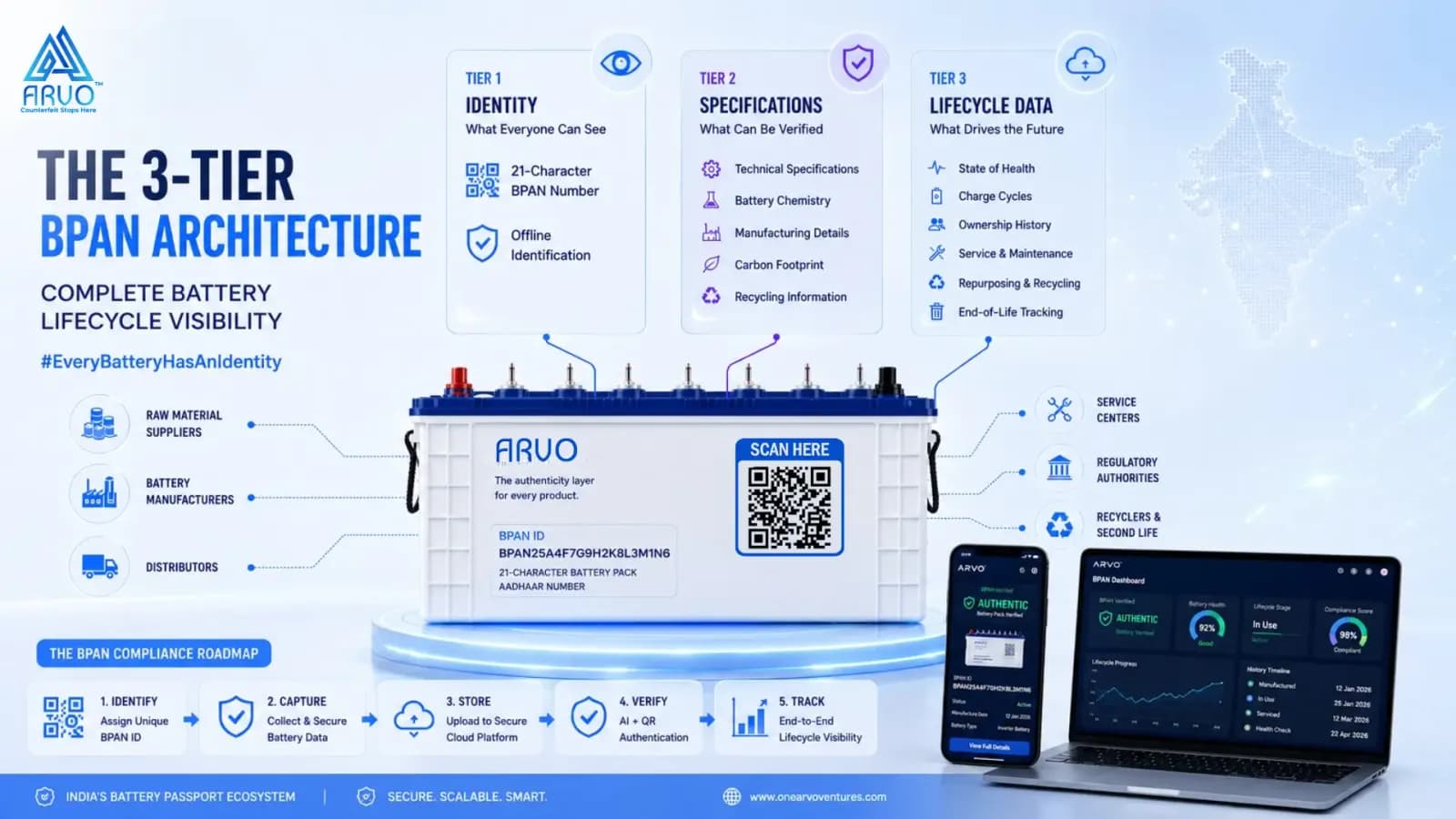
The draft organises battery data into three tiers, each with its own access rules.
| Tier | Carrier | Contents | Access |
|---|---|---|---|
| 1. Identity | 21 characters on the pack | Manufacturer, descriptor and identifier sections | Public, offline |
| 2. Static data | QR code | Material composition and construction (29 parameters); carbon footprint (5 parameters) | Authorised, offline |
| 3. Dynamic data | BPAN portal server | Ten parameters, including category, status, state of health and end-of-life methods | Authorised, online |
Tier 1: the alphanumeric code
The 21 characters are public and can be decoded without an internet connection. Anyone in the field, from an inspector to a first responder, can read who made the pack and what it is.
Tier 2: the QR code
The QR code works offline and holds static data that does not change over the pack's life. Its material and construction section covers items such as the anode, cathode, electrolyte and separator materials, cell type and form factor, cooling system, BMS hardware and software versions, warranty, disassembly method, circularity method and recyclability. A separate carbon footprint section breaks emissions down by life-cycle stage. The draft says this tier exists mainly so recyclers can recover materials efficiently and dismantle packs safely.
Tier 3: server-based dynamic data
The server holds the data that changes. The draft keeps it to ten parameters on purpose: the BPAN, battery category, status (original, re-used, repurposed, remanufactured or waste), state of health, the actual disassembly and circularity methods used, a date and time stamp, QR recovery data and two reserved fields. The draft's Annexure III bands state of health as operational above 80%, second life from 60 to 80% and end of life below 60%. It also says the government will develop the method for validating state of health separately.
Which batteries are covered?
The draft covers the battery categories of the Battery Waste Management Rules, 2022 that must keep a Battery Pack Aadhaar as an electronic record:
- Electric vehicle batteries for L category vehicles (two-wheelers, three-wheelers and quadricycles).
- Electric vehicle batteries for M and N category vehicles (passenger and goods vehicles).
- Industrial batteries above 2 kWh.
SLI (starting, lighting and ignition) batteries and portable batteries are outside its scope.
The draft focuses on EV applications. It notes that electric vehicles account for roughly 80 to 90% of India's lithium-ion battery demand, and proposes that EV batteries get priority during standard formulation, with other categories following. It also proposes phasing the data itself:
| Phase | Data | What it covers |
|---|---|---|
| 1 | BMI, BDS and BI | Identification and key descriptors |
| 2 | Material composition and dynamic data | Materials, circularity, status, state of health and end-of-life reporting |
| 3 | Carbon footprint | Footprint by life-cycle stage |
The draft attaches no dates to these phases.
Who is responsible for what under BPAN?
The draft spreads duties across the value chain. Producers and importers carry most of them.
| Stakeholder | Responsibilities in the draft |
|---|---|
| Battery producer or importer | Assign a BPAN to every pack placed on the market or used in-house, mark the code and QR code on the pack, upload data to the official BPAN portal |
| Cell and module suppliers | Provide the information and documents the pack maker needs |
| Battery manufacturer and national agency | Register the manufacturer identifier and factory code once, much like the WMI used in vehicle identification numbers |
| Authorised test agency | Check BPAN generation capability during plant audits |
| Vehicle manufacturer | Enter the BPAN in a dedicated field of Form 20, which feeds the VAHAN database; print the BPAN and QR code on the vehicle |
| Service providers | Read the record before working on a pack and upload new diagnostic results |
| Authorised recyclers | Add dismantling and material recovery outcomes |
The registration, audit, vehicle and recycler duties come from the draft's illustrative table of stakeholder responsibilities for EV batteries, so expect them to be refined as standards are written.
How should battery manufacturers prepare for BPAN?
This sequence turns the draft into a working plan. Our BPAN readiness checklist lets you tick off what you already have.
- Plan your manufacturer identifier and factory codes. The first five characters of every BPAN are pre-assigned, and the draft has the factory code registered at the same time. Be ready to register once the national process opens.
- Map your data against the three tiers. Check what you already capture for the code, the QR data and the server record, and where the gaps are: material composition, carbon footprint, state of health and end-of-life events.
- Line up supplier data. Agree with cell, module and BMS suppliers what they will send for each lot. The draft obliges them to supply it.
- Choose durable, trustworthy marking. The code has to last the life of the pack. A standard printed QR code can be photographed and reprinted, so a copied label can make a fake pack look genuine. Our guide to copy-proof battery QR codes explains why this matters.
- Set up dynamic data management. Connect your battery management system data, service records and status changes to one record per pack, ready to upload to the portal, with a rule for issuing a new BPAN when a pack is repurposed or recycled.
- Join it up with your other obligations. Use the same data for EPR under the Battery Waste Management Rules, 2022, for PLI documentation and, if you export, for the EU battery passport that applies from 18 February 2027 under Article 77 of the EU Battery Regulation.
- Run a pilot batch. Generate BPANs, mark packs, encode QR codes and check the records internally before you scale up.
How ARVO helps
ARVO (OneARVO Ventures Pvt. Ltd., Noida) helps battery makers generate, mark and manage pack identities. A copy-proof NOVA code sits beside the printed BPAN and is read by any phone camera; a Vision AI model is trained to detect even a minor variation in the code, so copies fail verification, with about 99% verification accuracy and a typical rollout of about 15 days. Vision Trace records each pack on the production line with a Vision AI model, and AIC holds every scan and journey with analytics, with records secured on a blockchain so the journey can't be rewritten.
Want to get your battery line BPAN-ready? Talk to our team.
Questions answered in this article
- Is BPAN currently mandatory for battery manufacturers in India?
- No. The Battery Pack Aadhaar System is set out in draft guidelines that have not been formally notified, and the draft gives no compliance dates or penalties. It recommends taking the framework forward through the Automotive Industry Standard route under the AISC.
- What does each part of the 21-character BPAN mean?
- The first 5 characters identify the country and manufacturer, the next 8 describe the pack (capacity, chemistry, voltage, cell origin and extinguisher class) and the last 8 identify the pack itself (manufacturing date, factory code and a four-digit serial number).
- Does a battery keep the same BPAN when it is repurposed or recycled?
- No. Under the draft, any change in a pack's attributes through recycling or repurposing results in a new BPAN, issued by the same or a new producer or importer.
- Which batteries are excluded from BPAN?
- SLI (starting, lighting and ignition) batteries and portable batteries are outside the draft's scope. It covers EV batteries for L, M and N category vehicles and industrial batteries above 2 kWh.
- What is the difference between BPAN and the EU battery passport?
- BPAN is a draft Indian framework with a lean data model and no start date. The EU battery passport is required under Regulation (EU) 2023/1542 from 18 February 2027 and asks for more data, though the draft says BPAN data can be mapped to European passport schemas.
Sources
- Draft Guidelines for Implementation of Battery Pack Aadhaar System, Ministry of Road Transport & Highways committee, published by the Office of the Principal Scientific Adviser
- India introduces 'Battery Aadhaar' system to track EV batteries across lifecycle, pv magazine India
- Regulation (EU) 2023/1542 concerning batteries and waste batteries, Official Journal of the European Union