The 40% Discount Trap: How Compatible Parts Are Costing Your Brand Equity
Compatible parts priced 30-40% below genuine ones quietly divert demand and weaken brand equity. Learn the warning signs and how unit-level visibility helps.
By Abhijeet Kumar, ARVOPublished Updated 6 min read
In short
Compatible parts hurt brand equity by capturing demand the genuine brand created. Sold through familiar channels at typically 30-40% lower prices, they look and perform similarly, so customers start treating all parts as interchangeable and price decides. Unit-level authentication and tracking show brands where genuine demand is being diverted and where to act.
- Compatible parts are not always counterfeits, but they match form and function closely enough that customers struggle to tell them from genuine parts.
- They are typically priced 30-40% lower and sold through familiar retail channels, so mechanics choose on margin and customers on price.
- The damage shows as strong demand with flat revenue, rising marketing spend with lower conversion, and dealer complaints about price competition.
- Most brands track shipments to distributors but not individual units, so they cannot see where genuine demand is lost.
- Item-level serialisation and authentication let brands find diversion points, detect unauthorised sellers and target enforcement where it matters.
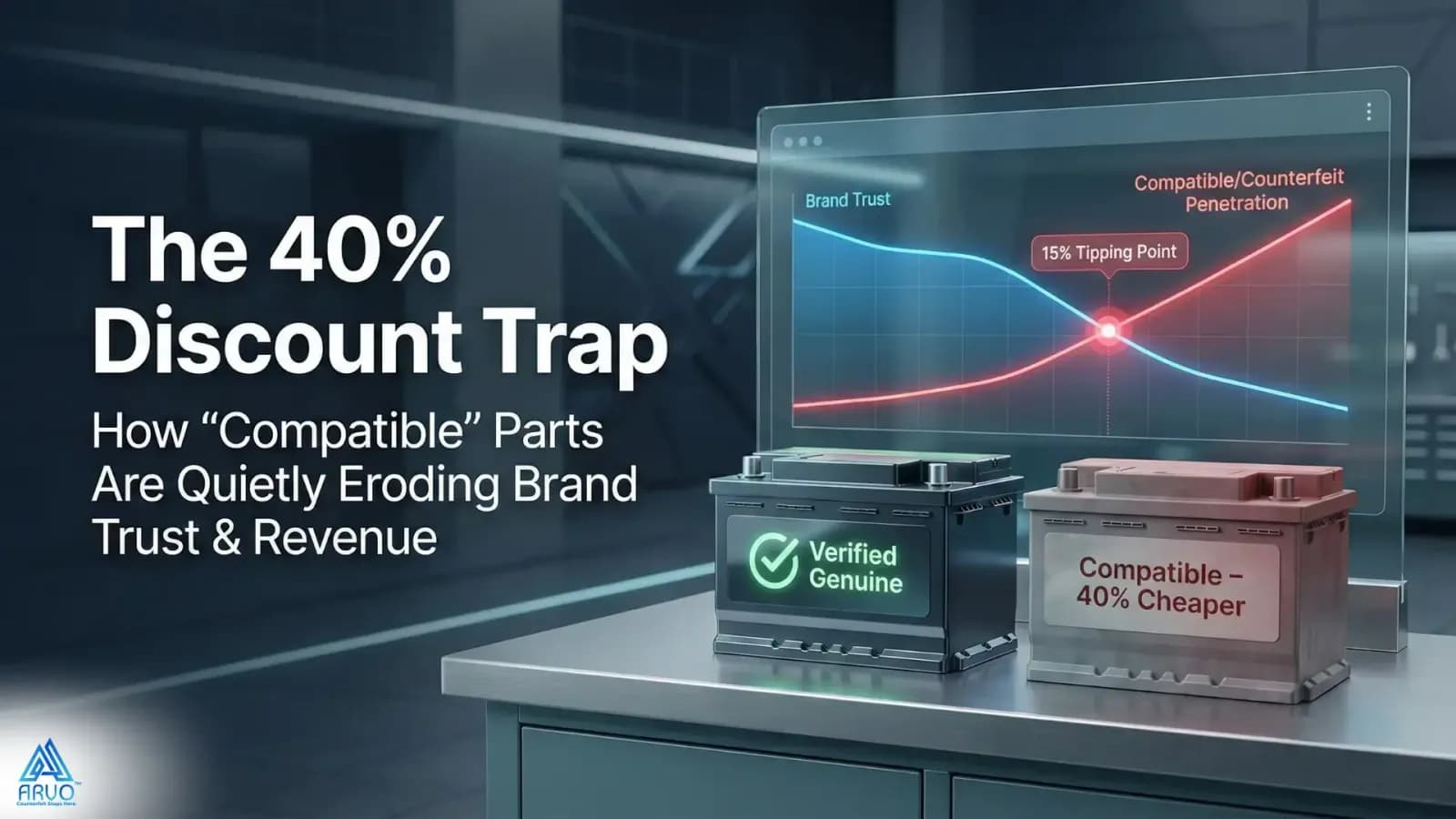
A 40% cheaper “compatible” part rarely stays a pricing issue for long. It becomes a trust issue, a channel issue, and eventually a compatible parts & brand equity issue. Many manufacturers across the automotive and industrial aftermarket pricing strategy believe they are competing against other brands. In reality, they are often competing against lookalike or compatible parts that quietly sit inside their own distribution ecosystem.
On paper, everything looks normal. Demand appears stable, distributors continue placing orders, and marketing campaigns generate awareness. Yet revenue growth begins to slow. Leadership teams attribute this to market competition or pricing pressure. What they don’t see is that a portion of their genuine demand is being redirected toward compatible alternatives. This is the core of what we call the 40% Discount Trap, when a lower-priced alternative starts reshaping customer behaviour and weakening brand trust without triggering immediate alarms.
Compatible parts are not always direct counterfeits. They often match form and function closely enough that customers struggle to distinguish them from genuine vs compatible parts. For mechanics and retailers, the decision is driven by margin and availability. For customers, the decision is driven by price. Over time, this combination starts to shift demand away from genuine channels. The brand still generates awareness, but it no longer captures the full value of that demand.
What makes compatible parts especially risky for brands:
- They often look and perform similarly to genuine products
- They are sold through familiar retail channels
- They are typically priced 30-40% lower
- Customers assume they are acceptable alternatives
The danger is not immediate. It builds gradually. At first, compatible parts occupy a small portion of the market. Genuine products still dominate. Brands assume the situation is manageable. But market data across multiple sectors shows that once compatible or counterfeit penetration crosses roughly 15%, brand trust begins to decline more sharply. Customers start to believe that all options are interchangeable. Price becomes the primary deciding factor. That is when the real damage begins.
From a distance, the business still looks healthy. Sales reports show movement. Distributors remain active. But when leadership teams examine revenue growth closely, they notice a mismatch between demand and actual sales. This is because a portion of the demand generated by marketing and brand reputation is being captured by compatible parts instead of genuine ones. The brand is essentially creating demand that others are monetising.
This shift affects more than just revenue. It impacts how the market perceives the brand. As compatible parts gain traction, customers begin to question why genuine products cost more. Workshops may recommend cheaper alternatives. Authorised dealers lose confidence when genuine stock moves more slowly than expected. Over time, pricing power weakens, and brand positioning becomes harder to maintain.
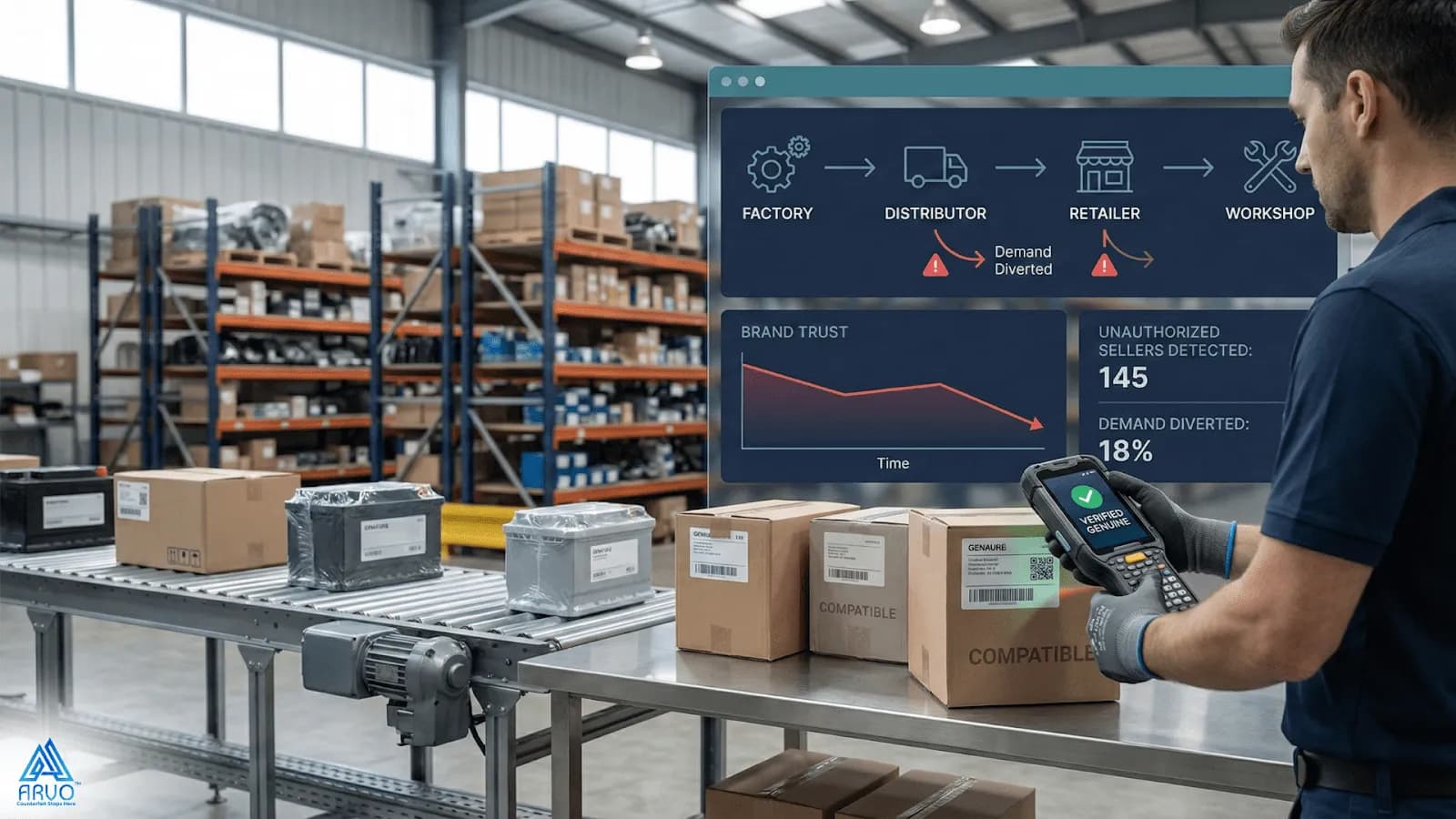
The hidden costs that follow this shift:
- Marketing spend starts driving demand to non-genuine channels
- Dealer confidence drops as cheaper parts move faster
- Genuine price perception weakens
- Warranty and quality complaints increase
- Brand trust becomes harder to rebuild
Many manufacturers underestimate how much of their demand is being diverted because traditional tracking systems were not designed for today’s fragmented aftermarket pricing strategy. Most brands track shipments to distributors and sales to dealers. Very few track individual units once they enter the market. Without item-level visibility, it becomes nearly impossible to measure how many customers intended to buy genuine products but ended up purchasing compatible alternatives instead.
This lack of visibility creates a blind spot. Leadership teams see strong market activity but cannot identify where genuine demand is being lost. By the time revenue stagnation becomes visible in financial reports, compatible parts have already established a foothold. Recovering that lost ground becomes expensive and time-consuming.
The relationship between compatible penetration and brand trust can be visualised as a curve. At low levels of penetration, genuine products maintain authority. As penetration approaches 15%, trust begins to decline. Once it crosses 20–25%, customers start treating all parts as interchangeable. Beyond that point, price wars often emerge, and rebuilding brand equity requires significant investment.
Signs that a brand may already be in the 40% Discount Trap
- Strong demand but flat revenue growth
- Rising marketing spend with lower conversion
- Dealer complaints about price competition
- Increasing presence of lookalike products
- Difficulty maintaining premium positioning
Leading manufacturers are beginning to approach this issue differently. Instead of treating compatible parts purely as a legal or enforcement problem, they are treating it as a visibility and intelligence problem. They recognise that without accurate data on where products are moving and how they are being replaced, it is impossible to protect brand equity effectively.
Modern strategies focus on giving each product a digital identity that can be tracked across the supply chain. When products can be authenticated and traced at the unit level, brands gain a clearer picture of where genuine demand is being diverted. They can identify unauthorised sellers, detect unusual market patterns, and understand which regions are most affected by compatible penetration.
This shift from reactive enforcement to proactive visibility changes the conversation. Instead of guessing where revenue is leaking, brands can measure it. Instead of broad market crackdowns, they can target specific problem areas. Instead of competing only on price, they can reinforce trust and authenticity.
What improved visibility allows brands to do:
- Track genuine products through the supply chain
- Identify diversion points in real time
- Detect unauthorized sellers early
- Recover demand from grey channels
- Strengthen dealer relationships
The importance of this shift is reflected in search behaviour across the industry. Queries related to counterfeit detection, brand protection, supply chain traceability, and aftermarket revenue leakage are rising. Manufacturers are realising that the cost of compatible parts is not limited to lost sales. It extends to brand equity, pricing power, and long-term market positioning.
Brands that address the issue early can stabilise trust and maintain premium positioning. Those who wait until compatible penetration becomes widespread often face a much steeper recovery path. Once customers become accustomed to cheaper alternatives, it takes sustained effort to rebuild confidence in genuine products.
This is where technology-driven visibility plays a critical role. When brands can see exactly where their products are moving and how they are being substituted, they gain the ability to respond strategically rather than reactively. They can support dealers, guide customers toward genuine channels, and protect the value they have built over the years.
ARVO works with manufacturers to help them escape the 40% Discount Trap by bringing clarity to product movement and market behaviour. Instead of relying on periodic audits and assumptions, brands gain real-time insights into how their products are performing in the field and where compatible parts are impacting demand.
How ARVO supports brand protection and visibility:
- Enables item-level serialisation and authentication
- Tracks product movement across channels
- Identifies unauthorised sellers and hotspots
- Provides real-time market intelligence
- Helps recover diverted genuine demand
When brands can see what is happening in the market at the unit level, they can protect revenue, strengthen channel confidence, and maintain brand trust. The goal is not just to stop counterfeits or compatible parts, but to ensure that genuine demand consistently returns to genuine channels.
If your brand is experiencing strong demand but slower-than-expected revenue growth, it may not be a pricing issue alone. It may be a visibility issue. Understanding where your demand is going is the first step toward protecting it.
Contact ARVO to learn how you can protect your brand equity and recover lost demand: Contact us
Questions answered in this article
- What are compatible parts?
- Compatible parts are non-genuine components designed to match original specifications. They are usually sold at lower prices and positioned as alternatives to genuine products.
- Why do compatible parts affect brand trust?
- As compatible parts gain market share, customers begin to see all options as interchangeable. That weakens the perceived value of genuine products and reduces brand loyalty.
- What is the 15% penetration tipping point?
- Market observations suggest that once compatible or counterfeit parts pass roughly 15% penetration, brand trust and genuine demand begin to decline more rapidly. Past that point, price increasingly decides the purchase.
- How can brands detect revenue leakage from compatible parts?
- With item-level tracking, authentication and supply chain visibility tools. They reveal where genuine demand is being diverted, which sellers are unauthorised and which regions are most affected.
- How does ARVO help brands facing compatible parts?
- ARVO provides item-level serialisation, authentication and market intelligence. Brands can track products across channels, identify unauthorised sellers and hotspots, and recover demand lost to compatible or counterfeit channels.