Grey Market Cosmetics India: How Distributor Diversion Costs Beauty Brands
Grey market cosmetics in India are genuine products sold through unauthorised channels. Where diversion happens, five warning signs and how to detect it.
By Abhijeet Kumar, ARVOPublished Updated 12 min read
In short
Grey market diversion is when a beauty brand's genuine products, sold to authorised distributors, are resold through channels and at prices the brand never approved. The leaks open at the regional distributor, sub-distributor and wholesaler tiers. Unit-level codes assigned to each distributor, with every scan's location recorded, show where stock actually ends up.
- Grey market products are genuine: what is unauthorised is the channel, the territory or the price they are sold at.
- Diversion takes three forms in Indian beauty distribution: geographic, channel and volume-based.
- In general trade, diversion risk grows from the regional distributor down to the wholesaler, where the manufacturer's visibility is effectively zero.
- FICCI CASCADE valued illicit trade in FMCG personal and household care goods at ₹73,813 Crore in 2022-23.
- When a code assigned to one distributor's territory is scanned somewhere else, the scan location flags the diversion and points to the distributor.
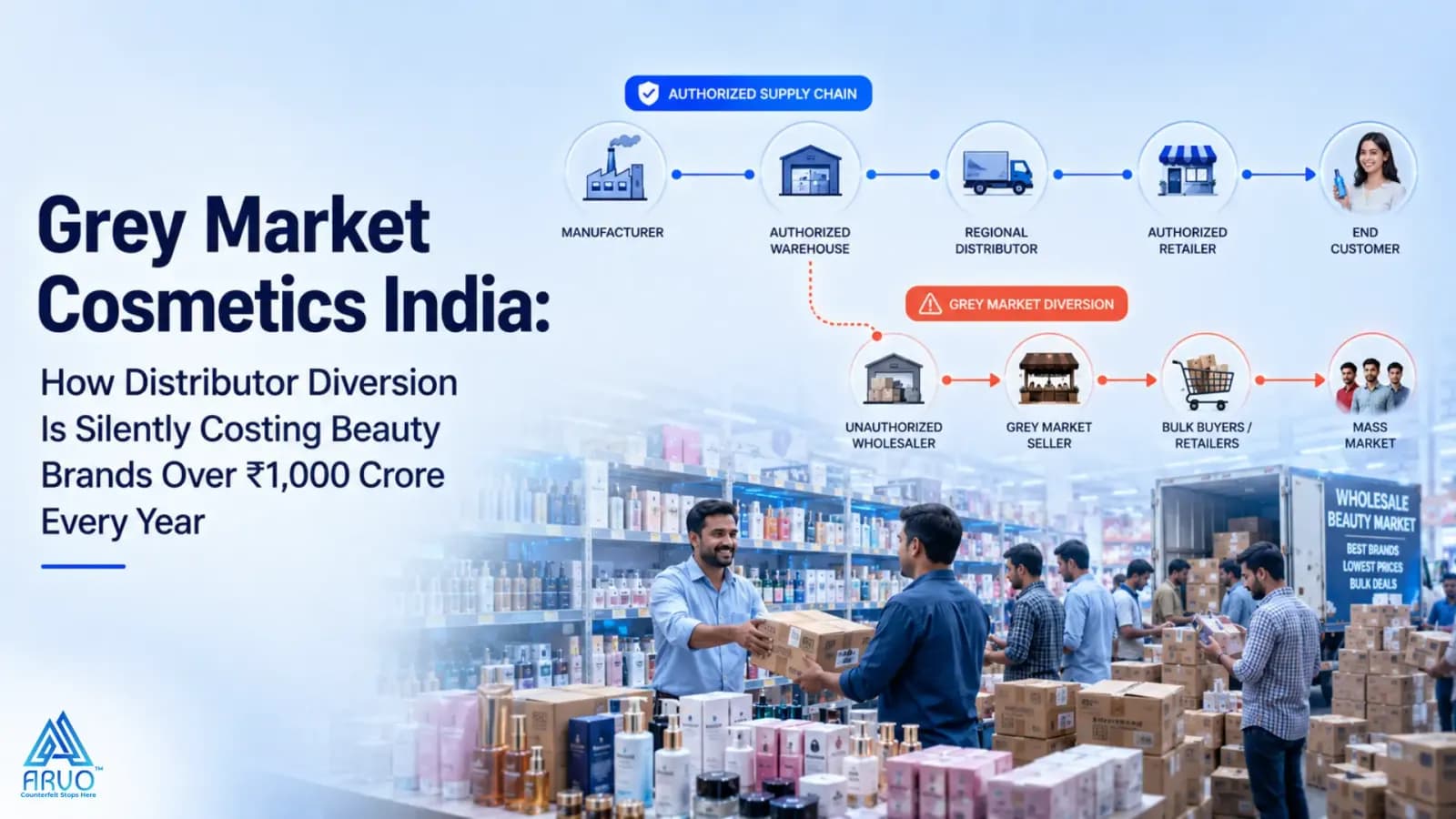
There is a category of revenue loss in the Indian beauty industry that most manufacturers do not track, do not measure, and often do not even recognise until the damage has compounded over years. It is not counterfeiting in the traditional sense. The products are genuine. They carry authentic packaging, genuine formulations, and legitimate batch codes. But they are being sold through channels the manufacturer never authorised, at prices the manufacturer never approved, in markets the manufacturer never intended.
This is the grey market cosmetics India problem. And it is costing Indian beauty manufacturers over ₹1,000 Crore every year in revenue erosion, pricing structure damage, and brand equity dilution. Unlike counterfeiting, which involves fake products, grey market diversion involves your own genuine products being sold against your interests by your own distribution partners.
According to the FICCI CASCADE report “Consuming The Illicit: How Changing Factors of Consumption Affect Illegal Markets in 5 Key Industries,” launched at MASCRADE 2024, the total illicit market across five key Indian industries was valued at ₹7,97,726 Crore in 2022-23. FMCG Personal and Household Care goods alone accounted for ₹73,813 Crore in illicit trade. The Nexdigm India Beauty and Personal Care Products Market Report (April 2026) explicitly identifies that “counterfeit and grey-market products affect consumer trust and brand pricing power” as one of the primary challenges in the Indian beauty market.
This blog is the first comprehensive analysis of how grey market diversion operates in India’s beauty distribution system, why it is more damaging than most leadership teams realise, and how product-level authentication technology provides the first practical detection mechanism.
What Grey Market Diversion Actually Means for Beauty Brands
Grey market diversion occurs when genuine products, manufactured by the brand and sold to authorised distributors, are resold through channels the brand never authorised and at prices the brand never approved. The products are real. The packaging is real. The formulations are real. But the distribution is unauthorised, and the consequences are severe.
Source: Definition framework based on GreyScout Global Grey Market Analysis and FICCI CASCADE illicit trade classification
In the Indian beauty industry, grey market diversion typically takes one of three forms.
Geographic diversion. An authorised distributor in Maharashtra receives stock intended for their assigned territory. Instead of selling within their territory, they divert a portion of the inventory to an unauthorised buyer in Gujarat, Rajasthan, or any market where the product commands a different price or where the brand has not yet established direct distribution. The manufacturer’s products appear in markets they never planned to enter, sold by sellers they have no relationship with, at prices they cannot control.
Channel diversion. Products intended for exclusive distribution through premium retail outlets or authorised e-commerce channels are diverted to discount marketplaces, unauthorised online seller accounts, or wholesale platforms. The brand’s premium pricing structure is undermined by its own products appearing at discounted prices through channels that communicate a different brand positioning.
Volume-based diversion. A distributor orders quantities that significantly exceed the consumption capacity of their assigned territory. The excess inventory is sold to unauthorised buyers, often across state lines, at prices negotiated independently of the manufacturer’s pricing guidelines. The manufacturer sees strong order numbers from the distributor but cannot explain why retail sell-through in that territory does not match.
Source: Diversion typology based on FICCI CASCADE illicit trade framework and Nexdigm India BPC Market Report, April 2026
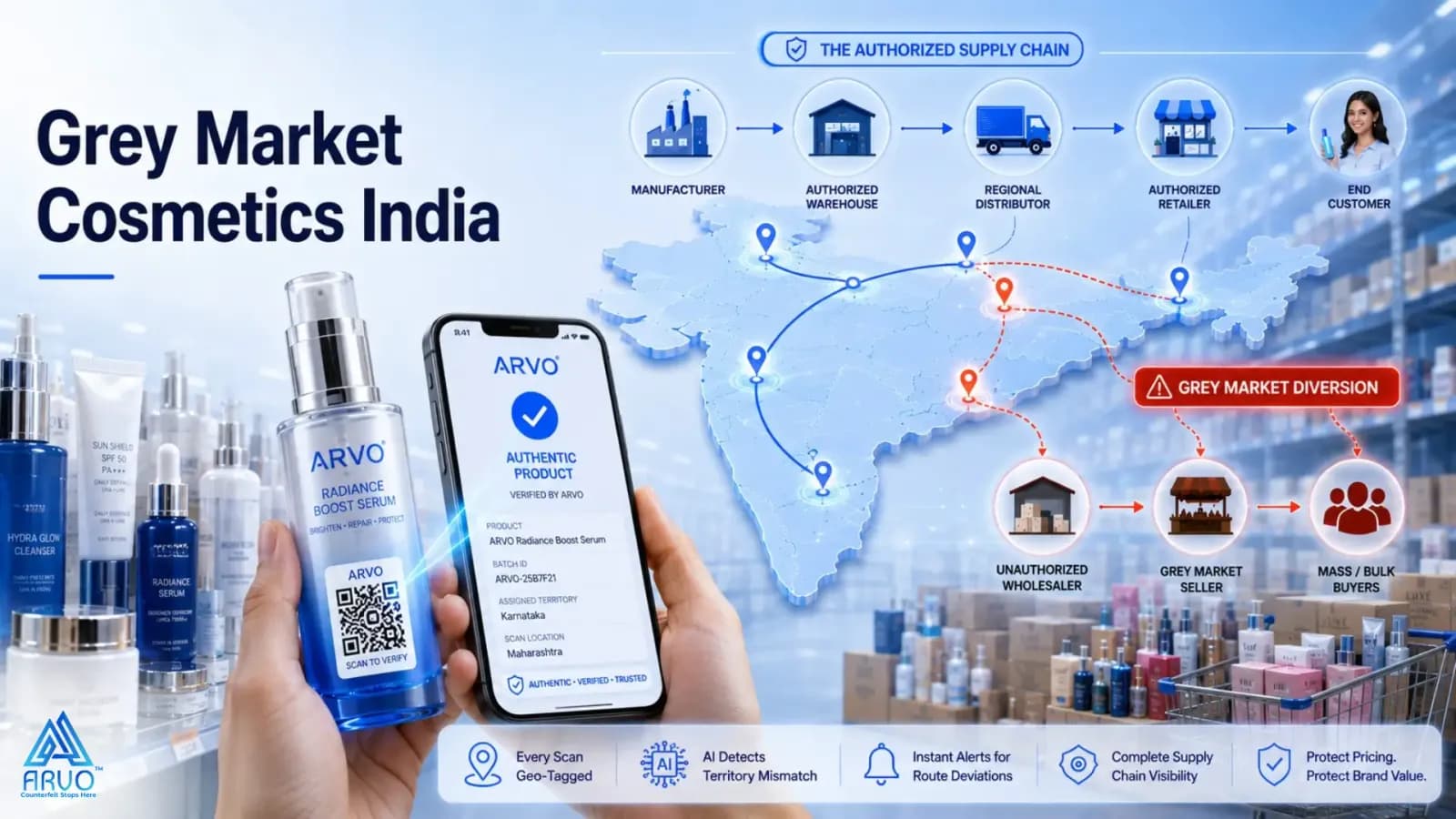
The 5-Tier Distribution Chain: Where Grey Market Leakage Occurs
To understand where grey market cosmetics India leakage occurs, it is necessary to map the distribution infrastructure that beauty products travel through between the manufacturing floor and the consumer’s hands.
According to Grand View Research’s India Cosmetics Market Report (2026), general trade accounts for 33% of all cosmetics distribution in India, making it the largest single channel. This general trade infrastructure operates through a multi-tier system that creates multiple points of potential diversion.
Source: Grand View Research, India Cosmetics Market Size & Share, Industry Report 2026-2033
Tier 1: Carrying and Forwarding (C&F) Agent
The manufacturer ships bulk inventory to C&F agents who manage regional warehousing and logistics. At this level, diversion risk is relatively low because C&F agents typically operate under direct manufacturer contracts with auditable inventory systems.
Tier 2: Regional Distributor
The C&F agent supplies authorised regional distributors. This is where the first significant diversion risk emerges. A regional distributor may sell a portion of their inventory to an unauthorised sub-distributor in another region, particularly when the product has high demand and limited supply. The manufacturer sees that the regional distributor is ordering consistently but has no visibility into whether 100% of those orders are reaching the intended retail endpoints.
Tier 3: Sub-Distributor
Regional distributors often supply sub-distributors who serve smaller geographic areas. At this tier, manufacturer visibility drops significantly. Sub-distributors may have informal arrangements with unauthorised retailers or other sub-distributors in neighbouring territories. Products begin moving laterally through the distribution network rather than vertically toward the intended retail endpoints.
Tier 4: Wholesaler
Wholesalers aggregate products from multiple sources and supply kirana stores, small beauty shops, and informal retail. At this tier, the manufacturer’s visibility is effectively zero. Products that were originally intended for a specific territory may have changed hands two or three times. The wholesaler’s source could be an authorised sub-distributor, an unauthorised reseller, or another wholesaler who acquired diverted stock.
Tier 5: Retailer
India has approximately 13 million kirana stores, accounting for over 90% of FMCG sales. The retailer purchases from whichever wholesaler offers the best margin. They have no mechanism to verify whether the products they stock arrived through the manufacturer’s authorised distribution chain or through grey market channels. And in most cases, they have no incentive to check.
Source: Retailer and kirana data: ASPA/CRISIL State of Counterfeiting in India 2025; FICCI CASCADE illicit trade research
Why Grey Market Diversion Is More Damaging Than Counterfeiting for Premium Beauty Brands
Counterfeiting creates fake products that damage the brand through poor quality and consumer health risks. Grey market diversion creates a different category of damage that is, in many ways, more insidious for premium and semi-luxury beauty brands.
Pricing structure destruction. When genuine products appear at discounted prices through unauthorised channels, the manufacturer’s entire pricing architecture collapses. Consumers who see the same product at 20% to 30% lower prices through an unauthorised seller conclude that the brand’s official retail price is inflated. Authorised retailers who are required to maintain MRP pricing lose sales to discounted grey market listings. The brand’s perceived value erodes across all channels simultaneously.
Authorised retailer attrition. Retail partners invest in shelf space, staff training, and brand presentation based on the expectation that they operate within a controlled distribution ecosystem. When they discover that the same products are available at lower prices through unauthorised sellers, they either demand better margins, reduce their brand commitment, or drop the brand entirely. The manufacturer loses its most valuable retail relationships.
Product integrity risk. Grey market products may be stored improperly, transported without temperature controls, or kept beyond their intended shelf life. The manufacturer has no oversight of storage conditions in unauthorised channels. A beauty product that arrives at the consumer through grey market distribution may have degraded in quality even though it was manufactured to genuine specifications. The consumer blames the brand.
Data and intelligence blindness. FICCI CASCADE reports that FMCG companies lose 21.7% of their market share to illicit trade. Without product serialization in India’s FMCG infrastructure, manufacturers have no way to distinguish between products sold through authorised channels and products sold through grey market channels. The 21.7% figure includes both counterfeiting and grey market diversion, and most manufacturers cannot separate the two because they lack the tracking infrastructure to do so.
Source: FICCI CASCADE / TARI, MASCRADE 2024, September 2024; Market share loss data from FICCI CASCADE “Invisible Enemy” report
5 Warning Signs That Your Distribution Network Has a Grey Market Leak
For beauty manufacturers who suspect but cannot confirm grey market activity, the following five indicators provide a diagnostic framework.
1. Geographic anomalies in consumer verification data. If your products carry any form of authentication or verification mechanism, analyse where consumers are scanning or verifying. Products being verified in cities or states where you have no authorised distribution is the strongest indicator of grey market diversion.
2. Distributor order volumes that exceed territory consumption. If a distributor in a mid-sized city is ordering volumes appropriate for a metropolitan market, the excess inventory is going somewhere. Cross-reference distributor orders against retail sell-through data for their assigned territory.
3. Your products appearing on unauthorised marketplace listings. If your products are listed by sellers on e-commerce platforms who are not your authorised partners, those products likely originated from a grey market source within your own distribution network.
4. Authorised retailers reporting competitor pricing from unauthorised sellers. When your authorised retail partners tell you that a competitor or unauthorised seller is offering your products at discounted prices, the source is almost certainly grey market diversion.
5. Consumer complaints from markets where you have not yet launched. If consumers in a city where your brand has not established formal distribution are contacting your customer service team, your products are reaching them through grey market channels.
How ARVO Detects Grey Market Diversion Through Geographic Scan Intelligence
ARVO’s anti-counterfeiting solution in India’s beauty ecosystem provides the first practical mechanism for Indian beauty manufacturers to detect, quantify, and act on grey market diversion in real time. The system works because it creates visibility at the individual unit level, which is precisely the layer where grey market activity becomes detectable.
Copy-Proof Nova Codes: Serialisation That Creates a Digital Chain of Custody
Every product unit receives a copy-proof Nova code. Each code is mathematically unique and carries a unit-level identity that cannot be duplicated. When assigned to a specific distributor’s serialisation range, every product that enters the distribution chain carries a digital identity linked to its intended distribution pathway. Authentication accuracy is 99%. No app download required for consumer verification.
Geographic Scan Intelligence: Seeing Where Your Products Actually End Up
Every time a Nova code is scanned by a consumer, retailer, or field team, the system captures the precise geographic location, timestamp, and verification result. This data flows in real time to the AIC (ARVO Integrated Cloud) dashboard. When a product assigned to a distributor in Hyderabad is scanned by a consumer in Kolkata, the system flags the geographic anomaly instantly. The manufacturer receives an alert. The diversion event is logged. The distributor is identified. For the first time, the supply chain visibility beauty brands have needed for years becomes operationally available.
Consumer Engagement and Loyalty After Verification
After a product is verified as authentic, the consumer can ask Arvie, the product's advisor, built on the manufacturer’s product knowledge. The consumer receives personalised guidance, ingredient transparency, and usage recommendations. Arvie also supports loyalty programme integration, creating ongoing engagement that builds retention. All interaction data flows into the AIC dashboard, enriching the geographic intelligence with consumer behaviour insights.
The AIC Dashboard: Grey Market Detection Command Centre
The AIC dashboard provides centralised intelligence across every dimension of brand protection. Geographic scan heatmaps reveal where products are being verified across Indian cities. Counterfeit alerts flag verification failures. Grey market detection analytics compare distribution records against actual scan geography, identifying which distributors are diverting stock, to which unauthorised markets, and at what volumes. Consumer engagement metrics and loyalty data provide additional context. Every scan generates a data point. Every data point is actionable intelligence.
The complete system rolls out in about 15 days. No production downtime. No packaging redesign.
Detect Grey Market Diversion Before It Destroys Your Pricing. Partner with ARVO.
Grey market diversion is the silent revenue drain that most Indian beauty brands cannot see, cannot measure, and cannot stop. Until now. ARVO’s geographic scan intelligence, powered by copy-proof Nova codes and the AIC dashboard, gives manufacturers the first real-time visibility into where their products actually end up versus where they were shipped.
Rolled out in about 15 days. 99% authentication accuracy. Grey market detection from the first consumer scan. No app required.
Detect diversion. Protect your pricing. Schedule a consultation
Questions answered in this article
- What is the difference between grey market diversion and counterfeiting?
- Counterfeiting is making and selling fake products that imitate a brand. Grey market diversion is reselling the brand's own genuine products through channels and at prices the manufacturer never authorised. The products are real, but the distribution undermines pricing, retail relationships and positioning. FICCI CASCADE classifies both as illicit trade.
- How big is the grey market problem for Indian beauty brands?
- FICCI CASCADE valued the illicit market across five key Indian industries at ₹7,97,726 Crore in 2022-23, with FMCG personal and household care at ₹73,813 Crore. It estimates FMCG companies lose 21.7% of their market share to illicit trade, counterfeiting and diversion together. The Nexdigm India BPC Market Report (April 2026) names grey-market products as a primary challenge to consumer trust and pricing power.
- Can ARVO tell grey market diversion apart from counterfeiting?
- Yes. If a NOVA code verifies as genuine but is scanned outside its assigned distribution territory, it is logged as a diversion event. If the scan fails verification because the code is unknown or duplicated, it is logged as possible counterfeiting. The AIC dashboard keeps the two apart, so each gets the right response: distributor action for diversion, enforcement for counterfeiting.
- How quickly can grey market diversion be detected?
- Detection starts with the first consumer scan, because every scan records its location in real time. A product assigned to one territory but scanned in another is flagged at once. How fast useful data builds up depends on how many consumers scan.
- What can a manufacturer do once diversion is detected?
- Scan data tied to serialisation ranges identifies the distributor, the volume and the markets involved. The manufacturer can confront that distributor with documented evidence, add anti-diversion terms to distribution agreements and, if needed, end the relationship with defensible records.
Sources
- MASCRADE 2024, FICCI CASCADE
- India Cosmetics Market Report, Grand View Research