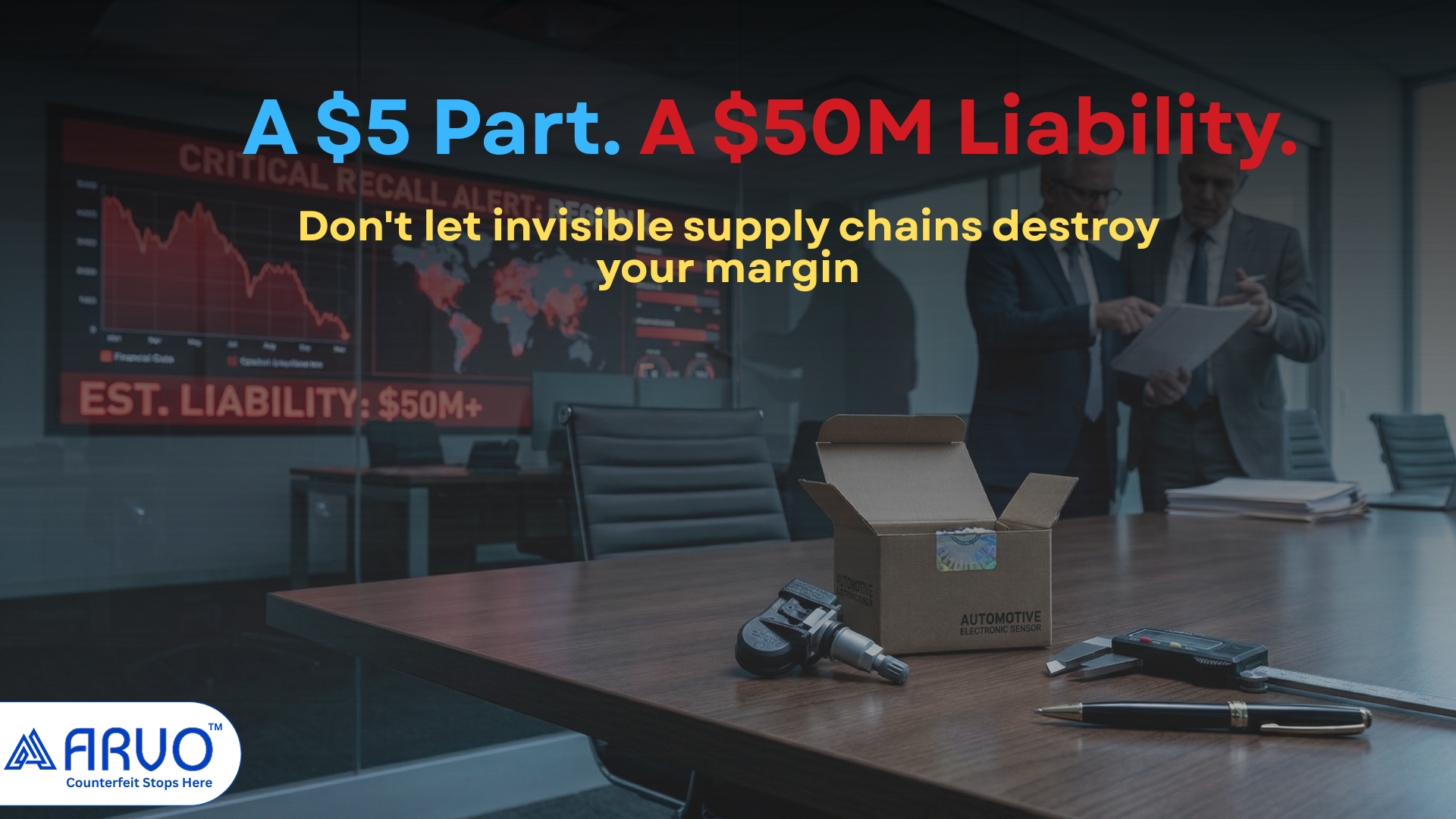
For automotive OEMs, the aftermarket is no longer just a revenue extension; it is a risk surface. Aftermarket Counterfeit Parts and unverified spare parts are quietly entering authorized channels, triggering warranty claims, expanding recall scope, and exposing brands to safety and liability risks. What makes this problem dangerous is not just the presence of fake parts, but the blind spots that prevent OEMs from detecting them early.
In many cases, one fake part is enough to trigger losses that run into crores.
This is not a theoretical issue. It is a measurable P&L problem.
How Counterfeit Parts Enter Authorized Channels
Most OEM leaders assume counterfeit spare parts are a grey-market issue. In reality, many enter through authorized-looking routes:
- Parallel sourcing by distributors under margin pressure
- Unauthorized substitutions at the dealer or workshop level
- Returned parts re-entering circulation without verification
- Lack of verification during secondary and tertiary distribution
Once a counterfeit part enters the authorized ecosystem, it becomes indistinguishable from genuine inventory unless part-level verification exists.
The aftermarket’s multi-tier nature, including manufacturers, distributors, dealers, and workshops, creates multiple handoffs. Each handoff without verification becomes a new entry point for risk.
Why Warranty, Recall, and Liability Exposure Escalates
The financial damage from counterfeit spare parts does not come from the part itself. It comes from what follows.
1. Warranty Costs Multiply
When a fake part fails:
- OEMs absorb warranty claims
- Failure analysis consumes engineering resources
- Root-cause investigations stall due to a lack of traceability
Since the part cannot be verified, claims are often honored by default, driving up warranty expenses.
2. Recall Scope Expands Unnecessarily
Without part-level visibility:
- OEMs cannot isolate affected batches
- Recalls expand “just to be safe.”
- Costs increase exponentially
Industry data consistently shows that recall costs increase 3–5× when traceability is incomplete.
3. Liability Always Falls on the Brand
Regardless of where the counterfeit originated:
- Regulators hold the OEM accountable
- Customer trust erodes
- Legal exposure escalates
In the eyes of the customer, a failure is a brand failure.
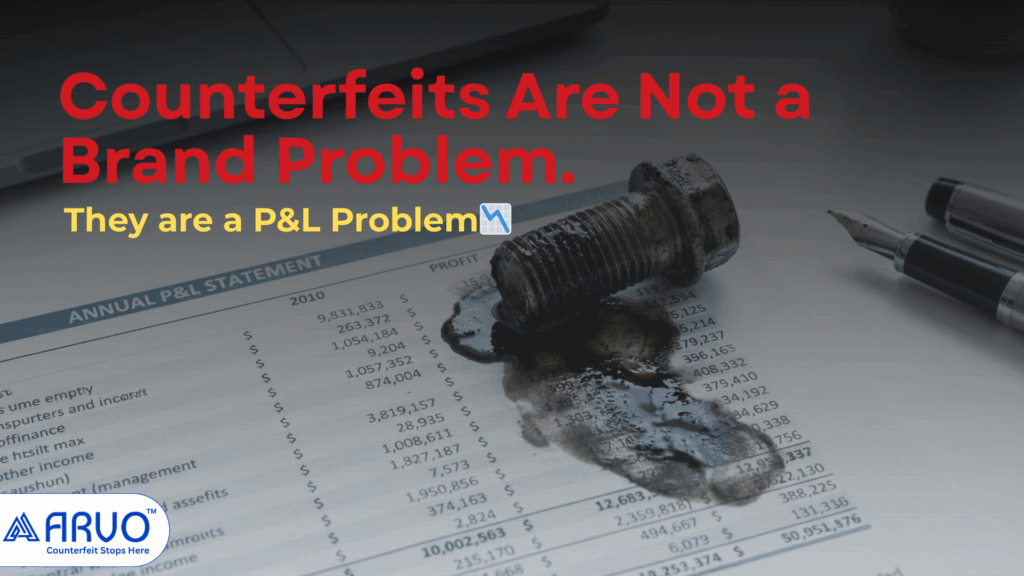
The Hidden Losses Most Reports Never Show
One of the biggest challenges with aftermarket counterfeit parts is that most losses never appear clearly in reports.
They are spread across:
- Warranty accruals
- Dealer adjustments
- Logistics write-offs
- Recall buffers
- Legal reserves
These costs are rarely labeled as “counterfeit-related.” Instead, they appear as operational inefficiencies or unavoidable overheads.
The result: leadership underestimates the true financial impact.
In many OEM environments, once these hidden costs are consolidated, the exposure often crosses ₹2–5 crore annually, sometimes more for high-volume or safety-critical components.
Why Traditional Controls Are No Longer Enough
Most OEMs rely on:
- Packaging-level authentication
- Distributor contracts
- ERP transaction records
These controls do not verify the physical part.
ERP systems confirm transactions, not authenticity.
Serialized packaging does not protect parts once removed.
Audits detect issues after damage is done.
What’s missing is part-level verification that travels with the product, from factory to workshop.
How OEMs Can Quantify Aftermarket Risk
The first step toward control is measurement.
OEMs can begin by asking:
- How many warranty claims cannot be traced to a verified part?
- How much of the recall cost comes from the overextended scope?
- Where are the verification gaps across dealer and workshop networks?
By mapping these gaps, many organizations uncover systemic leakage, not isolated incidents.
This is why leading OEMs are moving away from full-scale deployments upfront and instead adopting pilot-based validation.
Why a Pilot Is the Safest Way to Start
A focused pilot allows OEMs to:
- Establish part-level verification on one production line
- Track parts through selected aftermarket channels
- Measure recall containment speed
- Quantify warranty and leakage reduction
Most importantly, it enables teams to prove ROI before scaling.
Within 90 days, OEMs can replace assumptions with data and blind spots with visibility.
How ARVO Helps OEMs Regain Aftermarket Control
ARVO helps automotive OEMs eliminate aftermarket blind spots by enabling part-level traceability and verification, not just packaging or transaction tracking.
With ARVO, OEMs can:
- Track parts from production through distribution and installation
- Verify authenticity at dealer and workshop touchpoints
- Identify counterfeit exposure early
- Contain recalls to only the affected parts
Reduce warranty and liability risk
ARVO’s approach is designed to integrate with existing operations and ERP systems, allowing OEMs to start small, validate impact, and scale with confidence.
Start with a 90-Day Pilot
A single-line, low-risk pilot helps you:
- Identify hidden aftermarket exposure
- Validate recall and warranty risk reduction
- Build a data-backed business case for scale
👉 Book a 90-Day Pilot Discussion with ARVO
Because in today’s aftermarket, what you can’t see is what costs you the most.
FAQs
1. How do counterfeit spare parts enter authorized aftermarket channels?
Counterfeit parts usually enter through indirect routes such as parallel sourcing by distributors, unauthorized substitutions at the dealer or workshop level, and unverified returns re-entering circulation. Without part-level verification at each handoff, these parts become indistinguishable from genuine inventory once they enter the system.
2. Why do aftermarket counterfeit parts lead to such high warranty and recall costs?
When a counterfeit part fails, OEMs often cannot verify its authenticity. As a result, warranty claims are honored by default, and recalls expand beyond the actual affected parts to avoid safety risk. This lack of visibility significantly increases warranty payouts, recall scope, and operational costs.
3. Why don’t these losses clearly appear in financial reports?
Most counterfeit-related losses are spread across warranty accruals, logistics write-offs, recall buffers, dealer adjustments, and legal reserves. Since they are not tagged as “counterfeit costs,” the true financial impact remains hidden, often amounting to several crores annually.
4. Isn’t ERP or serialization enough to control aftermarket risk?
ERP systems track transactions, not physical part authenticity. Traditional serialization and QR codes can be copied once parts leave the original packaging. Without part-level verification that travels with the component, OEMs remain exposed to counterfeit infiltration beyond the factory.
5. How can OEMs start reducing aftermarket counterfeit risk without disrupting operations?
The most effective approach is to begin with a focused pilot on a single production line. A 90-day pilot enables OEMs to establish part-level verification, measure recall and warranty impact, and quantify ROI, without committing to a full-scale rollout upfront.