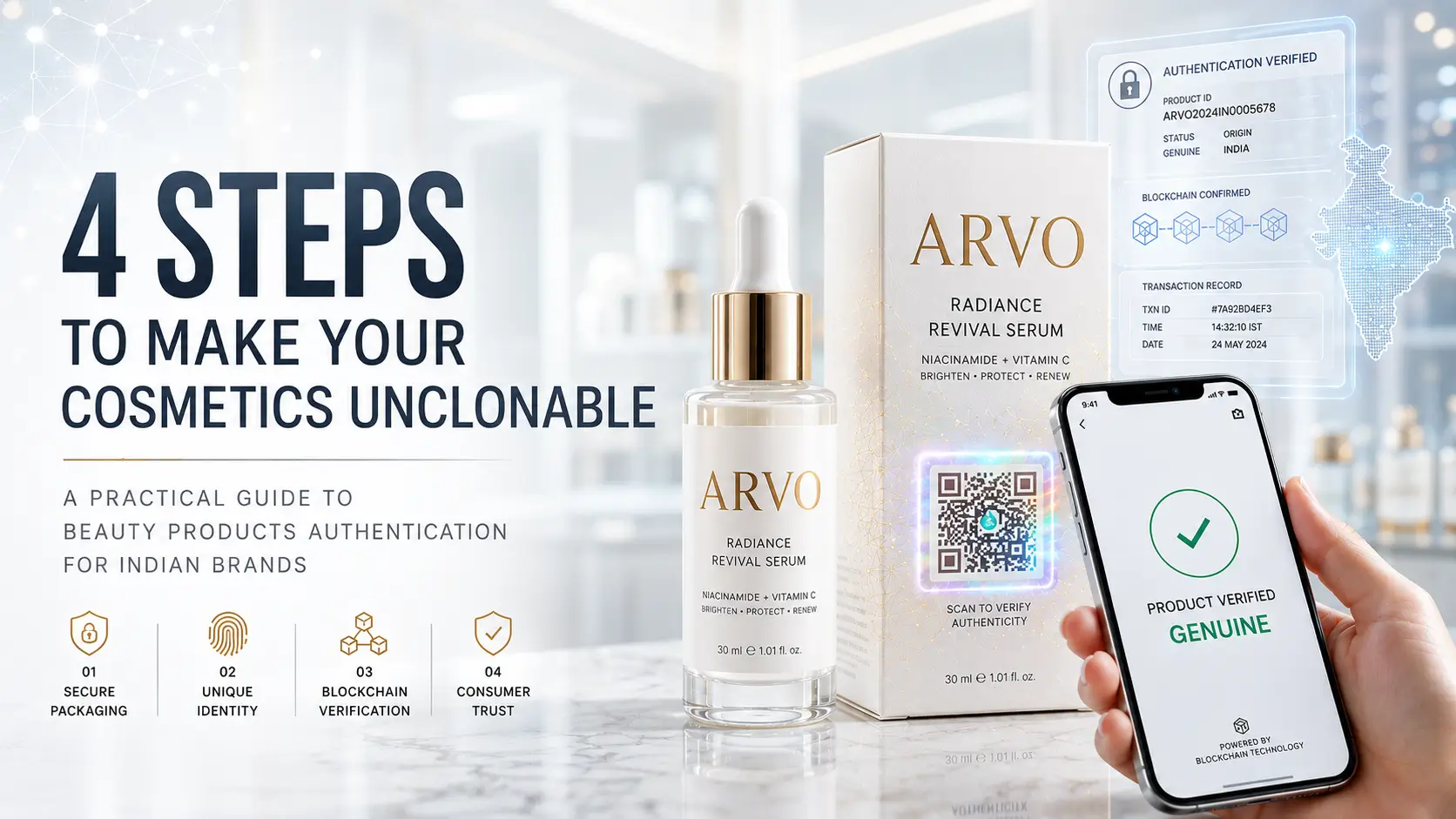
The Indian beauty and personal care industry is losing over ₹8,000 Crore annually across three channels: ₹4,200 Crore through offline retail counterfeits circulating via kirana stores and Tier 2 distributors, ₹2,800 Crore through fake products sold on online marketplaces, and over ₹1,000 Crore through grey market diversion where genuine products are sold at discounted prices, bypassing the manufacturer’s margins entirely. These are not projected losses. These are the numbers being reported by enforcement agencies and industry bodies right now.
For most Indian beauty manufacturers, the assumption has been that implementing beauty products authentication requires weeks of planning, significant capital expenditure, and disruptive changes to existing production lines. That assumption is no longer accurate. The technology has advanced to a point where a manufacturer can go from completely unprotected to fully authenticated, with AI-powered smart QR codes, tamper-evident packaging, Supply chain traceability, and a consumer verification portal, in just 7 days. Not 7 weeks. Not 7 months. Seven days.
The per-unit cost is measured in paise. The authentication accuracy is 99.97%. No app download is required for consumer verification. And the deployment is 2x faster than the industry standard.
This guide presents a practical, four-step framework mapped to a 7-day deployment timeline that any Indian beauty manufacturer can execute without halting production, without redesigning packaging, and without procuring new capital equipment. It is written for brand owners, CEOs, COOs, and operations leaders who need to move from decision to deployment in the shortest timeline possible.
Table of Contents
The ₹8,000 Crore Problem: Where Indian Beauty Brands Are Bleeding Revenue
Indian beauty manufacturers are haemorrhaging revenue through three distinct channels simultaneously, and most leadership teams do not have full visibility into the combined scale of the damage.
The first and largest channel is offline retail counterfeiting. An estimated ₹4,200 Crore is lost annually through counterfeit beauty products distributed via kirana stores, unregistered retailers, and Tier 2 distributors. These counterfeits are manufactured in unregistered facilities using industrial-grade raw materials. In July 2025, the Directorate of Revenue Intelligence (DRI) in Mumbai seized counterfeit cosmetics worth ₹6.5 Crore in a single operation. The Maharashtra FDA seized ₹2.5 Crore in fake products from one building in South Mumbai, where laboratory analysis revealed mercury in skin creams and lead compounds in colour cosmetics. In Delhi, a factory producing fakes for national distribution was dismantled. In Bhiwandi, another unit was shut down with ₹3.47 Lakh seized in April 2025.
The second channel is online marketplace counterfeiting. An estimated ₹2,800 Crore is lost annually through fake beauty products sold on e-commerce platforms. In Thane, the Maharashtra FDA raided a warehouse linked to e-commerce fulfilment and seized cosmetics worth ₹88 Lakh. The DCGI conducted nationwide raids across 30 locations and seized ₹4 Crore in non-compliant products. A 2022 survey found that 37% of Indian consumers aged 15 to 24 purchased counterfeit products through social media recommendations.
The third channel is grey market diversion. Over ₹1,000 Crore is lost annually when genuine products are diverted by distributors and sold at discounted prices, bypassing the manufacturer’s pricing structure entirely. Unlike counterfeiting, grey market diversion involves your own authentic products being sold through unauthorised channels. Without serialised tracking, manufacturers have no way to identify which distributors are diverting stock, to which markets, or at what volumes.
Combined, these three channels represent over ₹8,000 Crore in annual losses for the Indian beauty industry. FICCI reports that 30% of all FMCG products sold in India are counterfeit. ASPA documented a 20% increase in counterfeiting incidents between 2018 and 2020. The Cosmetics Amendment Rules 2025, notified on 29 July 2025, now mandate stricter testing, labelling, and supply chain documentation for all cosmetics manufactured or sold in India.
Step 1: Brand Onboarding and AI-Powered Smart QR Deployment (Days 1 to 2)
The first step in any beauty product authentication deployment is configuring the AI-powered smart QR system for your brand and product portfolio. This is not a standard QR code. Standard QR codes simply encode a URL and offer zero security, because any counterfeiter can photograph and reproduce them using a basic printer. AI-powered smart QR codes are fundamentally different.
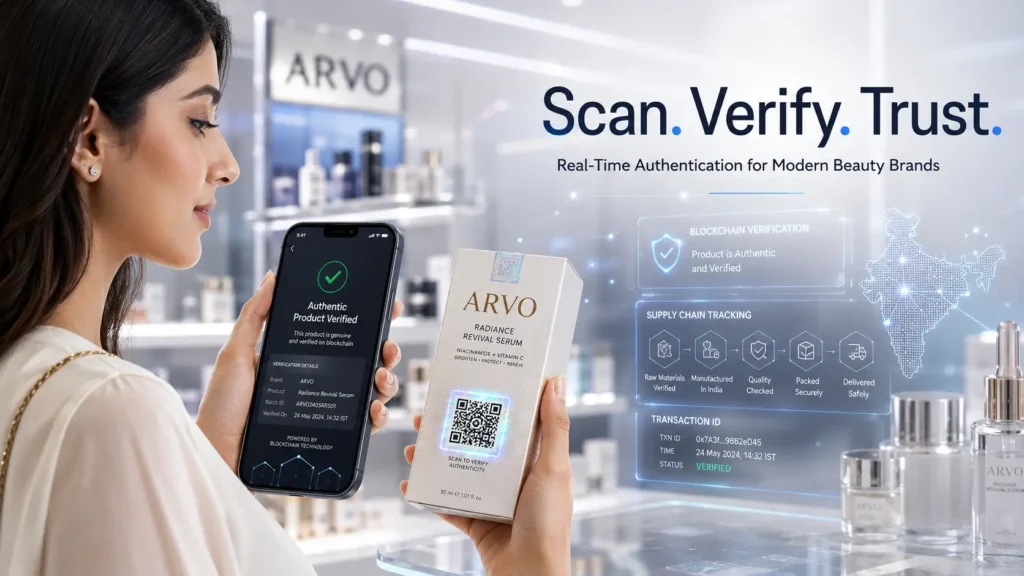
Each smart QR code carries a Cryptographic Data Pattern (CDP) that generates a mathematically unique digital fingerprint for every individual product unit. The code cannot be copied, cloned, screen-captured, or mass-reproduced through any known printing or scanning technology. When a consumer scans the code with their smartphone camera, the system validates the code against a secure cloud database and returns an instant result: authenticated or unverified. No app download is required. The verification opens directly in the smartphone’s web browser.
What distinguishes AI-powered smart QR from conventional authentication is the post-verification experience. Once a product is verified as authentic, the system opens an AI-powered chat interface trained on your brand’s specific knowledge base. The consumer can ask questions about ingredients, receive personalised usage guidance, access skincare or haircare routines, and interact with your brand directly, all within the verification interface. Every product scan transforms from a security checkpoint into a brand engagement touchpoint.
Day 1 to 2 implementation covers brand onboarding, SKU selection (up to five initial SKUs), and system configuration. The authentication platform is cloud-based, requiring no on-premise hardware installation. The AI chat widget is trained on your brand’s product data during onboarding. By the end of Day 2, your QR generation system is configured and ready for label production.
Step 2: Label Design and Tamper-Evident Packaging Integration (Days 2 to 4)
While AI-powered QR codes verify product identity, tamper-evident packaging cosmetics solutions verify product integrity. They provide physical proof that the product has not been opened, refilled, diluted, or substituted at any point between your manufacturing floor and the consumer.
ASPA has documented a counterfeiting method increasingly prevalent in India, where criminals collect discarded genuine packaging and refill it with fake products. The outer carton, tube, or bottle is authentic. Only the product inside is counterfeit. No visual inspection can detect this substitution. Only a tamper-evident seal that produces irreversible evidence of interference can expose it.
Modern tamper-evident labels combine multiple security layers: a destructible substrate that fragments permanently when peeled, a non-cloneable smart QR embedded within the label material, and heat-activated security ink that changes colour when subjected to heat-based removal attempts. Any tampering attempt produces visible, permanent evidence that the consumer can identify before use.
Day 2 to 4 implementation covers label design customised to your packaging formats (tubes, bottles, jars, sachets, cartons), printer integration with your existing labelling equipment, and adhesion testing on your specific packaging substrates. No packaging redesign is required. Labels are designed to integrate with the equipment already on your manufacturing floor. The per-unit cost of combined QR authentication and tamper-evident packaging is measured in paise, typically representing less than 1% to 2% of the product’s retail price.
Step 3: First Production Run Serialised with Blockchain Records (Days 4 to 6)
Steps 1 and 2 protect the individual product unit. Step 3 activates the manufacturing layer by running your first fully serialised production batch with blockchain-backed records and supply chain intelligence.
Every unit produced during this run receives a unique smart QR code. Every batch is recorded on a blockchain ledger with an immutable token containing the manufacturing date and facility, raw material lot numbers and supplier details, quality testing certifications, and the complete serialisation range of all units in the batch. This record cannot be altered, backdated, or deleted by any party.
The operational intelligence layer activates simultaneously. Every scan of every authenticated product generates a real-time location signal. The brand intelligence dashboard, the AIC (Authenticated Intelligence Cloud), aggregates this data into geographic scan heatmaps, counterfeit alert systems, and grey market detection analytics. For the first time, your operations team gains visibility into where your products are actually being consumed, not just where they are being shipped.
This is where beauty products authentication becomes a strategic asset rather than a compliance requirement. Grey market diversion, which costs the Indian beauty industry over ₹1,000 Crore annually, becomes detectable because products scanned in geographic locations inconsistent with their assigned distribution channel are immediately flagged. Counterfeit activity is identified when verification failure rates spike in specific markets. Supply chain leakage becomes visible at the distributor level.
Day 4 to 6 implementation covers the first serialised production run, blockchain record activation, and dashboard configuration. The system integrates with your existing batch management and ERP systems through standard API connections. No new hardware is required.
Step 4: Consumer Verification Portal Goes Live (Day 7)
Day 7 is go-live. The consumer-facing verification experience activates, closing the complete authentication loop from manufacturer to consumer.
When a consumer scans the smart QR code on your product, the experience unfolds in three stages. First, the system authenticates the product and displays a clear, unambiguous result: verified as genuine, or flagged as unverified. The authentication accuracy is 99.97%. Second, upon successful verification, the AI-powered chat widget activates. The consumer can interact with a brand-trained AI assistant that provides personalized ingredient insights, usage routines, beauty tips, and product recommendations. Third, every scan generates intelligence: geographic location data, time stamps, verification results, and engagement metrics, all flowing into the AIC dashboard in real time.
The entire experience is mobile-first, browser-based, and requires zero app downloads. Given that 94% of Indian internet users access content on smartphones, the no-app approach eliminates the friction that destroys adoption rates for app-based verification systems. The consumer scans, verifies, and engages, and the brand captures intelligence. All within seconds. All from Day 7 onwards.
By the end of Day 7, your complete authentication ecosystem is live: AI-powered smart QR codes on every unit, tamper-evident packaging on every product, blockchain records for every batch, a consumer verification portal with AI chat engagement, geographic scan heatmaps, counterfeit alerts, and grey market detection. All operational. All generating data. All deployed in 7 days.
The 7-Day Deployment Timeline
The following timeline maps the complete deployment from Day 1 to Day 7.
| Day | Focus Area | Key Activities | Measurable Outcome |
| Day 1 to 2 | Brand Onboarding and Smart QR Configuration | Brand onboarding, SKU selection (up to 5 SKUs), AI chat widget training on brand knowledge, and QR system configuration | AI-powered Smart QR system configured and ready for label production |
| Day 2 to 4 | Label Design and Printer Integration | Tamper-evident label design for packaging formats, printer integration with existing equipment, adhesion and durability testing | Labels designed, tested, and integrated into the packaging line |
| Day 4 to 6 | First Serialised Production Run | First production batch with smart QR codes, blockchain batch record activation, AIC dashboard configuration, and grey market detection setup | Serialised products manufactured with blockchain records live |
| Day 7 | Consumer Verify Goes Live | Consumer verification portal activation, AI chat widget live, scan analytics connected, counterfeit alert system enabled | The full authentication ecosystem is live and generating real-time intelligence |
This 7-day timeline is 2x faster than the industry standard for authentication deployment. The entire implementation completes without halting production, without redesigning packaging, and without procuring new capital equipment. The system is cloud-based, API-integrated, and additive to your existing manufacturing operations. It works with what you already have.
What Happens After Day 7: The Compounding Returns of Beauty Products Authentication
Once your authentication system is live, the value compounds daily across three dimensions.
Brand protection compounds. Every authenticated product in circulation makes counterfeiting more difficult and more detectable. Consumers learn to scan. Retailers begin to expect authenticated packaging. Counterfeit products without smart QR codes become visibly suspect. The AI chat engagement creates a consumer experience that counterfeiters cannot replicate, because the intelligence behind it is trained on your brand’s proprietary knowledge.
Regulatory readiness compounds. The Cosmetics Amendment Rules 2025 mandate digitised batch-level documentation retained for a minimum of three years. Your blockchain records already exceed this requirement with cryptographically sealed, independently verifiable documentation. As Indian regulations tighten further, your compliance infrastructure is already operational.
Commercial intelligence compounds. Every scan generates data. Geographic heatmaps reveal where your products are actually being consumed versus where they are shipped. Counterfeit alert clusters identify compromised markets before the damage spreads. Grey market diversion patterns expose distributor-level leakage. AI chat engagement data reveals consumer preferences, usage patterns, and product feedback at a granularity that no distributor report or marketplace dashboard can provide.
The Decision for Indian Beauty Manufacturers
The question facing every Indian beauty manufacturer is not whether beauty product authentication works. A 99.97% authentication rate, crores in seizures prevented, and real-time grey market detection confirm that it does. The question is not whether the investment is justified. At a few paise per unit, against ₹8,000 Crore in combined annual industry losses, the return on investment is beyond debate.
The question is not even a timeline. Seven days from decision to live deployment eliminates every procurement and implementation excuse that previously justified inaction.
The only question remaining is this: how many more days of unprotected production can your brand afford? Every day without authentication is a day in which counterfeiters are manufacturing and selling products under your name, in which genuine products are being diverted through grey market channels, and in which consumers are attributing counterfeit product failures to your brand.
Four steps. Seven days. A few paise per unit. 99.97% accuracy. No app required. No production downtime. No packaging redesign. The technology is proven. The timeline is validated. The losses are quantified. The only variable remaining is the decision to begin.
Start Your 7-Day Deployment
If you manufacture beauty or cosmetic products in India, you can move from unprotected to fully authenticated in 7 days. The deployment requires no production downtime, no packaging redesign, and no capital-intensive equipment procurement. The per-unit cost is a few paise. The system goes live by Day 7.
To receive a complimentary assessment of your current authentication readiness and a customised 7-day deployment plan for your product portfolio, request a brand protection consultation.
Request a Complimentary Brand Protection Assessment.
How do AI-powered smart QR codes prevent counterfeit beauty products?
AI-powered smart QR codes use cryptographic data patterns (CDP) to generate a unique digital fingerprint for every product unit. Unlike standard QR codes, they cannot be copied, cloned, or reproduced, allowing consumers to instantly verify authenticity through their smartphone browser.
Can beauty product authentication be implemented without changing existing packaging?
Yes. Modern authentication systems are designed to integrate with existing packaging formats and production lines. Manufacturers can deploy tamper-evident labels and smart QR codes without redesigning packaging or purchasing new machinery.
How long does it take to deploy a beauty products authentication system?
A complete authentication ecosystem, including smart QR codes, tamper-evident packaging, blockchain traceability, and consumer verification portals, can be deployed in as little as 7 days without halting production.
What is grey market diversion in the beauty industry?
Grey market diversion happens when genuine beauty products are sold through unauthorised channels at discounted prices, bypassing the manufacturer’s intended pricing and distribution structure. Serialised tracking and blockchain records help brands detect and prevent this activity.
Why is consumer verification important for cosmetic brands in India?
Consumer verification builds trust by allowing customers to instantly confirm product authenticity before use. It also helps brands reduce counterfeit-related damage, improve customer engagement, and comply with evolving Indian cosmetic regulations.