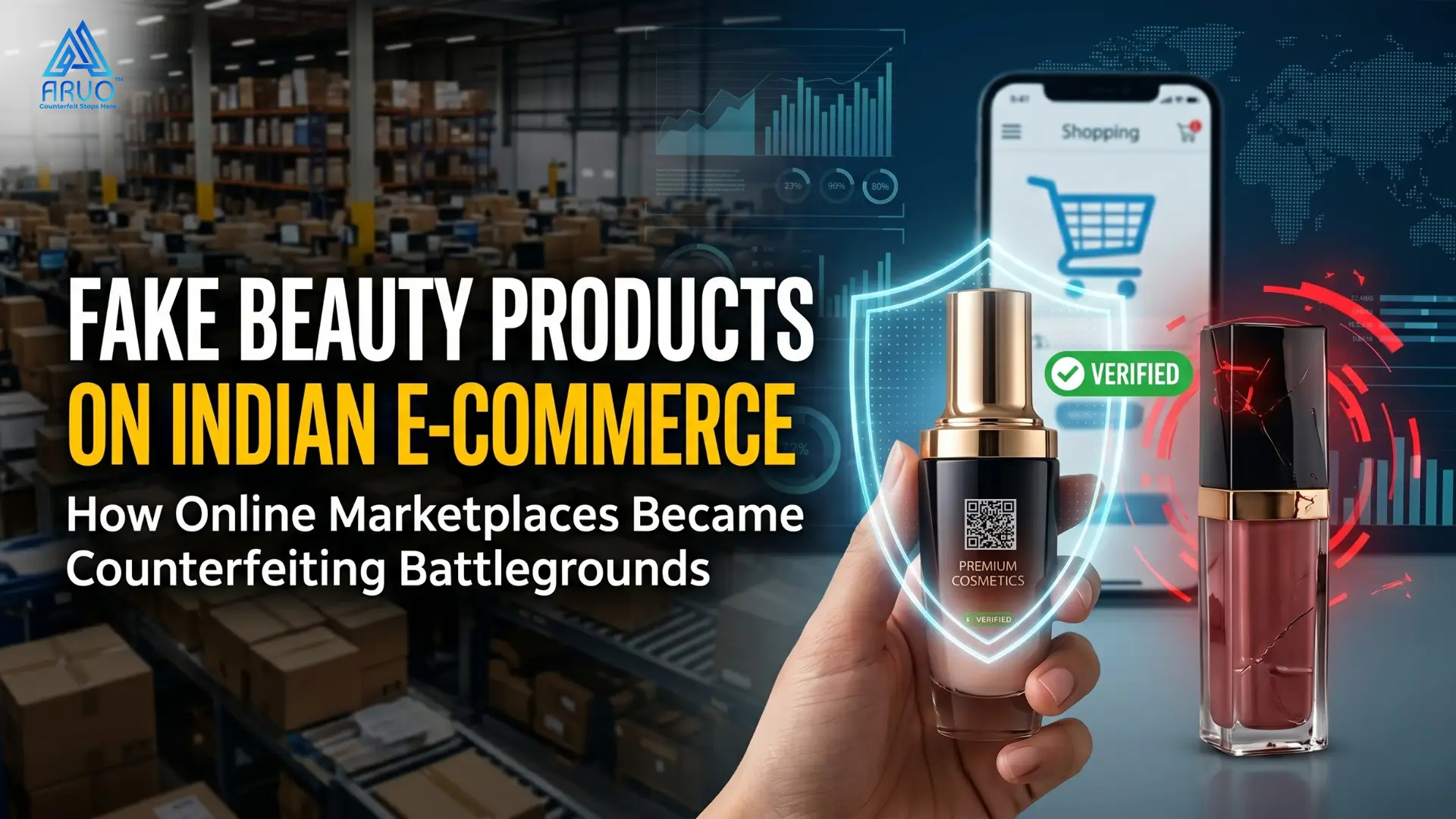
India’s e-commerce beauty market is growing at an unprecedented pace. Online stores now account for 30% of all beauty and personal care distribution in the country, and the D2C beauty segment alone crossed $2.1 billion in 2024. Indian consumers are purchasing skincare, haircare, makeup, and fragrance products through marketplaces, brand websites, quick commerce apps, and social media storefronts at volumes that double every 18 to 24 months.
But this growth has created a crisis that every beauty manufacturer needs to confront. The same digital infrastructure that enables brands to reach millions of consumers has become the primary distribution channel for counterfeit cosmetics. The problem of fake beauty products online India has moved from a minor nuisance to a systemic threat that costs legitimate manufacturers crores in lost revenue, brand damage, and consumer trust erosion every year.
FICCI reports that 30% of FMCG products sold in India are counterfeit. The DCGI has been forced to intervene directly, mandating that major e-commerce platforms remove unauthorised cosmetic listings and sign seller agreements prohibiting the sale of fake products. Enforcement agencies have conducted raids across multiple states, seizing counterfeit cosmetics worth crores from warehouses, manufacturing units, and distribution networks that feed directly into online marketplace supply chains.
This article is written for beauty and cosmetics manufacturers, brand owners, and leadership teams. It examines how Indian e-commerce platforms became counterfeiting battlegrounds, what the enforcement data reveals about the scale of losses, and what manufacturers can do to protect their brands across every online and offline channel.
Table of Contents

1. The Enforcement Data: What Indian Raids Reveal About E-Commerce Counterfeiting
The scale of counterfeit cosmetics circulating through Indian e-commerce channels becomes clear when you examine the enforcement actions from the last 18 months alone.
In July 2025, the Directorate of Revenue Intelligence (DRI) in Mumbai seized counterfeit cosmetics worth ₹6.5 Crore in a single operation. The products were being manufactured in an unregistered facility and distributed through both offline retailers and online marketplace seller accounts. The counterfeiting operation had established multiple seller identities across leading Indian e-commerce platforms, making detection through platform-level screening virtually impossible.
The Maharashtra Food and Drug Administration (FDA) conducted a separate operation and seized fake beauty products worth ₹2.5 Crore from a single building in South Mumbai. The operation revealed that counterfeit versions of well-known beauty brands were being manufactured using industrial-grade raw materials including mercury, lead-based compounds, and unregistered chemical formulations. A significant portion of the seized inventory was packaged and ready for shipment to online marketplace fulfilment centers.
In Thane, the Maharashtra FDA raided a warehouse linked to a major e-commerce fulfilment operation and seized cosmetics worth ₹88 Lakh. In Delhi, law enforcement dismantled a factory dedicated entirely to mass-producing counterfeit cosmetics for national online distribution. Raw materials worth ₹50.16 Lakh were recovered. In Bhiwandi, another unit was shut down with ₹3.47 Lakh in seized counterfeit cosmetics as recently as April 2025. In Gujarat, the FDCA conducted similar operations. In Bhubaneshwar, Karnataka, and Tamil Nadu, enforcement agencies reported comparable seizures.
The DCGI’s nationwide raids across 30 locations yielded counterfeit and non-compliant cosmetics worth ₹4 Crore. These products did not conform to Bureau of Indian Standards (BIS) requirements and included items with ingredients not certified for human use, including stem cell-based serums, unregistered skin whitening creams, glutathione injections, and hyaluronic acid fillers. The critical insight for manufacturers is this: the majority of these counterfeit products were entering the market through e-commerce seller accounts, not traditional brick-and-mortar retail.
2. The DCGI Mandate: How Regulators Are Responding to Online Counterfeiting
The Drug Controller General of India has taken direct regulatory action against the e-commerce counterfeiting crisis. Following the nationwide raids, the DCGI summoned representatives from major Indian e-commerce platforms and issued formal directives requiring them to remove all unauthorised and counterfeit cosmetic listings from their platforms, sign revised seller agreements that explicitly prohibit the listing or sale of fake cosmetics, accept responsibility for verifying whether products sold through their platforms are legitimate, and implement systems to prevent re-listing of removed counterfeit products.
According to statements from DCGI officials, the platforms were instructed to begin correcting their systems immediately and to establish different agreements with sellers specifically designed to prevent the sale of fake cosmetics. This regulatory intervention established a precedent that strengthens every manufacturer’s position when filing takedown requests and pursuing legal action against counterfeit sellers.
The Cosmetics Amendment Rules 2025, notified on 29 July 2025 by the Ministry of Health and Family Welfare, introduced additional regulatory pressure. The amended rules mandate stricter testing, labelling, and documentation standards for all cosmetics manufactured or imported in India. Manufacturers are now required to maintain digitised batch-level records accessible for audits and inspections for a minimum of three years or six months beyond the product’s expiry date, whichever is longer. Non-compliance carries penalties including licence suspension and cancellation.
For manufacturers, the regulatory landscape is clear. The government is tightening enforcement. The platforms are being held accountable. But regulations alone cannot solve the problem of fake beauty products online India. Manufacturers themselves must deploy technology-driven solutions to protect their products from the point of manufacture to the consumer’s doorstep.
3. The Gen Z Factor: Why 37% of Young Indian Consumers Are Buying Fakes
A 2022 consumer survey found that 37% of Indian consumers aged 15 to 24 purchased at least one counterfeit product in the preceding 12 months, driven primarily by recommendations they encountered on social media platforms. This statistic demands the attention of every beauty manufacturer’s leadership team, because it reveals the mechanism through which counterfeiting is scaling in India.
Young Indian consumers are discovering beauty products through Instagram reels, YouTube reviews, and influencer recommendations. They are purchasing through links in social media posts, unverified seller accounts, and third-party marketplace listings that offer significant discounts below the manufacturer’s suggested retail price. Price sensitivity, combined with limited experience in identifying counterfeit products, makes this demographic the most vulnerable entry point for fake beauty products into the Indian market.
The consequence for manufacturers extends beyond immediate revenue loss. When a 19-year-old consumer purchases a counterfeit face serum through a social media link and experiences skin irritation or an allergic reaction, they do not blame the counterfeit seller. They blame the brand printed on the packaging. The negative review is posted against the genuine brand. The consumer tells friends to avoid the genuine brand. The lifetime value of that consumer, and potentially their entire peer network, is permanently lost.
The 37% statistic also reveals a generational challenge. Today’s Gen Z consumers are tomorrow’s core beauty market. India’s median age is 28. The consumers who are currently buying counterfeits through social media will become the primary beauty market within the next five to seven years. If their first experiences with your brand are through counterfeit products that cause harm, the brand damage compounds across an entire generation.
4. Platform-by-Platform Risk Assessment for Beauty Manufacturers
Not all e-commerce channels carry equal counterfeiting risk. Manufacturers need to understand where their exposure is greatest in order to allocate protection resources effectively.
Large horizontal marketplaces carry the highest volume risk. These platforms host millions of third-party sellers, and despite IP protection programmes, counterfeit cosmetics routinely appear through new seller accounts that are created, used for a few weeks of high-volume sales, and then abandoned before enforcement can act. The DCGI’s direct intervention with major platforms confirms that even the largest Indian marketplaces have not been able to self-regulate this problem effectively.
Vertical beauty platforms carry a different risk profile. While they typically exercise greater control over seller quality, the ₹88 Lakh warehouse seizure in Thane demonstrates that even specialised beauty e-commerce operations are vulnerable to counterfeit infiltration at the fulfilment and warehousing level. The counterfeiting entry point is not always the seller listing. It can be the supply chain feeding the warehouse itself.
Social commerce and quick commerce represent the fastest-growing counterfeiting vector. Social media sellers operate with minimal verification, no GST registration requirements enforcement, and no standardised IP reporting mechanisms. The 37% Gen Z purchasing statistic is driven almost entirely by this channel. Quick commerce platforms, while growing rapidly for beauty products, face their own challenges with sourcing verification as they onboard local suppliers at speed.
Reseller and wholesale platforms cater to small retailers and kirana stores. These platforms are often the source of counterfeit products that eventually reach consumers in Tier 2, Tier 3, and rural markets. The DCGI’s notice to one such major wholesale platform confirms that B2B e-commerce is as vulnerable as B2C.
5. Five Steps Manufacturers Must Take to Protect Brands Across Online Channels
Step 1: Deploy serialised, cryptographic QR codes on every unit. This is the non-negotiable foundation of any anti counterfeiting solution India beauty strategy. Every product that leaves your manufacturing floor must carry a unique, secure QR code that cannot be copied, cloned, or reproduced. The per-unit cost is measured in paise, not rupees. The return on investment is measured in crores of protected revenue. Secure QR codes with Cryptographic Data Pattern (CDP) encryption create a mathematically unique digital fingerprint for every unit, tokenised on blockchain for permanent, immutable verification.
Step 2: Implement systematic marketplace monitoring. Assign a team member or deploy automated monitoring tools to continuously scan product listings across all relevant platforms. Document counterfeit listings with screenshots and evidence. File takedown requests through each platform’s IP violation system. Track removal and prevent re-listing. The DCGI’s mandate gives manufacturers regulatory backing that makes takedown requests significantly more effective than they were even two years ago.
Step 3: Launch a consumer scan-to-verify portal. Give consumers the power to verify authenticity before they use the product. When a consumer scans the QR code on your product, they should see an instant, unambiguous result: genuine or unverified. This single feature closes the trust gap that counterfeiters exploit. It also generates scan data that reveals where counterfeits are appearing, which marketplaces are most affected, and which geographic markets require immediate attention.
Step 4: Integrate tamper-evident packaging across all e-commerce SKUs. E-commerce products pass through multiple handling points: manufacturing, warehousing, fulfilment centres, and last-mile delivery. At each point, the product is vulnerable to tampering, substitution, or refilling. Tamper evident packaging cosmetics solutions with multi-layer labels that fragment when peeled, combined with heat-activated security ink, ensure that any tampering attempt is immediately visible to the consumer upon delivery.
Step 5: Establish serialised distributor and channel tracking. Assign unique serialisation ranges to each fulfilment partner, marketplace channel, and distribution node. When a counterfeit is discovered on a specific platform, you can trace the supply chain backwards to identify the point of infiltration. This is the difference between reactive brand protection and proactive supply chain intelligence.
6. From Online to Offline: Building a Unified Brand Protection Strategy
The most sophisticated counterfeiting operations in India do not distinguish between online and offline channels. The counterfeit factory in Delhi that was producing fake cosmetics for national distribution was supplying both marketplace seller accounts and physical retail outlets simultaneously. The ₹6.5 Crore DRI seizure in Mumbai involved products destined for both e-commerce fulfilment and traditional wholesale markets.
This means that any effective beauty brand protection India strategy must be unified across channels. The same QR authentication that protects a product sold through an e-commerce marketplace must also protect the same product sold through a general trade distributor in a Tier 3 city. The same tamper-evident label that secures an online-delivered package must also secure a product sitting on a retail shelf. The same consumer verification portal that a Gen Z consumer uses after an Instagram purchase must also work for a consumer who bought the product from a neighbourhood store.
This unified approach is only possible when authentication is embedded at the manufacturing stage, before the product enters any distribution channel. The per-unit cost of implementing multi-layer authentication at the point of manufacture is a few paise. The cost of not implementing it is measured in ₹6.5 Crore seizures, ₹2.5 Crore raids, ₹88 Lakh warehouse operations, destroyed consumer trust, negative reviews attributed to your brand, and a generation of young consumers whose first experience with your products was through a counterfeit that harmed their skin.
For every beauty manufacturer in India, the equation is simple. The cost of protection is paise. The cost of inaction is crores. The technology exists. The regulatory environment supports it. The only remaining variable is the decision by leadership to act.
Protect Your Brand Across Every Channel
If you manufacture beauty or cosmetic products and sell through any online channel in India, product authentication is no longer optional. It is a competitive necessity and an emerging regulatory requirement.
To explore how multi-layer authentication can be integrated into your existing manufacturing and packaging operations, with deployment timelines measured in weeks and per-unit costs measured in paise, request a complimentary brand protection assessment.
Request a Complimentary Brand Protection Assessment
FAQs
How can consumers identify fake beauty products online in India?
Consumers can identify counterfeit beauty products by checking for unusually low prices, poor packaging quality, spelling mistakes, missing batch numbers, and unauthorised seller accounts. Brands using secure QR code authentication and tamper-evident packaging also allow customers to verify product authenticity before use.
Why are counterfeit cosmetics increasing on Indian e-commerce platforms?
The rapid growth of online marketplaces, social commerce, and quick commerce platforms has made it easier for counterfeit sellers to reach consumers at scale. Multiple seller accounts, weak verification processes, and price-driven purchasing behaviour have accelerated the spread of fake beauty products across India.
What risks do counterfeit beauty products pose to consumers?
Fake cosmetics may contain harmful ingredients such as mercury, lead compounds, or unapproved chemical formulations that can cause skin irritation, allergic reactions, infections, and long-term health complications. Counterfeit products also damage consumer trust in genuine beauty brands.
What can beauty manufacturers do to prevent product counterfeiting?
Beauty manufacturers can reduce counterfeiting risks by implementing serialised QR codes, cryptographic authentication, tamper-evident packaging, marketplace monitoring, and consumer verification systems. A unified brand protection strategy across online and offline channels is essential for long-term protection.
Are Indian regulators taking action against fake cosmetics sold online?
Yes. The Drug Controller General of India (DCGI) and state enforcement agencies have conducted nationwide raids, seized counterfeit cosmetics worth crores, and directed major e-commerce platforms to remove unauthorised cosmetic listings. The Cosmetics Amendment Rules 2025 have also introduced stricter compliance and documentation requirements for manufacturers.