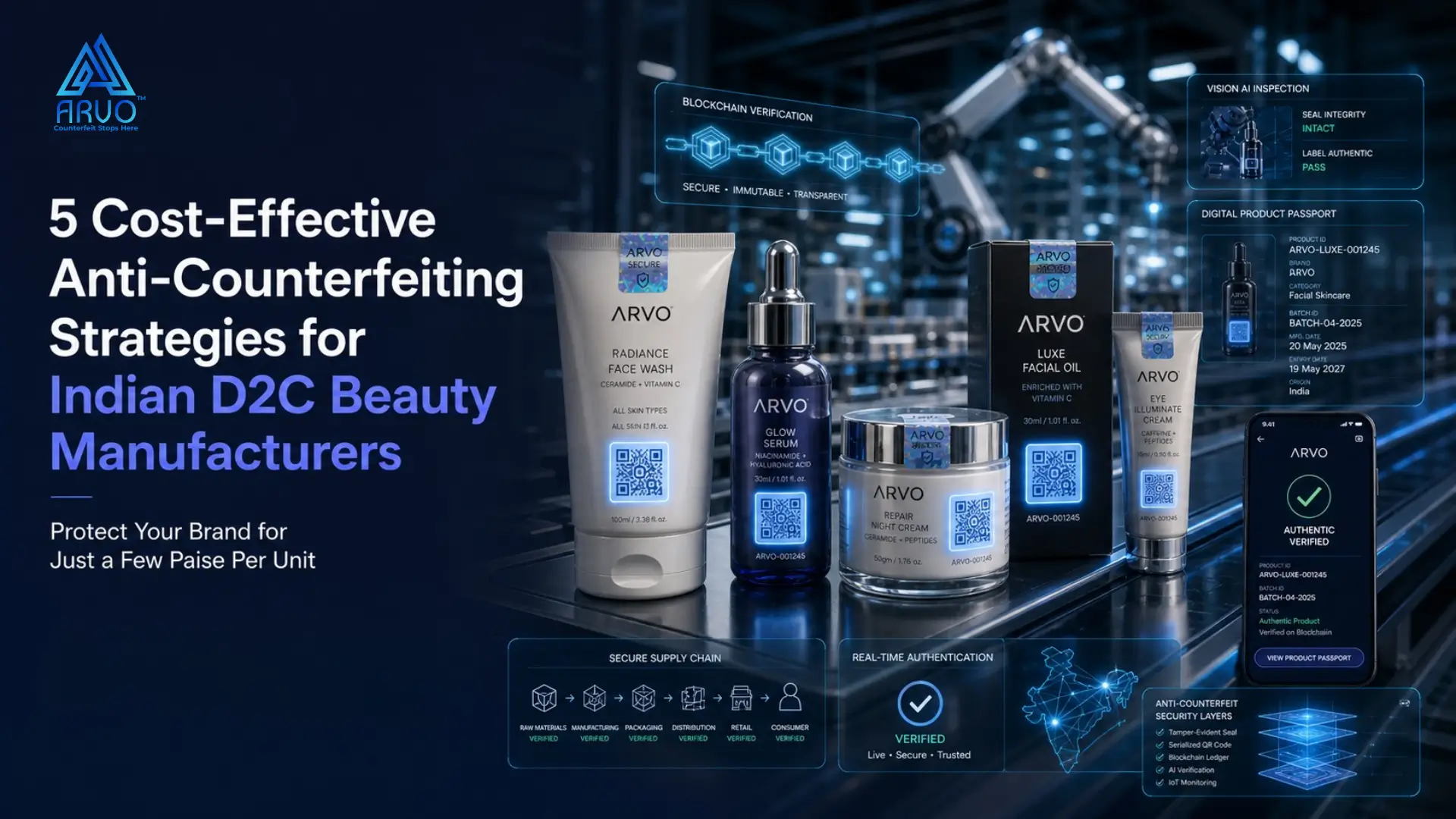
India’s beauty and personal care market is valued at $31.19 billion in 2025 and is projected to reach $48.72 billion by 2034. The D2C segment alone crossed $2.1 billion in revenue in 2024, with the broader D2C beauty and personal care category expected to reach $35.92 billion by 2032 at a 36.4% CAGR. India is now home to over 800 direct-to-consumer beauty brands. The growth trajectory is extraordinary.
But this growth has created a parallel crisis. According to FICCI, 30% of all FMCG products sold in India are counterfeit. The beauty and cosmetics category is among the most targeted. Every manufacturer reading this needs to understand one number clearly: 1 out of every 5 beauty products sold in India, online or offline, is fake. That is not a projection. That is the current state of the Indian market.
For beauty manufacturers, the financial and reputational exposure is severe. And the most persistent misconception among leadership teams is that D2C brand anti-counterfeiting strategies require large capital expenditure. They do not. The authentication technologies available today cost only a few paise per unit, deliver measurable return on investment within months, and can be deployed without disrupting existing manufacturing or packaging operations.
This guide is written for founders, CEOs, COOs, and operations heads of Indian beauty and cosmetics manufacturing companies. It presents five proven strategies that can be implemented within a combined investment that is a fraction of what counterfeiting costs your business every quarter.
Table of Contents
The Cost of Doing Nothing: What Indian Enforcement Data Reveals
Before examining solutions, it is important to understand the scale of losses that counterfeiting inflicts on Indian beauty manufacturers. The enforcement data from the last 18 months alone paints a clear picture of the financial damage.
In July 2025, the Directorate of Revenue Intelligence (DRI) in Mumbai seized counterfeit cosmetics worth ₹6.5 Crore in a single enforcement operation. The products were manufactured in an unregistered facility and distributed through both offline retail and online marketplaces. The Maharashtra Food and Drug Administration (FDA) separately seized fake products worth ₹2.5 Crore from a single building in South Mumbai, where counterfeit versions of multiple well-known Indian and international beauty brands were being produced using industrial-grade raw materials.
In Thane, the Maharashtra FDA raided a warehouse associated with a major e-commerce platform and seized cosmetics worth ₹88 Lakh. In Delhi, law enforcement dismantled an entire factory that was mass-producing counterfeit cosmetics for national distribution. Raw materials worth ₹50.16 Lakh, intended exclusively for manufacturing fake beauty products, were recovered. In Bhiwandi, another manufacturing unit was shut down with ₹3.47 Lakh in counterfeit cosmetics seized as recently as April 2025.
These are only the operations that were detected and reported. The actual volume of counterfeit beauty products circulating in the Indian market is significantly higher. For every raid that succeeds, dozens of manufacturing and distribution operations continue undetected.
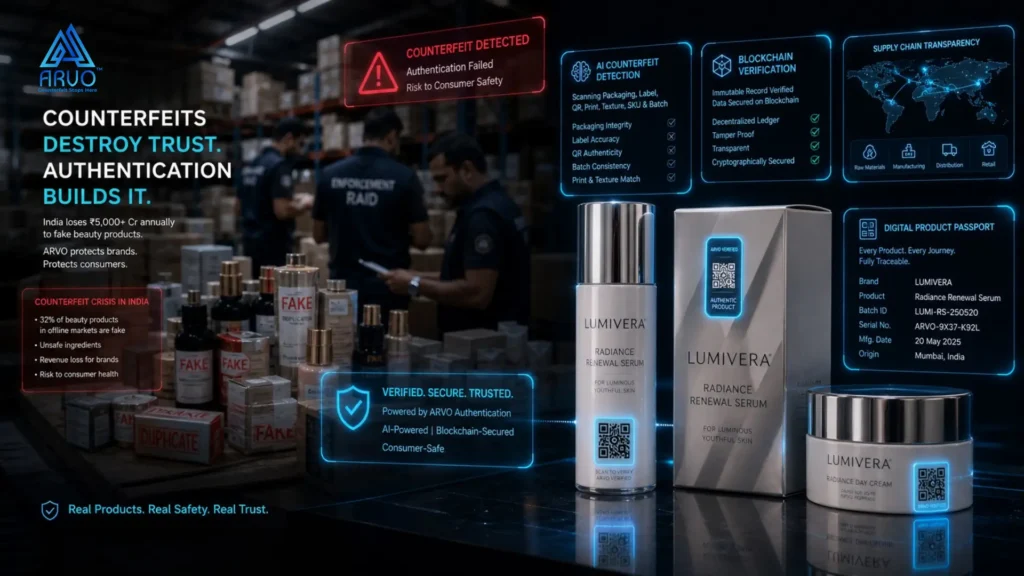
For manufacturers, the losses are not limited to diverted revenue. Counterfeit products containing lead, mercury, industrial adhesives, and toxic chemicals cause real harm to consumers. When a consumer experiences skin burns, hair loss, or allergic reactions from a counterfeit product, they do not blame the counterfeiter. They blame your brand. The reputational damage, the customer service burden, the negative reviews, and the erosion of consumer trust all land on the genuine manufacturer’s balance sheet.
Strategy 1: Serialised QR Code Authentication on Every SKU
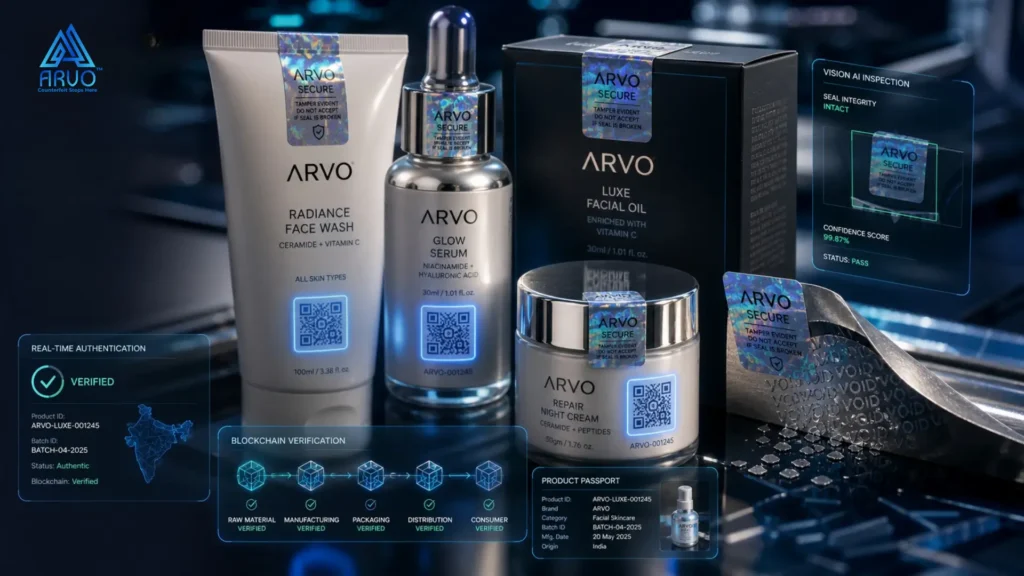
The single most impactful investment any Indian beauty manufacturer can make is deploying unique, serialised, cryptographically secure QR codes on every unit of every product. This is the foundation of any effective D2C brand anti-counterfeiting India strategy, and the unit economics are far more favourable than most leadership teams realise.
A standard QR code offers zero security. Any counterfeiter with a smartphone camera and a basic printer can duplicate a standard QR code in minutes. The critical distinction is between standard QR codes and secure, cryptographic QR codes. Secure QR codes carry a unique digital fingerprint generated through Cryptographic Data Pattern (CDP) encryption. Each code is mathematically unique at the unit level and can be tokenised on a blockchain to create a permanent, immutable record of the product’s identity.
The cost of deploying secure QR codes on beauty products today is measured in paise per unit, not rupees. For a manufacturer producing tens of thousands of units monthly, the total investment in QR authentication represents a fraction of what a single enforcement raid recovery is worth. The return on investment is not theoretical. It is the direct difference between revenue lost to counterfeit products and the cost of preventing that loss in the first place.
Implementation is compatible with existing Indian packaging lines. QR codes can be printed directly onto cartons, tubes, bottles, sachets, and labels without requiring any packaging redesign. Typical deployment timelines are four weeks from decision to live operation, including integration with existing inventory management and ERP systems.
Strategy 2: Online Marketplace Monitoring and Takedown Protocols
For D2C beauty manufacturers, online marketplaces are the primary distribution channel and simultaneously the most vulnerable counterfeiting vector. A 2022 consumer survey found that 37% of Indian consumers aged 15 to 24 purchased counterfeit beauty products through social media recommendations. The enforcement actions against major e-commerce warehouses confirm that even established platforms are not immune to counterfeit infiltration.
Marketplace monitoring involves systematically tracking product listings across all relevant platforms to identify unauthorised sellers, abnormal pricing patterns, and counterfeit listings. The process includes regular keyword searches for your brand name and product names, documentation of suspected counterfeit listings with evidence, formal takedown requests through each platform’s intellectual property violation reporting system, and follow-up tracking to confirm listing removal and prevent re-listing.
The Drugs Controller General of India (DCGI) has already directed e-commerce platforms to remove unauthorised cosmetic listings, establishing a regulatory precedent that strengthens brand takedown requests. Most platforms respond within 48 to 72 hours when provided with clear evidence of trademark infringement or product counterfeiting.
This function can be managed internally by a single team member dedicating two to three hours per week, or it can be automated through monitoring tools that scan listings across platforms continuously. The cost is negligible relative to the revenue protected. Every counterfeit listing that remains active is a sale that your manufacturing operation funded through R&D, production, and marketing, but never received revenue for.
Strategy 3: Consumer Scan-to-Verify Portal
A consumer-facing verification portal transforms product authentication from a back-end operational function into a front-end trust-building mechanism. When a consumer purchases your product and scans the QR code with their smartphone, they are directed to a branded verification page that instantly confirms whether the product is genuine or unverified.
This is where the D2C brand anti-counterfeiting India strategy intersects with the customer engagement strategy. The same scan that verifies authenticity can deliver product origin information, ingredient sourcing details, manufacturing batch data, usage recommendations, and sustainability credentials. For the consumer, it is reassurance. For the manufacturer, it is a direct data channel to the end user that bypasses every intermediary in the supply chain.
The verification experience must be optimised for mobile devices, given that 94% of Indian internet users access content on smartphones. It should load within three seconds on standard 4G connections, function without requiring any app download, and deliver an unambiguous result. Genuine or unverified. No room for consumer confusion.
The operational value for manufacturers extends beyond consumer trust. Every scan generates data. You gain visibility into which products are being verified, in which geographic locations, at what frequency, and through which retail channels. This data becomes an early warning system for counterfeiting activity. A sudden spike in verification failures in a particular city or from a particular marketplace seller is actionable intelligence that your operations team can respond to immediately.
Strategy 4: Tamper-Evident Packaging Integration
While QR codes verify product identity, tamper-evident packaging verifies product integrity. It confirms that the product has not been opened, refilled, diluted, or altered after leaving your manufacturing facility. This is a critical distinction for beauty manufacturers, because ASPA has documented a growing practice in India where counterfeiters collect discarded genuine packaging and refill it with fake products. Visual packaging inspection alone is no longer sufficient to protect consumers or brands. Tamper-evident packaging cosmetics solutions address this vulnerability at the physical layer.
Modern tamper-evident labels for beauty products use multi-layer technology. The most effective solutions incorporate a destructible substrate material that fragments irreversibly when peeled, a non-cloneable QR code embedded within the label itself, and heat-activated security ink that changes colour if subjected to heat-based removal attempts. Any single attempt to remove, replace, or duplicate the label produces visible, irreversible evidence of tampering.
The per-unit cost for tamper-evident labels is, like QR authentication, measured in paise rather than rupees. When combined with serialised QR codes, the total per-unit authentication cost typically represents between 1% and 2% of the product’s retail price. For context, most beauty manufacturers spend between 8% and 15% of revenue on marketing. Spending 1% to 2% to ensure that the product reaching the consumer is actually your product is not a cost. It is the most capital-efficient brand protection investment available.
Integration with existing manufacturing lines is straightforward. Tamper-evident labels can be applied to tubes, bottles, jars, sachets, and carton seals using standard labelling equipment already present on most Indian beauty manufacturing floors. No packaging redesign is required.
Strategy 5: Distributor Tracking with Serialised Codes
For beauty manufacturers expanding beyond direct e-commerce into offline retail, general trade, and multi-channel distribution, serialised distributor tracking is the strategy that closes the supply chain visibility gap. Without it, you have no way to identify where counterfeit products are entering your distribution chain, which distributors may be diverting products to unauthorised sellers, or which geographic markets are most vulnerable to counterfeiting activity.
Serialised tracking works by assigning unique identification codes not only to individual products but also to cases, cartons, and shipments. Each distributor, stockist, or retail partner receives products within a specific serialisation range, creating a digital chain of custody from your manufacturing floor to the point of sale. If a counterfeit product is discovered in a specific market, you can trace the supply chain backwards to identify the exact point of infiltration.
The Cosmetics Amendment Rules 2025, notified on 29 July 2025, now mandate stricter supply chain documentation for all cosmetics manufactured or imported in India. Non-compliance carries penalties including licence suspension and cancellation. Manufacturers who implement serialised distributor tracking today are not only preventing counterfeiting, but also They are building the regulatory compliance infrastructure that Indian law will increasingly require.
The practical implementation involves three steps. First, integrate serialised QR codes at the manufacturing stage, which overlaps with Strategy 1 and carries no additional per-unit cost. Second, assign serialisation ranges to each distributor and record assignments in a centralised tracking platform. Third, monitor scan data to identify anomalies: products scanned in geographic locations inconsistent with their assigned distribution channel, or verification volumes exceeding shipped quantities. This is where an effective anti-counterfeiting solution, the India beauty platform, delivers its highest operational value.
The Return on Investment: Paise That Protects Crores
The combined cost of implementing all five strategies is, by any financial measure, negligible relative to the losses they prevent. The per-unit cost of secure QR authentication and tamper-evident labels is measured in paise. The operational costs of marketplace monitoring, consumer verification, and distributor tracking are modest fixed investments that scale efficiently as production volumes grow.
Consider the mathematics. The DRI Mumbai seizure alone recovered ₹6.5 Crore in counterfeit cosmetics from a single raid. The Maharashtra FDA’s Mumbai operation recovered ₹2.5 Crore. The Thane warehouse raid recovered ₹88 Lakh. The Delhi factory operation recovered products and raw materials worth over ₹60 Lakh. These are the losses from individual operations that were successfully detected. The total market-wide loss to Indian beauty manufacturers from counterfeiting runs into hundreds of crores annually.
Against this scale of financial exposure, investing a few paise per unit in authentication technology is not an expense. It is the highest-return investment available to any beauty manufacturer operating in India today. The return is measured in protected revenue, preserved brand equity, reduced legal liability, regulatory compliance readiness, and, most fundamentally, consumer safety.
Why Manufacturers Cannot Afford to Treat This as a Future Priority
The most common strategic error among Indian beauty manufacturers is treating anti-counterfeiting as something to address after the brand has scaled. This approach fundamentally misunderstands the economics of counterfeiting. Counterfeiters do not wait for brands to become large. They target brands that are growing, because growth creates the demand that counterfeiters exploit.
By the time a manufacturer discovers counterfeit products in the market, the damage has already compounded. Consumers have already experienced poor product performance. Negative reviews have already been posted. Trust has already eroded. And in the most serious cases, consumers have already suffered health consequences from toxic counterfeit ingredients, and they have already attributed those consequences to your brand.
The five strategies outlined in this guide are not theoretical. They are operational, proven at an Indian manufacturing scale, and deployable within weeks. The per-unit cost is a few paise. The return on investment is measured in crores of protected revenue and years of preserved brand equity. For every Indian beauty manufacturer, the question is not whether to invest in D2C brand anti-counterfeiting India solutions. It is whether the leadership team can justify the consequences of not investing.
Take the First Step Toward Brand Protection
If you are a beauty or cosmetics manufacturer operating in India, the time to implement product authentication is now. The technology is proven, the per-unit investment is measured in paise, deployment timelines are measured in weeks, and the return on investment begins from the first unit that reaches a consumer verified and protected.
To explore how anti-counterfeiting solutions can be integrated into your existing manufacturing and packaging operations, request a complimentary brand protection assessment. The consultation covers your current vulnerability exposure, recommended authentication strategy, implementation timeline, and projected return on investment.
Request a Complimentary Brand Protection Assessment
How much does anti-counterfeiting protection actually cost for beauty brands?
Modern anti-counterfeiting solutions such as secure serialized QR codes and tamper-evident labels typically cost only a few paise per unit. For most Indian D2C beauty brands, the investment represents a very small percentage of product pricing while helping protect revenue, customer trust, and brand reputation.
Can counterfeit protection be added without changing existing packaging?
Yes. Most authentication solutions are designed to integrate directly into existing packaging and manufacturing workflows. Secure QR codes and tamper-evident labels can be applied to bottles, cartons, tubes, sachets, and jars without requiring a complete packaging redesign
How do consumers verify whether a product is genuine?
Consumers can simply scan the product’s secure QR code using their smartphone camera. The scan redirects them to a verification page that instantly confirms whether the product is genuine or potentially counterfeit, while also providing additional product and brand information.
Why are Indian D2C beauty brands increasingly targeted by counterfeiters?
India’s rapidly growing beauty and personal care market has created massive demand for popular products online and offline. Counterfeiters often target fast-growing D2C brands because they can exploit brand popularity, marketplace visibility, and consumer demand before brands implement proper protection systems
What are the biggest risks of not implementing anti-counterfeiting measures?
Without protection systems, brands risk revenue loss, fake marketplace listings, damaged customer trust, negative reviews, legal exposure, and reputational damage caused by harmful counterfeit products. In many cases, consumers blame the original brand rather than the counterfeiter when they experience poor product quality or safety issues.