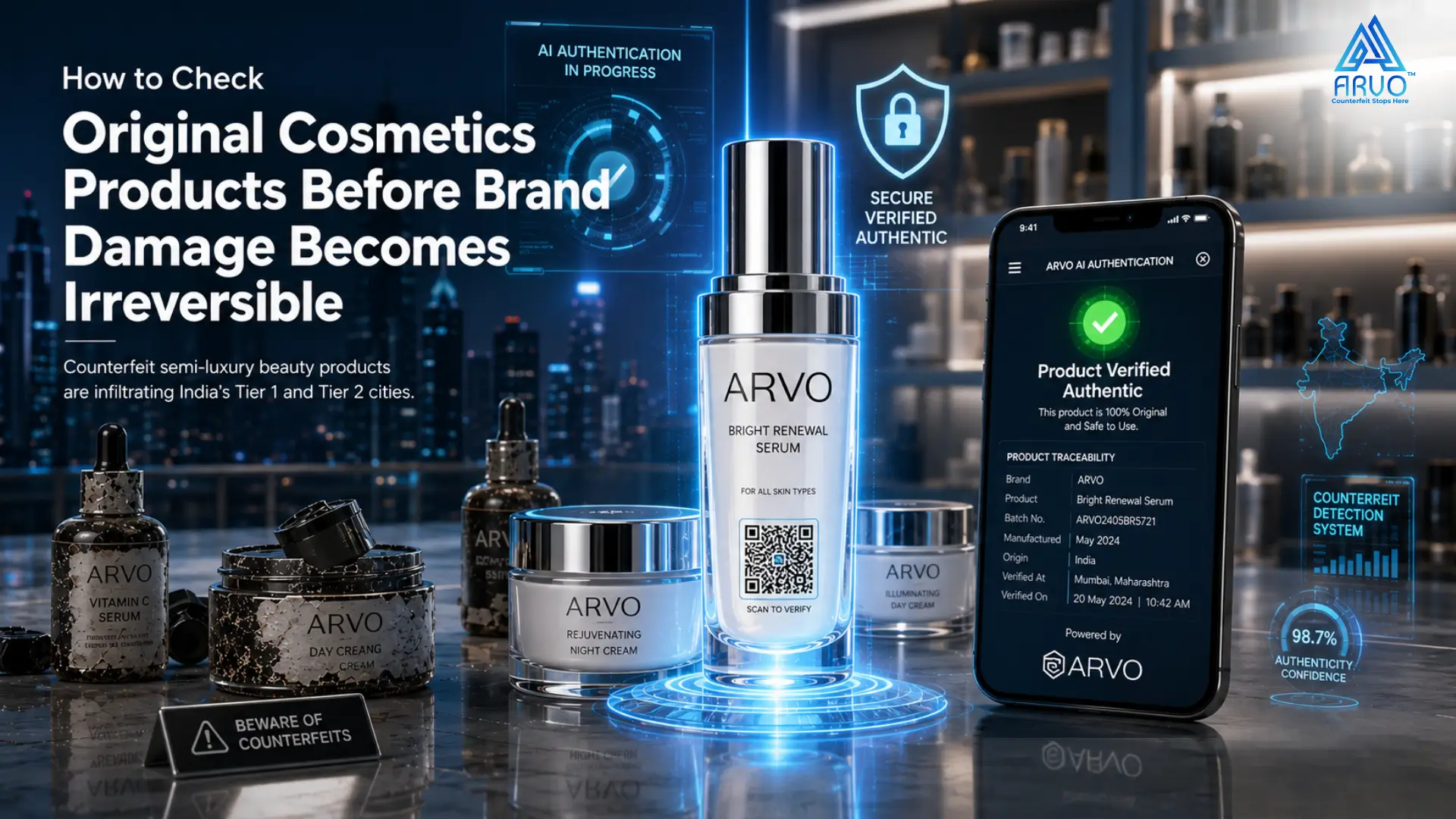
India’s semi-luxury beauty segment is one of the fastest-growing categories in the country’s $31.19 billion beauty and personal care market. Premium serums, dermatologist-formulated skincare, clinical-grade haircare, curated fragrance collections, and performance-driven colour cosmetics have moved from niche to mainstream across India’s Tier 1 and Tier 2 cities. Consumers in Mumbai, Delhi, Bangalore, Hyderabad, Pune, Jaipur, Lucknow, Chandigarh, and Ahmedabad are investing in beauty products that carry a promise of quality, efficacy, and brand credibility.
But that promise is being systematically exploited. The semi-luxury price point, typically ranging from ₹500 to ₹5,000 per unit, creates the most attractive margin opportunity for counterfeiters. The products command premium pricing but do not carry the fortress-level authentication infrastructure of global luxury houses. The question of how to check original cosmetics products has become a critical concern not just for consumers but for every semi-luxury beauty manufacturer whose brand equity is being eroded in India’s largest and most valuable urban markets.
The ASPA and CRISIL Intelligence “State of Counterfeiting in India 2025” report found that 35% of urban Indians encountered counterfeit products in the past year. In the FMCG category, 27% of consumers reported encountering fakes. ASPA recorded a 2.5-fold increase in counterfeiting instances between 2018 and 2025, with 1,022 cases documented in FMCG alone. The FICCI Cascade report confirms that the counterfeit FMCG market is growing at 15% annually, outpacing the legitimate market’s growth rate.
This article examines why semi-luxury beauty products in Tier 1 and Tier 2 Indian cities are disproportionately targeted, how counterfeits infiltrate premium distribution channels, and what manufacturers can do to protect their brands in the markets where their most valuable consumers shop.
Table of Contents
Why Semi-Luxury Beauty Is Counterfeiting’s Most Profitable Target
Counterfeiters operate on profit maximisation. They target product categories where the margin between manufacturing cost and retail price is widest, where consumer demand is growing fastest, and where authentication infrastructure is weakest. Semi-luxury beauty products in India’s Tier 1 and Tier 2 cities sit at the intersection of all three criteria.
The margin incentive is substantial. A counterfeit version of a ₹1,500 face serum can be manufactured for a fraction of that cost using industrial-grade raw materials. The counterfeiter sells it at a slight discount or at full price through unauthorised channels, capturing a margin that legitimate manufacturers invest in R&D, quality control, dermatological testing, and regulatory compliance to earn. The semi-luxury price point is high enough to be worth counterfeiting but not high enough to warrant the kind of individual-item authentication that ultra-luxury brands deploy.
The demand trajectory amplifies the opportunity. India’s beauty market is projected to reach $48.72 billion by 2034, growing at 5.08% CAGR. Tier 2 cities like Jaipur, Lucknow, and Surat have emerged as significant growth drivers, with consumers demonstrating purchasing behaviours that increasingly mirror Tier 1 metro consumers. Quick commerce beauty sales surged 160% year-on-year. This means more premium beauty products are flowing through more distribution channels in more cities than ever before, creating more opportunities for counterfeits to enter the supply chain.
The authentication gap is the final enabler. Most semi-luxury Indian beauty brands have invested heavily in formulation, packaging design, marketing, and distribution. Very few have invested in product-level authentication. Every unit that ships without a copy-proof QR code, without tamper-evident packaging, and without supply chain traceability is a unit that counterfeiters can replicate and sell with zero resistance.
The Tier 1 and Tier 2 Counterfeiting Landscape: What Enforcement Data Reveals
The enforcement operations of the last 18 months confirm that semi-luxury beauty counterfeiting is concentrated in India’s most commercially significant urban markets.
In July 2025, the Directorate of Revenue Intelligence (DRI) in Mumbai seized counterfeit cosmetics worth ₹6.5 Crore in a single operation. The products were manufactured in an unregistered facility and distributed through both premium retail channels and online marketplace accounts. The Maharashtra FDA separately seized ₹2.5 Crore in fake beauty products from one building in South Mumbai, where laboratory analysis confirmed the presence of mercury in skin creams and lead-based compounds in colour cosmetics. These were not low-cost counterfeits targeting price-sensitive consumers. They were premium-packaged products designed to sit convincingly on the shelves of urban retail outlets.
The DCGI conducted nationwide raids across 30 locations and recovered ₹4 Crore in products that failed BIS compliance, including stem cell-based serums, unregistered glutathione injections, and hyaluronic acid fillers being sold as cosmetic products. In Delhi, law enforcement dismantled a factory mass-producing counterfeit beauty products for national distribution. In Thane, a warehouse linked to e-commerce fulfilment was raided, yielding ₹88 Lakh in seized cosmetics.
The pattern across these operations is consistent. The counterfeit products were sophisticated enough in packaging and presentation to pass as semi-luxury items. They were distributed through channels that premium consumers trust: modern retail outlets, e-commerce platforms, and multi-brand beauty stores. And they contained ingredients that posed genuine health risks.
How Counterfeits Enter Premium Distribution Channels in Indian Cities
The assumption that premium distribution channels are immune to counterfeiting is demonstrably false. The enforcement data shows that counterfeit semi-luxury beauty products are entering Indian urban markets through four primary vectors.
The first vector is e-commerce marketplace infiltration. Third-party seller accounts on major platforms list counterfeit products with professional photography and competitive pricing. A 2022 survey found that 37% of Indian consumers aged 15 to 24 purchased counterfeit products through social media recommendations. For semi-luxury beauty, where online discovery and purchase is a dominant channel, this represents a direct threat to brand integrity.
The second vector is distributor-level substitution. Between the manufacturer’s warehouse and the retail shelf, products pass through regional distributors, sub-distributors, and stockists. At each level, there is an opportunity for counterfeit products to enter the supply chain, either through intentional mixing or through the distributor unknowingly sourcing from unauthorised suppliers.
The third vector is grey market diversion. Genuine products are diverted by authorised distributors and sold through unauthorised channels at discounted prices, bypassing the manufacturer’s pricing structure. Over ₹1,000 Crore is lost annually to grey market activity in the Indian beauty industry. For semi-luxury brands where price positioning is central to brand perception, grey market discounting is as damaging as counterfeiting itself.
The fourth vector is packaging refill. ASPA has documented an increasingly prevalent method where counterfeiters collect discarded genuine packaging from waste streams and refill premium bottles, tubes, and jars with fake products. The exterior packaging is authentic. Only the product inside is counterfeit. For semi-luxury beauty, where packaging quality is a key brand signal, this method is particularly effective and difficult to detect without tamper-evident technology.
The Consumer Trust Crisis: When Premium Buyers Stop Believing
For semi-luxury beauty brands, consumer trust is the single most valuable asset on the balance sheet. It is what justifies the price premium. It is what drives repeat purchases. And it is what counterfeiting destroys most efficiently.
When a consumer in Pune pays ₹1,800 for a clinical-grade face serum through a trusted retailer and the product causes skin irritation, they do not investigate whether the product was counterfeit. They conclude that the brand does not deliver on its promise. They post a negative review. They tell friends. They switch to a competitor. The lifetime value of that consumer, and the network effect of their recommendation, is permanently lost.
The ASPA/CRISIL 2025 report found that 35% of urban Indians encountered counterfeit products in the past year. FICCI reports that 30% of FMCG products in India are counterfeit. For semi-luxury beauty consumers who are investing in products they believe are premium, the discovery that fakes exist in their market creates a broader confidence crisis. They begin questioning every purchase. They start asking how to check original cosmetics products before buying. And if your brand does not provide a clear, instant, technology-backed answer to that question, they will gravitate toward brands that do.
This is the competitive dimension of authentication that most leadership teams underestimate. In a market where consumers are actively seeking verification, the brands that provide it gain a trust advantage that translates directly into purchase preference and long-term loyalty.
How ARVO Protects Semi-Luxury Beauty Brands Across Indian Cities
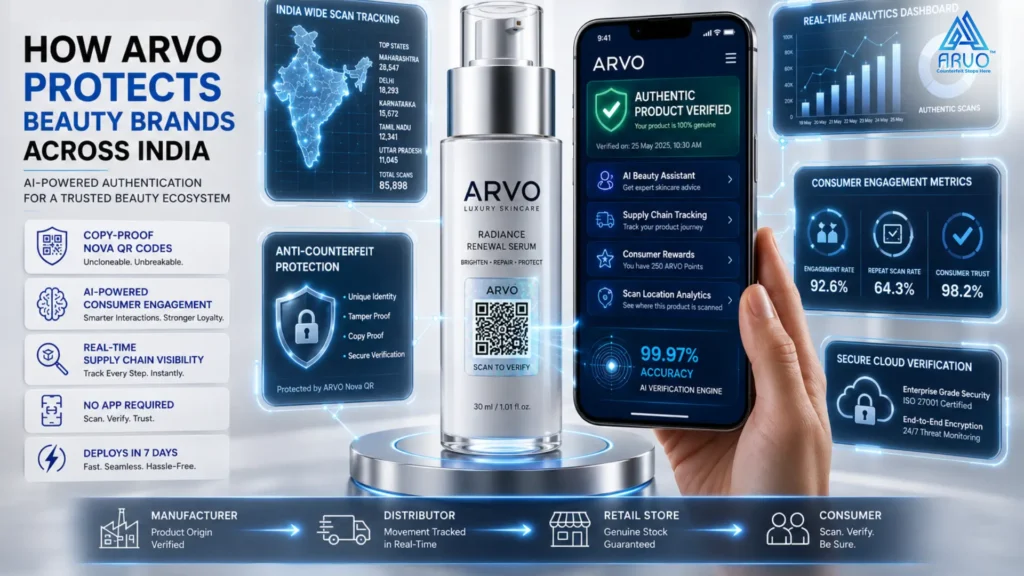
ARVO provides an end-to-end beauty products authentication ecosystem specifically designed for semi-luxury cosmetic manufacturers operating in Indian markets. The system deploys in 7 days, costs a few paise per unit, and delivers 99.97% authentication accuracy. Here is how each component works to protect your brand, engage your consumers, and give your leadership team complete visibility into your product’s journey from factory to consumer.
Copy-Proof QR Codes Powered by Nova Technology
At the core of ARVO’s anti counterfeiting solution India beauty offering are Nova codes: copy-proof QR codes that use Cryptographic Data Pattern (CDP) encryption to generate a mathematically unique digital fingerprint for every individual product unit. Unlike standard QR codes that any counterfeiter can photograph and reproduce, Nova codes cannot be cloned, copied, screen-captured, or mass-printed. Each code is unique at the unit level, creating an unbreakable digital identity for every serum, cream, shampoo, fragrance, and colour cosmetic that leaves your manufacturing floor.
When a consumer scans a Nova code with their smartphone camera, the system verifies the product against ARVO’s secure cloud database and returns an instant result: verified as authentic, or flagged as unverified. No app download is required. The entire experience is browser-based, mobile-first, and delivers results within seconds. The authentication accuracy is 99.97%.
Complete Supply Chain Visibility with Every Scan
Every time a consumer or retailer scans a Nova code on your product, ARVO’s system captures the complete scan event: the precise geographic location, the date and time stamp, the verification result, and the device information. This data flows in real time to your dashboard, giving your operations team complete visibility into where your products are being scanned, when they are being verified, and whether the verification was successful.
For semi-luxury brands distributing across Tier 1 and Tier 2 Indian cities, this transforms supply chain management. You can see if products assigned to a distributor in Hyderabad are being scanned in Kolkata. You can detect if verification failure rates spike in a specific Tier 2 market, indicating counterfeit infiltration. You can identify grey market diversion by comparing shipped distribution data against actual scan geography. For the first time, manufacturers gain real-time intelligence about where their products actually end up versus where they were shipped.
AI-Powered Consumer Engagement After Every Scan
Once a product is verified as authentic through a Nova code scan, the consumer’s experience does not end at the verification screen. ARVO activates an AI-powered chat interface that is trained specifically on your brand’s product knowledge. The consumer can interact with your product directly: asking questions about ingredients, receiving personalised skincare or haircare routines, understanding usage recommendations, exploring product origin and sourcing details, and getting guidance tailored to their specific concerns.
For semi-luxury beauty brands, this AI engagement layer converts a security function into a premium brand experience. The consumer scans, verifies, and then receives the kind of personalised consultation that was previously only available in a flagship store or through a dedicated beauty advisor. This creates a direct brand-to-consumer communication channel that bypasses every intermediary in the distribution chain.
The AI chat also enables loyalty programme integration. Consumers who scan and engage can earn rewards, access exclusive content, receive early launch notifications, and participate in brand community activities. Every scan becomes a touchpoint for building long-term loyalty, not just confirming authenticity.
The AIC Dashboard: Your Complete Brand Intelligence Centre
All of the data generated by Nova code scans, supply chain tracking, AI chat interactions, and consumer engagement flows into the AIC (ARVO Integrated Cloud) dashboard. This is your centralised command centre for brand protection and consumer intelligence.
The AIC dashboard provides real-time geographic scan heatmaps showing where your products are being verified across Indian cities, counterfeit alert systems that flag verification failures and suspicious scan patterns instantly via email and SMS, grey market detection analytics that compare distribution records against actual scan locations, consumer engagement metrics from AI chat interactions including question patterns and product feedback, loyalty programme participation data across your consumer base, and complete scan history for every individual product unit from manufacturing to consumer verification.
For semi-luxury beauty brand leadership teams, the AIC dashboard delivers the kind of product-level, consumer-level, and market-level intelligence that no distributor report, marketplace analytics tool, or syndicated research study can provide. Every scan is a data point. Every data point is actionable intelligence.
Deployment: 7 Days from Decision to Live Protection
ARVO’s complete system deploys in 7 days. Day 1 to 2 covers brand onboarding, SKU selection, and AI chat training on your product knowledge base. Day 2 to 4 covers Nova code label design and integration with your existing packaging lines. Day 4 to 6 covers the first serialised production run with supply chain tracking activated. Day 7 is go-live: consumer verification, AI chat engagement, loyalty integration, and the AIC dashboard all become operational simultaneously.
No production downtime. No packaging redesign. No app development. No capital equipment procurement. The per-unit cost is a few paise. The system is 2x faster to deploy than the industry standard. And the return on investment begins from the first authenticated unit that reaches a consumer in any Indian city.
Frequently Asked Questions
1. How does ARVO’s Nova code differ from a standard QR code printed on beauty packaging?
A standard QR code is simply a URL encoded into a scannable pattern. Any counterfeiter can photograph it and reproduce it using a basic printer. ARVO’s Nova codes use Cryptographic Data Pattern (CDP) encryption, which generates a mathematically unique digital fingerprint for every individual product unit. This fingerprint is embedded at a level that cannot be copied, cloned, photographed, or mass-reproduced through any known printing technology. When scanned, the Nova code is verified against ARVO’s secure cloud database and returns an instant result with 99.97% accuracy. Standard QR codes provide zero security. Nova codes provide copy-proof, unit-level authentication.
Do consumers need to download an app to verify a product with ARVO?
No. ARVO’s verification experience is entirely browser-based. When a consumer scans a Nova code using their smartphone’s native camera, the verification page opens directly in the phone’s web browser. There is no app download, no registration, and no account creation required. The result is delivered within seconds. This no-app approach is specifically designed for the Indian market, where smartphone storage limitations and app fatigue significantly reduce adoption rates for app-dependent verification systems.
How does the AI chat feature work after a product is verified?
Once a consumer’s scan confirms the product as authentic, ARVO activates an AI-powered chat widget that is trained specifically on your brand’s product data. The consumer can ask questions about ingredients, receive personalised usage routines (skincare regimens, haircare schedules, application techniques), explore product origin and sourcing information, and interact with your brand in a conversational format. The AI chat also supports loyalty programme integration, allowing consumers to earn rewards, access exclusive content, and receive personalised recommendations based on their scan and engagement history. All interactions generate data that flows into the AIC dashboard for your team to analyse.
What kind of data does the AIC dashboard provide to brand leadership teams?
The AIC (ARVO Integrated Cloud) dashboard provides real-time intelligence across five key dimensions. First, geographic scan heatmaps showing where your products are being verified across every Indian city. Second, counterfeit alert systems that flag verification failures and suspicious patterns with instant email and SMS notifications. Third, grey market detection analytics that compare your distribution records against actual consumer scan locations. Fourth, consumer engagement metrics from AI chat interactions, including the most frequently asked questions, product feedback themes, and engagement duration. Fifth, loyalty programme participation data across your entire consumer base. Every scan, every chat interaction, and every verification event is captured and made accessible through a single, centralised dashboard.
Can ARVO’s system be deployed without changing our existing packaging or halting production?
Yes. ARVO’s entire system is designed to integrate with your existing manufacturing and packaging infrastructure. Nova code labels are designed to work with standard labelling equipment already present on Indian beauty manufacturing lines. No packaging redesign is required. No new capital equipment is needed. The deployment timeline is 7 days from decision to live operation, which is 2x faster than the industry standard. Your production continues uninterrupted throughout the implementation process, and the authentication layer is purely additive, meaning it integrates with your current workflow without replacing or modifying any existing process.
Protect Your Semi-Luxury Beauty Brand Across Every Indian City
If you manufacture semi-luxury beauty or cosmetic products sold in India’s Tier 1 and Tier 2 cities, ARVO delivers the complete protection ecosystem: copy-proof Nova codes for unit-level authentication, real-time supply chain visibility with every scan, AI-powered consumer engagement with loyalty integration, and the AIC dashboard for centralised brand intelligence. Deployed in 7 days. A few paise per unit. 99.97% accuracy. No app required.
To receive a complimentary assessment of your current brand protection readiness and a customised deployment plan for your product portfolio, request a consultation.