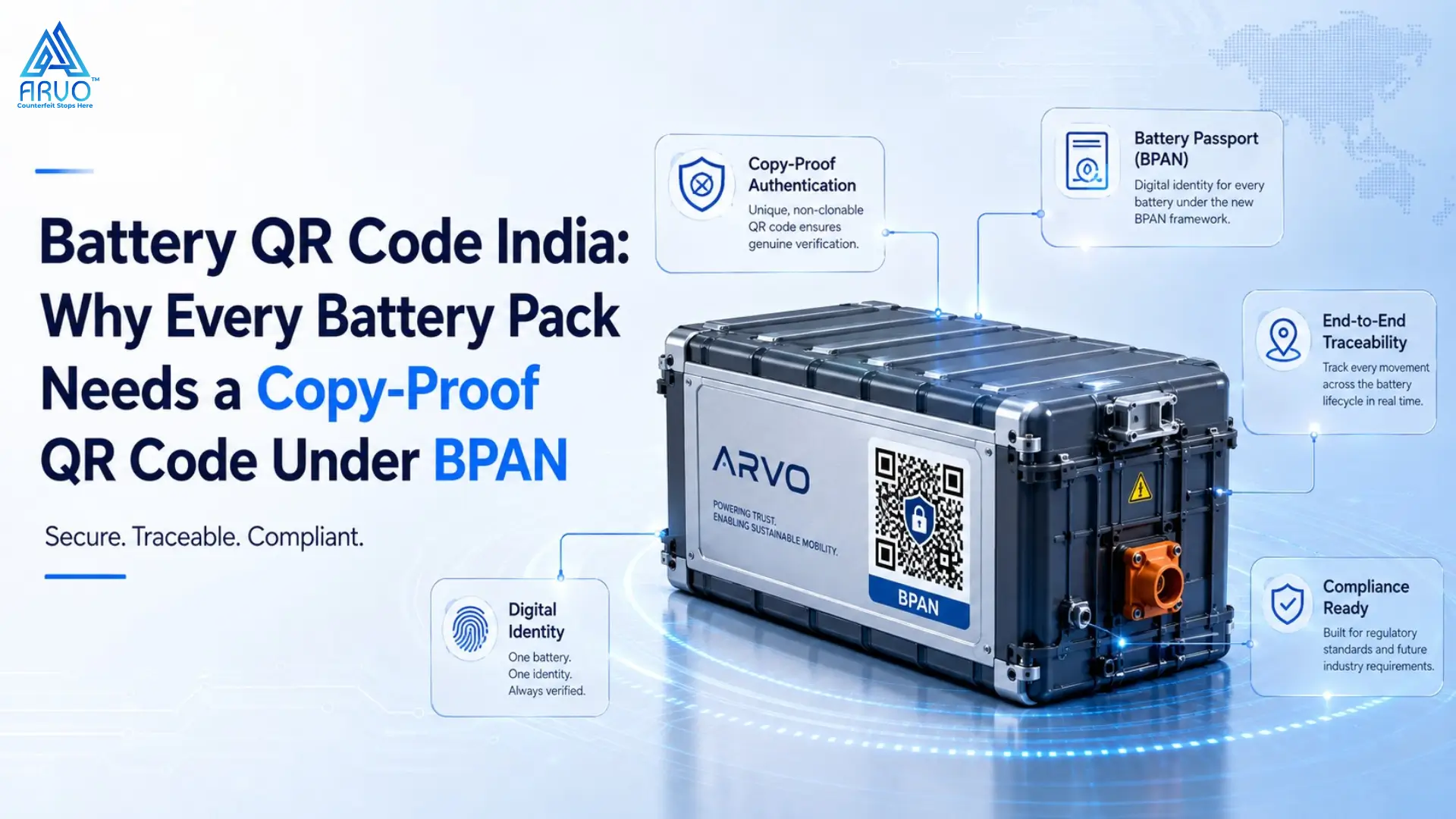
It takes 11 seconds.
That is how long it takes to photograph a standard QR code on a battery pack with a smartphone, upload the image, and print an identical copy on a counterfeit label. Eleven seconds to clone the digital identity that is supposed to guarantee traceability, safety, and regulatory compliance for a battery that will power a vehicle carrying passengers through Indian traffic for the next eight years.
Eleven seconds. That is the security gap that India’s battery industry is about to build its entire traceability framework on unless manufacturers understand the critical difference between a standard QR code and a copy-proof QR code battery solution.
The Battery Pack Aadhaar System (BPAN) mandates that every battery pack manufactured in or imported into India must carry a QR code encoding critical static data: material composition, technical specifications, carbon footprint parameters, and recycler information. The mandate is clear. What the mandate does not specify, and what most manufacturers have not yet thought through, is that a standard QR code fulfils the letter of this requirement while completely undermining its purpose. Understanding this distinction is the single most important technical decision any manufacturer will make in their battery QR code India implementation.
Source: MoRTH Draft Guidelines for Battery Pack Aadhaar System, January 2026; PSA.gov.in 49-page guideline
Table of Contents
What BPAN Specifically Requires from the QR Code on Your Battery
Before examining why standard QR codes fail, it is important to understand precisely what the BPAN QR code requirements demand. The BPAN framework defines the QR code as the second tier of a three-tier data architecture, sitting between the publicly visible 21-character alphanumeric code and the restricted server-based dynamic data layer.
Source: PSA.gov.in Battery Pack Aadhaar Guideline, Tier 2 QR specifications
The QR code on a battery pack must encode static technical data that does not change over the battery’s lifetime. According to the guideline and the CoEZET IIT Madras platform documentation, this data includes detailed material composition (cathode chemistry, anode type, electrolyte formulation), technical specifications (nominal voltage, capacity, energy density, weight), carbon footprint parameters calculated at the manufacturing stage, and recycling information (recommended disassembly method, hazardous material declarations, recoverable material data).
Source: CoEZET, IIT Madras, Battery Pack Aadhaar System Platform, 6 data categories
The QR code must be accessible offline by authorised stakeholders. This means the data must be encoded within the QR itself, not simply linked to a URL that requires internet connectivity. This is a critical design requirement because the QR code must function in environments where internet access may be limited: recycling facilities in industrial zones, inspection checkpoints at border crossings, emergency response situations involving thermal events, and rural service centres.
The QR code must also be permanently affixed to the battery pack in a location that prevents damage, deterioration, or removal. The MobilityNotes guideline summary confirms that a new BPAN, and therefore a new QR code, must be generated whenever a battery is recycled, repurposed, or materially altered. The QR code is not a disposable label. It is a permanent component of the battery’s digital identity for the duration of that identity’s validity.
Source: MobilityNotes, Battery Pack Aadhaar Guideline, January 25, 2026, permanent marking requirements
The 11-Second Problem: Why Standard QR Codes Fail at Security
A standard QR code is an encoding format. It takes data and converts it into a pattern of black and white squares that a scanner can read. That is all it does. It does not authenticate. It does not verify. It does not secure. It encodes.
This means that any standard QR code can be perfectly duplicated by anyone with access to a smartphone camera and a label printer. The process is trivially simple: photograph the QR code, decode the data it contains, re-encode that data into a new QR code, and print it on a new label. The duplicate is not an approximation. It is a perfect, byte-for-byte clone. There is no way to distinguish the original from the copy because there is no distinction. They are identical.
Now apply this reality to the battery industry. India’s EV battery pack market is growing at 42.47% CAGR toward $16.32 billion by 2030. The lithium-ion battery market is valued at $6.73 billion in 2026. The PLI scheme has committed ₹18,100 Crore. The BPAN framework is designed to ensure lifecycle traceability for every battery pack in this rapidly expanding market. The entire system’s integrity depends on the QR code being a reliable, tamper-proof anchor of the battery’s digital identity.
Source: MarqStats, India EV Battery Pack Market 2026-2030; Mordor Intelligence, India Li-ion Battery Market 2026-2031
If that anchor is a standard QR code, the entire system can be compromised in 11 seconds. A counterfeit battery manufacturer can photograph a genuine QR code, replicate it on a fake battery, and inject a counterfeit product into the supply chain with a digital identity that appears completely legitimate. The traceability chain does not break. It lies. The system records the counterfeit battery as genuine because the QR code is genuine. The only fake thing is the battery itself.
Standard QR vs Copy-Proof QR: The Technical Breakdown That Every Engineer Needs to Understand
The difference between a standard QR code and a copy-proof QR code battery solution is not a matter of degree. It is a fundamental difference in how the code works at the physical and mathematical level.
| Attribute | Standard QR Code | Copy-Proof QR Code (CDP) |
| Data Encoding | Encodes data as a URL or plain text pattern | Encodes data plus a Cryptographic Data Pattern (CDP) unique to each physical print |
| Clonability | Can be photographed and perfectly reproduced in 11 seconds | Cannot be cloned. CDP is destroyed during any reproduction attempt. |
| Unit-Level Uniqueness | Every copy is identical. No way to distinguish original from duplicate. | Every printed code is mathematically unique at the physical level. |
| Verification Method | Decodes data only. Cannot confirm if code is original or copy. | Algorithmic verification confirms code authenticity with 99.97% accuracy. |
| Offline Accessibility | Data accessible offline if encoded directly (not URL-linked) | Static data accessible offline. Authentication requires brief connectivity. |
| Tamper Detection | None. A reprinted QR on a tampered battery looks identical. | Any physical interference with the code alters the CDP, flagging tampering. |
| BPAN Suitability | Meets data encoding requirement. Fails security requirement. | Meets data encoding, security, and tamper-resistance requirements. |
| Cost | Near zero per unit | A few paise per unit |
Source: Technical comparison based on MoRTH BPAN Guidelines QR specifications; SRM Technologies BPAN analysis, March 2026
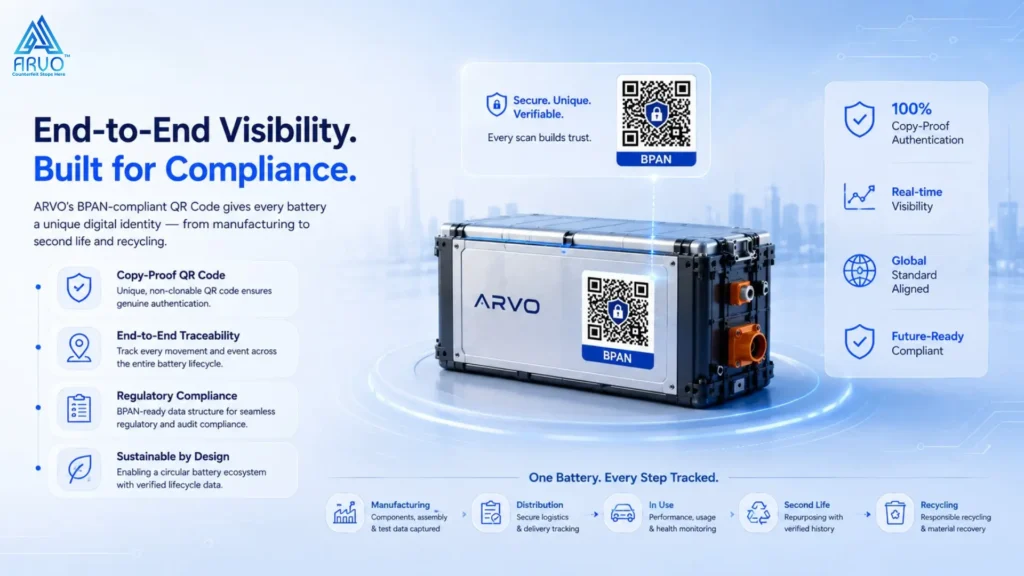
The core technology that makes copy-proof QR codes unclonable is Cryptographic Data Pattern (CDP) encryption. A CDP is a microscopic pattern embedded within the QR code during printing. This pattern is generated through a cryptographic algorithm that creates a mathematically unique fingerprint for each individual printed code. The CDP cannot be captured by photography, photocopying, or scanning because the pattern’s resolution exists below the threshold that reproduction technologies can capture. Any attempt to reproduce the code destroys the CDP, and the copy fails verification.
5 Real-World Scenarios Where Standard QR Destroys Your Traceability Chain
The vulnerability of standard QR codes is not theoretical. Here are five operational scenarios where standard QR codes undermine the traceability system they are supposed to support.
Scenario 1: Counterfeit Battery Enters the Supply Chain with a Cloned QR
A counterfeit battery manufacturer photographs the QR code from a genuine battery pack. They print identical copies and affix them to counterfeit batteries built with substandard materials. The counterfeit batteries enter the market with QR codes that scan as genuine. The BPAN system records them as legitimate products. When one of these batteries fails, the traceability chain leads back to the genuine manufacturer, not the counterfeiter. The legitimate manufacturer faces the recall, the liability, and the reputational damage.
Scenario 2: Recycler Receives a Battery with Fraudulent Composition Data
A recycler scans the QR code on a battery pack to determine its composition before disassembly. The QR code was cloned from a different battery with different chemistry. The recycler follows disassembly procedures designed for NMC chemistry, but the battery is actually LFP. The mismatch creates safety risks, reduces material recovery efficiency, and wastes processing capacity.
Scenario 3: Second-Life Valuation Based on Fraudulent Identity
A used battery is offered for second-life repurposing. The buyer scans the QR code and sees a battery manufactured two years ago with high SoH. In reality, the QR was cloned from a newer battery and affixed to an older, degraded pack. The buyer overpays for an asset that will underperform its documented specifications.
Scenario 4: EPR Compliance Data Corrupted by Duplicate QR Codes
Under the Battery Waste Management Rules, 2022, producers must document the collection and recycling of batteries they introduce into the market. If counterfeit batteries carry cloned QR codes from a legitimate manufacturer, the recycling data attributed to that manufacturer becomes inaccurate. The manufacturer appears to have more batteries in circulation than they actually produced. EPR compliance calculations are corrupted.
Scenario 5: Safety Recall Cannot Distinguish Real from Counterfeit
A safety incident triggers a recall. The manufacturer traces the affected batch through the BPAN system. But counterfeit batteries with cloned QR codes from that batch also exist in the market. The recall must cover both genuine and counterfeit units because the system cannot distinguish between them. The scope, cost, and complexity of the recall multiply. The manufacturer pays for the counterfeiter’s products.
What Copy-Proof QR Technology Actually Does Differently
A battery QR code India implementation built on copy-proof technology eliminates every one of the five scenarios described above. Here is how it works at the technical level.
Cryptographic Data Pattern (CDP) Encryption
During the printing process, the QR code is embedded with a CDP: a microscopic visual pattern generated through a cryptographic algorithm. This pattern is unique to each printed code. It exists at a resolution that is visible to algorithmic scanning but invisible to standard cameras, photocopiers, and label printers. The CDP is physically integrated into the ink and substrate of the label, meaning it cannot be separated from the printed code without destroying it.
Mathematical Uniqueness at the Unit Level
Unlike standard QR codes where every copy is identical, every copy-proof QR code is mathematically unique at the physical level. Even if two batteries carry QR codes encoding the same data, the CDP embedded in each code is different. This means the system can distinguish between the original code and any attempted reproduction. The authentication is not based on what data the code contains. It is based on how the code was physically printed.
Verification Through Algorithmic Scanning
When a copy-proof QR code is scanned, the scanner reads both the encoded data (composition, specifications, carbon footprint) and the CDP. The CDP is compared against the original cryptographic signature stored in the authentication database. If the patterns match, the code is confirmed as genuine. If they do not match, because the code was reproduced, damaged, or tampered with, the scan flags the code as unverified. The authentication accuracy is 99.97%.
Tamper Detection Built into the Physics of the Code
Any physical interference with a copy-proof QR code alters the CDP. Peeling, heat application, chemical solvent exposure, abrasion, or any other form of tampering changes the microscopic pattern, causing subsequent scans to fail authentication. The code does not merely store data. It testifies to its own physical integrity.
Source: Technical specifications based on CDP encryption technology applied to MoRTH BPAN QR requirements
How ARVO’s Nova Codes Deliver BPAN-Compliant Copy-Proof QR for Battery Manufacturers
ARVO’s Nova codes are the battery authentication technology purpose-built to meet the BPAN QR mandate while providing the copy-proof security that standard QR codes cannot deliver. Here is how the system works for battery manufacturers.
Nova Codes: Copy-Proof QR with CDP Encryption
Every Nova code carries a Cryptographic Data Pattern that makes it mathematically unique, physically unclonable, and algorithmically verifiable. The code encodes all BPAN-required static data (composition, specifications, carbon footprint, recycler information) in an offline-accessible format. Authentication accuracy is 99.97%. No app download is required for verification. The code is designed for permanent application on battery packs across all form factors and operating environments.
BPAN Data Encoding That Meets Every Specification
Nova codes encode the complete Tier 2 data set specified by the BPAN framework: cathode and anode chemistry, electrolyte formulation, nominal voltage and capacity, energy density, weight, carbon footprint calculations, hazardous material declarations, and recycler disassembly guidance. The data is accessible offline, meeting the BPAN requirement for functionality in environments without internet connectivity.
Lifecycle Data Management Through the AIC Dashboard
The AIC (ARVO Integrated Cloud) dashboard manages all three BPAN data tiers through a single platform. Static data encoded in the QR code, dynamic lifecycle data stored on the server, and the 21-character alphanumeric identity are all centralised, accessible, and audit-ready. On-demand compliance reports support BPAN portal uploads, EPR documentation, PLI audits, and export certifications.
Supply Chain Visibility with Every Scan
Every Nova code scan captures geographic location, timestamp, and verification result. For QR code battery traceability, this means manufacturers gain real-time visibility into where their batteries are scanned throughout the lifecycle. Counterfeit batteries with cloned codes are immediately flagged because they fail CDP verification. Grey market diversion is detected through geographic anomalies.
7-Day Implementation for Battery Manufacturers
Day 1 to 2: Manufacturer onboarding and Nova code configuration for battery pack formats. Day 2 to 4: Label design with copy-proof QR and integration with existing production lines. Day 4 to 6: First BPAN-compliant production run with lifecycle data activation. Day 7: AIC dashboard goes live. No production downtime. No battery pack redesign. A few paise per unit. 2x faster than industry standard.
Frequently Asked Questions
1. Does the BPAN framework specifically mandate copy-proof QR codes, or just QR codes?
The BPAN guidelines mandate that every battery carry a QR code encoding static technical data. The guidelines specify permanent marking and offline accessibility. While the document does not explicitly use the term “copy-proof,” the entire purpose of the BPAN system, which is to ensure tamper-proof lifecycle traceability, is fundamentally undermined if the QR code can be duplicated. Copy-proof QR technology is the only way to achieve the system’s stated objective of reliable, tamper-resistant digital identity.
Source: MoRTH BPAN Guidelines; PSA.gov.in guideline
2. How does copy-proof QR technology survive the harsh operating conditions of battery packs?
Copy-proof QR codes with CDP encryption are printed on industrial-grade substrates designed for the operating environments of battery packs: high temperatures, vibration, moisture, chemical exposure, and prolonged UV radiation. The CDP is embedded within the printing material at the molecular level, meaning it degrades only if the entire label is destroyed. Labels are selected and tested for adhesion and durability on the specific battery pack materials used by each manufacturer.
3. Can copy-proof QR codes be read by standard smartphone cameras?
Yes. The data layer of a copy-proof QR code is readable by any standard QR scanner or smartphone camera, functioning identically to a standard QR code for data access purposes. The CDP layer, which provides the authentication and anti-cloning capability, requires algorithmic verification through the authentication platform. Data access is universal. Authentication is platform-verified. This means recyclers, inspectors, and service providers can access the static data offline with any scanner, while authentication confirmation is available through the verification system.
4. What is the additional cost of copy-proof QR compared to standard QR?
The cost of a standard QR code is effectively zero since it is a data format printed with standard equipment. Copy-proof QR codes with CDP encryption cost a few paise per unit. For battery packs that retail at thousands or tens of thousands of rupees, this per-unit cost is negligible. When weighed against the cost of a single counterfeit battery entering the supply chain, triggering a safety incident, or corrupting the lifecycle traceability data of an entire production batch, the investment is orders of magnitude lower than the risk.
5. How quickly can a battery manufacturer switch from standard QR to copy-proof QR on their production line?
ARVO’s Nova code system deploys in 7 days. The switch from standard QR to copy-proof QR does not require new printing hardware or changes to the production workflow. Nova codes are applied using standard labelling equipment already present on most battery production lines. The configuration, label design, and integration are completed within the first four days. The first BPAN-compliant production run with copy-proof QR codes can be completed by Day 6, with the full AIC dashboard live by Day 7.
Stop Building Your Traceability on a Foundation That Can Be Cloned in 11 Seconds
The BPAN framework is the most important regulatory development in India’s battery industry in a decade. The QR code is the anchor of the entire system. If that anchor can be duplicated by anyone with a smartphone and a printer, the system provides the illusion of traceability without the reality of security. Copy-proof QR technology eliminates this illusion. It provides the tamper-proof, unclonable, algorithmically verifiable QR infrastructure that the BPAN framework requires to achieve its stated purpose.
ARVO’s Nova codes deliver copy-proof BPAN-compliant QR codes with 99.97% authentication accuracy. Deployed in 7 days. A few paise per unit. No production downtime. The traceability anchor your batteries deserve.
Replace your standard QR with copy-proof Nova codes. Start today: