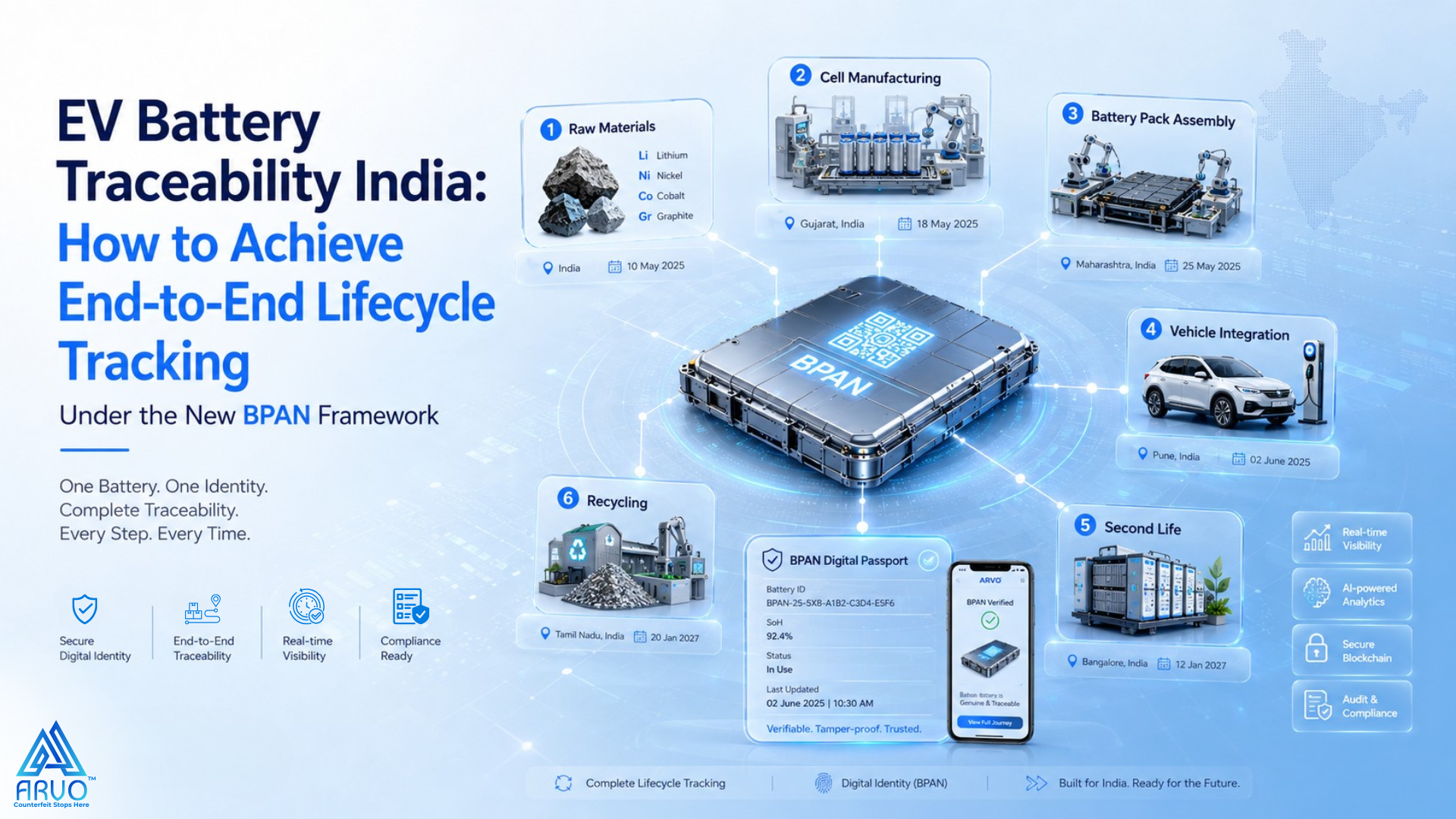
Here is a question that should keep every EV battery manufacturer in India awake at night.
If one of the battery packs you manufactured today catches fire in a vehicle three years from now, can you trace it back to the exact production batch, the specific cell supplier, the raw material lot, and the quality inspection that cleared it? Can you identify every other battery from that same batch and issue a targeted recall within hours rather than weeks? Can you prove to the regulator, with documented evidence, that your manufacturing process was compliant at the time of production?
If the answer to any of those questions is no, your operation has a traceability gap. And in India’s EV battery market, valued at $2.78 billion in 2025 and projected to reach $16.32 billion by 2030 at a 42.47% CAGR, a traceability gap is not a minor operational weakness. It is an existential risk.
Source: MarqStats, India EV Battery Traceability India Pack Market Report 2026-2030
The Battery Pack Aadhaar System (BPAN), introduced through draft guidelines by MoRTH in January 2026, is India’s answer to this gap. But BPAN is more than a compliance requirement. It is the framework that will define how EV battery traceability India operates for the next two decades. And the manufacturers who build traceability infrastructure today will not only survive the regulatory transition. They will dominate the competitive landscape that emerges from it.
This guide is an operational manual. It maps the complete traceability chain from raw material to recycling, identifies the six stages where data must be captured, and provides a practical implementation path that any Indian EV battery manufacturer can execute.
Table of Contents
The Traceability Gap: What Indian EV Battery Manufacturers Cannot See Today
India is building one of the world’s most ambitious battery manufacturing ecosystems. The PLI scheme for Advanced Chemistry Cells has committed ₹18,100 Crore to 11 cell manufacturers, targeting 50 GWh of domestic production capacity. Gigafactory capacity exceeded 68 GWh in 2025. The cumulative energy storage demand target is 903 GWh by 2030. India imported over 18,200 tonnes of lithium in 2025 alone to feed its battery production pipeline.
Source: MarketsandMarkets, India Li-ion Battery Market 2025-2030; Grand View Research, India Li-ion Battery Market 2024-2030; Mordor Intelligence, India Li-ion Battery Market 2026-2031
But here is the paradox. India is investing billions in building batteries while investing almost nothing in tracking them. Most Indian battery manufacturers today can tell you what they produced. Very few can tell you where that production is right now, who is using it, how healthy it is, or whether it has experienced a safety event.
This blindness has consequences. When a battery fails in the field, the manufacturer cannot trace it back to a specific batch to determine if other units are at risk. When a battery reaches end of life, the recycler does not know its exact composition without laboratory testing. When a used EV needs financing, no lender can objectively assess the battery’s remaining value. When the government asks for EPR compliance documentation, the data is fragmented across disconnected systems or simply does not exist.
The BPAN framework addresses this blindness by mandating a battery pack aadhaar QR code on every battery, creating a digital identity that follows the pack from birth to recycling. But the mandate alone does not create traceability. Manufacturers must build the data capture, storage, and accessibility infrastructure that makes traceability operational.
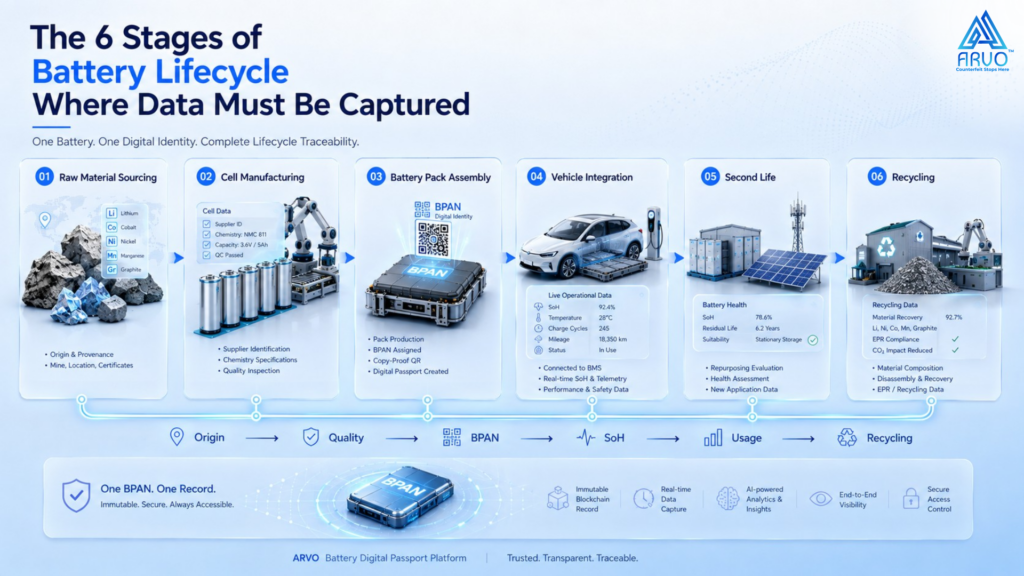
The 6 Stages of Battery Lifecycle Where Data Must Be Captured
End-to-end EV battery traceability in India requires data capture at six distinct lifecycle stages. Each stage generates different categories of data, involves different stakeholders, and serves different compliance and operational purposes. Missing data at any single stage breaks the traceability chain.
Source: CoEZET, IIT Madras, Battery Pack Aadhaar System Platform, 6 data categories
Stages 1 and 2: Raw Material Provenance and Cell Manufacturing
Stage 1: Raw Material and Precursor Sourcing
The traceability chain begins before the battery exists. It begins with the lithium, cobalt, nickel, manganese, and graphite that will become the cells. Under the BPAN framework, the battery passport must record the country of origin for key raw materials and the carbon footprint of the production process. This means manufacturers need upstream visibility into their material supply chain.
For Indian manufacturers, this is particularly relevant because the majority of cell-grade materials are currently imported. India imported over 18,200 tonnes of lithium in 2025. Traceability at this stage is not just about compliance. It is about supply chain risk management. Knowing exactly where your materials come from, and being able to prove it with documented records, protects manufacturers against supply disruption claims, ESG audit requirements, and future regulatory requirements around responsible sourcing.
Source: Mordor Intelligence, India Li-ion Battery Market 2026-2031, import data
Stage 2: Cell Manufacturing
When cells arrive at the battery manufacturer’s facility, whether produced domestically under the PLI scheme or imported, each cell lot must be recorded with supplier identification, chemistry specifications, quality certifications, and incoming inspection results. Under BPAN, this data feeds into the static layer of the battery’s digital identity. The cell origin country is encoded directly in the 21-character BPAN code.
Source: PSA.gov.in BPAN Guideline, BMI code structure, Table 3
Stages 3 and 4: Pack Assembly and Vehicle Integration
Stage 3: Battery Pack Assembly
This is the stage where the BPAN is born. During pack assembly, the manufacturer generates the 21-character Battery Pack Aadhaar Number, encodes the QR code with static data (material composition, specifications, carbon footprint, recycler information), and permanently affixes both the alphanumeric code and QR code to the battery pack. This is also the stage where the choice of QR technology becomes critical.
A standard QR code can be photographed and reproduced by any entity, undermining the entire traceability framework. A copy-proof QR code with cryptographic data patterns ensures that each code is unique, tamper-proof, and verifiable. The BPAN mandates that QR codes must be permanently affixed and accessible. For manufacturers serious about lithium-ion battery traceability, the QR code is not a label. It is the anchor of the battery’s digital identity.
Stage 4: Vehicle Integration and Commissioning
When the battery pack is installed in a vehicle, the BPAN must be linked to the vehicle’s documentation. From this point forward, the dynamic data layer activates. The Battery Management System (BMS) begins generating operational data: State of Health measurements, charge and discharge cycles, cell voltage balancing events, temperature readings, and any thermal anomalies. This data forms the operational history that will define the battery’s value and safety profile for the rest of its life.
Source: MoRTH BPAN Guidelines, dynamic data requirements; The Policy Edge analysis
Stages 5 and 6: Second Life, Recycling, and Closing the Loop
Stage 5: Second-Life Repurposing
When an EV battery’s State of Health drops below the threshold for automotive use (typically 70% to 80% of original capacity), it enters the second-life evaluation stage. This is where battery lifecycle management in India becomes a value-creation mechanism rather than just a compliance exercise.
A battery with a documented lifecycle history, verified SoH, known charge cycle count, and zero critical thermal events is a precisely valued asset. It can be sold for stationary energy storage, telecom tower backup, or solar energy buffering at a price justified by data. A battery without lifecycle data is an unknown risk that buyers discount heavily or refuse entirely. The difference between a documented battery and an undocumented one is the difference between an asset and a liability.
Source: Deccan Herald, A Green Mobility Push Through Battery Aadhaar, used EV valuation analysis
Under BPAN, a new Battery Pack Aadhaar Number must be generated when a battery is repurposed or materially altered. The new BPAN reflects the battery’s current configuration and application. The previous BPAN is retained as a historical record, maintaining the complete lifecycle trail.
Stage 6: End-of-Life Recycling
The final stage completes the circular economy loop. When a battery arrives at a certified recycling facility, the recycler scans the QR code and accesses complete material composition data: cathode chemistry, anode type, electrolyte formulation, hazardous materials present, and recommended disassembly procedures. India has targeted 80% domestic recycling capacity by the end of the decade. Achieving this target efficiently depends entirely on recyclers knowing what is inside every battery before they begin processing.
Source: Battery Waste Management Rules, 2022, MoEFCC; India e-Mobility R&D Roadmap recycling targets
The EPR (Extended Producer Responsibility) framework under the Battery Waste Management Rules, 2022 requires producers to take responsibility for the collection and recycling of batteries they introduce into the market. BPAN automates EPR compliance by creating a continuous digital trail from production through disposal, eliminating the fragmented paper-based documentation that makes EPR audits a compliance nightmare for most manufacturers.
Source: Battery Waste Management Rules, 2022; The Policy Edge, BPAN as ‘common digital spine’
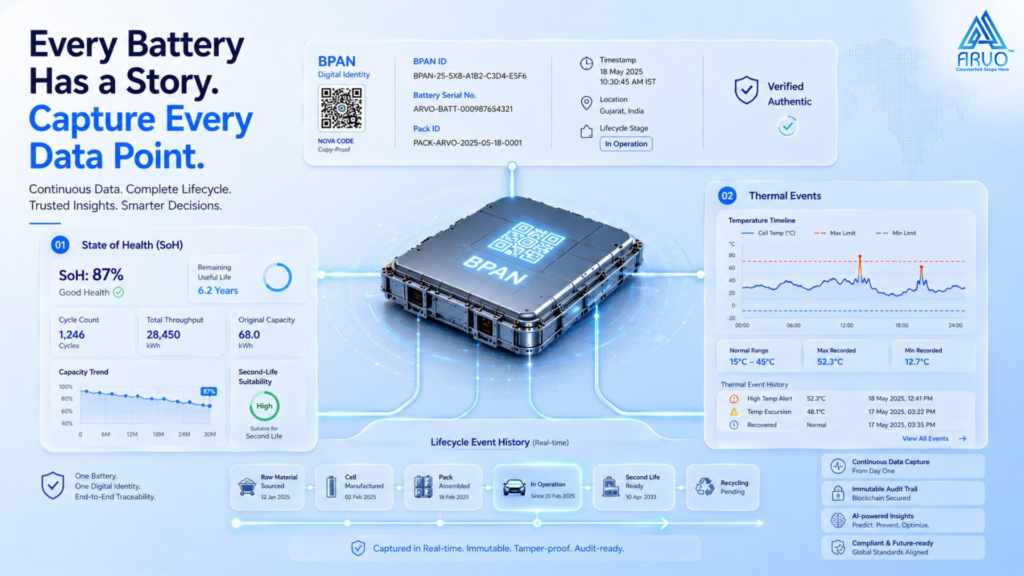
The Data That Matters Most: SoH, Thermal Events, and Why Every Reading Counts
Not all lifecycle data is equally important. Two categories of dynamic data carry disproportionate significance for safety, valuation, and regulatory compliance.
State of Health (SoH): The Battery’s Vital Sign
SoH is the single most important data point in the battery’s lifecycle record. It represents the battery’s current capacity as a percentage of its original rated capacity. An EV battery tracking system that captures SoH continuously enables three critical functions: predicting remaining useful life, determining second-life suitability, and establishing fair market value for used batteries and used EVs. Without SoH data, every used battery transaction is a gamble. With it, every transaction is a data-backed decision.
Thermal Events: The Safety Record That Cannot Be Reconstructed
Thermal events, whether minor temperature excursions or significant thermal runaway incidents, must be logged in real time and stored permanently in the battery’s dynamic data layer. A battery with zero documented thermal events is a different risk profile from a battery with three minor events, which is a fundamentally different proposition from a battery with one major event. This data cannot be reconstructed after the fact. If it is not captured when the event occurs, it is lost forever. For manufacturers, this means the thermal monitoring and logging infrastructure must be operational from the moment the battery enters service.
The BPAN framework requires both SoH and thermal event data to be recorded in the server-based dynamic layer. For manufacturers building their EV battery traceability infrastructure in India, these two data streams should be treated as non-negotiable requirements, not optional enhancements.
Source: CoEZET, IIT Madras, BPAN dynamic data specifications; MoRTH BPAN Guidelines
How ARVO Delivers Complete EV Battery Traceability in 7 Days
ARVO provides the technology infrastructure that transforms the BPAN framework from a compliance document into an operational reality on your manufacturing floor. The system addresses every stage of battery supply chain traceability and deploys in 7 days.
Copy-Proof Nova Codes: The QR That Cannot Be Forged
ARVO’s Nova codes use Cryptographic Data Pattern (CDP) encryption to create copy-proof QR codes that serve as the BPAN QR layer. Each code is mathematically unique, permanently affixed, and impossible to clone or reproduce. The QR encodes all required static data (composition, specifications, carbon footprint, recycler information) in an offline-accessible format. Authentication accuracy is 99.97%. Standard QR codes can be duplicated by anyone with a printer. Nova codes cannot. For a lifecycle traceability system where the integrity of the QR code determines the integrity of the entire data chain, copy-proof technology is not optional.
Lifecycle Data Management Through the AIC Dashboard
The AIC (ARVO Integrated Cloud) dashboard manages all three tiers of BPAN data: alphanumeric identity, QR-encoded static data, and server-based dynamic data. SoH readings, charge cycle counts, thermal events, ownership transfers, service records, and recycling outcomes are all stored, updated, and accessible through one centralised platform. On-demand reports can be generated for BPAN portal uploads, EPR compliance, PLI audits, and export certifications.
Supply Chain Visibility at Every Lifecycle Stage
Every Nova code scan at any stage captures geographic location, timestamp, and scan context. Whether a battery is being inspected on the manufacturing floor, installed in a vehicle at an OEM facility, serviced at a workshop, or processed at a recycling plant, the scan generates real-time data that flows into the AIC dashboard. Manufacturers gain visibility not just into what they produced, but into what happened to every battery after it left their facility.
7-Day Deployment for Battery Manufacturers
Day 1 to 2: Manufacturer onboarding, BPAN configuration, data field mapping. Day 2 to 4: Nova code label design and integration with battery production lines. Day 4 to 6: First BPAN-compliant production run with lifecycle data capture activated. Day 7: AIC dashboard goes live with traceability, compliance reporting, and scan analytics. No production downtime. No battery pack redesign. A few paise per unit.
Frequently Asked Questions
1. What is end-to-end EV battery traceability and why does BPAN require it?
End-to-end traceability means the ability to track a battery from raw material sourcing through cell manufacturing, pack assembly, vehicle integration, operational use, second-life repurposing, and final recycling. BPAN requires it because India’s EV battery market is growing at 42.47% CAGR, and without lifecycle tracking, there is no way to ensure safety, enable recalls, value used batteries, or comply with EPR recycling obligations. The 21-character BPAN code plus QR code creates the digital backbone for this traceability.
Source: MarqStats EV Battery Pack Report; MoRTH BPAN Guidelines
2. What specific data must manufacturers capture at the production stage?
At the production stage, manufacturers must generate the 21-character BPAN, encode the QR with static data (material composition, cell chemistry, capacity, carbon footprint, recycler disassembly information), and physically mark both the code and QR on the battery pack permanently. The manufacturer must also upload initial data to the BPAN portal and link the BPAN to the batch-level production records, including raw material lot numbers, supplier details, and quality certifications.
Source: PSA.gov.in BPAN Guideline; CoEZET, IIT Madras
3. How does BPAN traceability help with battery recalls?
Without traceability, a battery safety incident triggers a broad recall affecting entire product lines. With BPAN traceability, the manufacturer can trace the incident battery to its specific production batch, identify every other battery from the same batch through serialisation records, assess whether the issue is batch-specific or systemic, and issue a targeted recall that affects only the relevant units. This reduces recall scope, cost, and reputational damage dramatically.
4. How does BPAN support the PLI-ACC scheme requirements?
The PLI scheme for Advanced Chemistry Cells requires manufacturers to demonstrate domestic value addition and manufacturing provenance. BPAN traceability creates a documented chain from raw material through cell production to pack assembly, providing exactly the kind of provenance evidence that PLI audits require. The AIC dashboard generates on-demand reports mapping material origins, manufacturing stages, and value-addition documentation. BPAN compliance and PLI compliance are served by the same data infrastructure.
Source: NITI Aayog/MHI, PLI-ACC Scheme; MarketsandMarkets PLI impact analysis
5. Can ARVO’s system track batteries after they leave the manufacturer’s facility?
Yes. Every time a Nova code is scanned at any point in the battery’s lifecycle, whether by an OEM during installation, a service provider during maintenance, or a recycler at end of life, the scan generates location, timestamp, and context data that flows to the AIC dashboard. The manufacturer maintains visibility into the battery’s journey across its entire lifecycle, not just during production. This is the operational definition of end-to-end traceability: visibility from the manufacturing floor to the recycling plant, and every stop in between.
Build Traceability Before the Regulation Demands It
India’s EV battery market is growing at 42.47% CAGR toward $16.32 billion by 2030. The PLI scheme has committed ₹18,100 Crore. The BPAN framework is moving through AIS standardisation. The Battery Waste Management Rules require EPR compliance. And the EU Battery Passport will demand compatible traceability for exports by 2027. Every one of these forces converges on the same requirement: end-to-end lifecycle traceability. The manufacturers who build it now will lead the market. Those who wait will scramble to comply.
ARVO delivers complete EV battery traceability infrastructure: copy-proof Nova codes, lifecycle data management, supply chain visibility, and the AIC dashboard. Deployed in 7 days. A few paise per unit. 99.97% accuracy. One system serving BPAN, PLI, BWM Rules, and EU Battery Passport readiness simultaneously.
Build traceability before the regulation demands it. Start with ARVO: