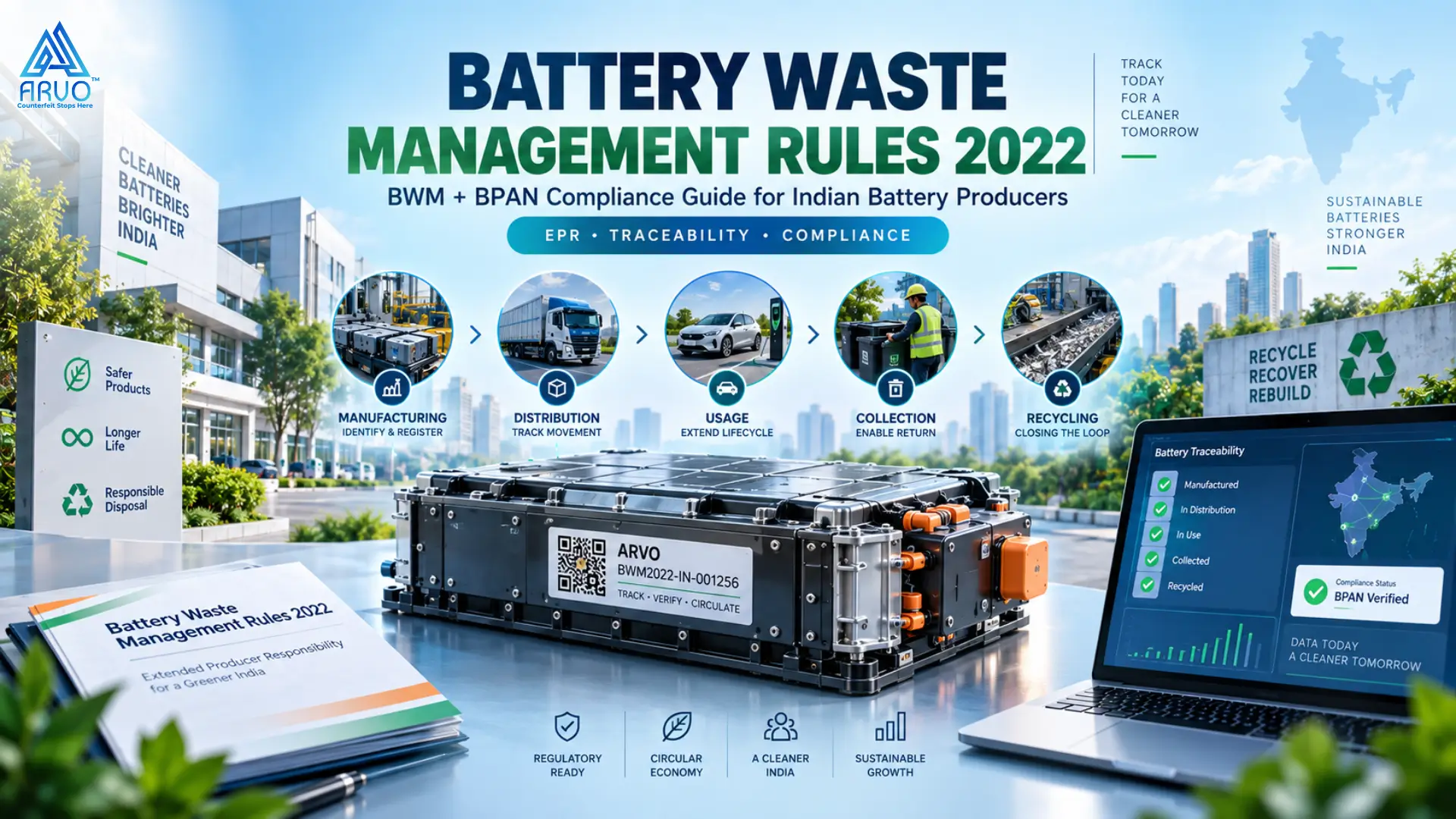
Two regulatory frameworks. One compliance headache. And a single infrastructure that solves both.
If you manufacture, import, or assemble batteries in India, you are currently navigating two of the most significant regulatory workstreams in the country’s industrial history. The Battery Waste Management Rules, 2026, notified by the Ministry of Environment, Forest and Climate Change (MoEFCC) on 22 August 2022, mandate Extended Producer Responsibility for every battery introduced into the Indian market. The Battery Pack Aadhaar System (BPAN), introduced through MoRTH draft guidelines in January 2026, mandates a unique digital identity and lifecycle traceability for every battery pack.
Most manufacturers treat these as two separate compliance projects with two separate budgets, two separate timelines, and two separate data systems. That approach doubles the cost, doubles the complexity, and misses the most important insight in the entire regulatory landscape: BPAN was explicitly designed as the ‘common digital spine’ that automates BWM compliance. One infrastructure serves both. This guide explains exactly how.
Source: PSA.gov.in Battery Pack Aadhaar Guideline, ‘common digital spine’ reference; MoEFCC Battery Waste Management Rules, 22 August 2022
Understanding this crossover is essential because the compliance deadlines are not theoretical. FY 2026-27 marks the year when EV and portable battery material recovery targets reach 90%. Collection targets are scaling aggressively. And battery waste management rules 2026 compliance is being measured, audited, and enforced through the CPCB’s centralised EPR portal right now.
Table of Contents
BWM Rules 2022: What Every Battery Producer Must Know
The Battery Waste Management Rules, 2022 establish the legal framework for the collection, recycling, and environmentally safe disposal of all batteries in India. The Rules follow the principle of EPR battery India, meaning that whoever introduces a battery into the Indian market bears legal responsibility for ensuring that an equivalent quantity is collected and recycled at end of life.
Source: MoEFCC, Battery Waste Management Rules, 2022, notified 22 August 2022
The scope is comprehensive. The Rules cover every category of battery: portable batteries used in consumer electronics, automotive batteries including lead-acid SLI batteries, industrial batteries for UPS, telecom, and energy storage applications, and electric vehicle batteries across all vehicle categories. No battery type is exempt from the EPR framework.
Every producer, importer, and brand owner must register on the CPCB’s centralised EPR portal (eprbattery.cpcb.gov.in) before placing batteries in the Indian market. The portal is the backbone of the enforcement system. Sales quantities are reported. Recycling certificates from registered recyclers are uploaded. And the two must reconcile. If your reported sales exceed your documented recycling, the gap is a compliance violation.
Source: CPCB EPR Battery Portal; GreenPermits.in, Battery Waste EPR Compliance 2026 Filing Guide, March 2026
Producers are prohibited from sending collected batteries to landfills or incinerators. All collected batteries must be routed to registered recyclers or refurbishers. The Rules also mandate that producers incorporate minimum percentages of domestically recycled materials in new batteries, starting at 5% in FY 2027-28 and increasing to 20% by FY 2030-31.
Source: IEA Policy Database, India Battery Waste Management Rules 2022
The EPR Targets That Are Coming Due in FY 2026-27
FY 2026-27 is the compliance inflection point for Indian battery producers. The material recovery targets reach their most aggressive levels yet, and battery recycling compliance shifts from a reporting obligation to an operational mandate with quantifiable, auditable outcomes.
| Target Category | FY 2024-25 | FY 2025-26 | FY 2026-27 |
| EV and Portable Battery Material Recovery | 70% of dry weight | 80% of dry weight | 90% of dry weight |
| Automotive and Industrial Battery Recovery | 50% of dry weight | 55% of dry weight | 60% of dry weight |
| EV Battery Collection Obligation | No collection target | Registration and reporting | 70% by FY 2027-28 |
| Minimum Domestically Recycled Content | Not yet applicable | Not yet applicable | 5% starting FY 2027-28 |
Source: IEA Policy Database; Karparivartan.com, Key Updates in Battery Waste Management Rules, January 2026
The FY 2026-27 column in the table above is where compliance becomes operationally demanding. 90% material recovery means that for every 1,000 kg of EV battery waste processed, 900 kg of materials must be documented as recovered. This requires precise data about what is inside every battery: cathode chemistry, anode composition, electrolyte formulation, hazardous materials, and recoverable material quantities. Without this data, recyclers cannot optimise recovery. Without optimised recovery, producers cannot meet the 90% target. Without meeting the target, CPCB compliance returns cannot be filed.
The collection gap compounds this challenge. Repose India’s August 2026 analysis identifies collection as “the least built-out link in the chain” and notes that “EPR compliance is measured on what actually gets collected, not what technically could be.” Producers need verifiable documentation proving that specific batteries were collected, transported to registered recyclers, and processed to the mandated recovery standards. This documentation chain is where most compliance systems break down.
Source: Repose India, India’s Battery Recycling Market: Where’s the Entry Point?, August 2026
The Compliance Pain Point: Data Fragmentation Is the Real Enemy
The fundamental challenge of simultaneous BWM and BPAN compliance is not regulatory complexity. The rules themselves are clearly written. The challenge is data fragmentation.
Under the BWM Rules, producers must report to CPCB: total sales volumes by battery type, collection quantities routed to registered recyclers, recycling certificates received, material recovery percentages achieved, and domestically recycled content incorporated in new production. Under BPAN, producers must capture and maintain: a 21-character unique identity per battery, QR-encoded static data (composition, specifications, carbon footprint, recycler information), and server-based dynamic data (SoH, charge cycles, thermal events, ownership transfers, recycling outcomes).
Most manufacturers maintain these as separate data streams. BWM data lives in one system. Production data lives in another. Quality data lives in a third. Distribution data is partially captured or not captured at all. The result is that every compliance filing becomes a manual data reconciliation exercise, pulling numbers from disconnected sources, hoping they align, and discovering gaps only during audits.
This fragmentation is not just inefficient. It is risky. A discrepancy between reported sales and documented recycling creates an immediate compliance flag. A battery that appears in a recycler’s intake log but cannot be traced back to the producer’s sales records creates an EPR attribution gap. A battery whose composition is documented differently in the production system versus the recycler’s processing records creates an audit red flag.
How BPAN Automates BWM Compliance as the Common Digital Spine
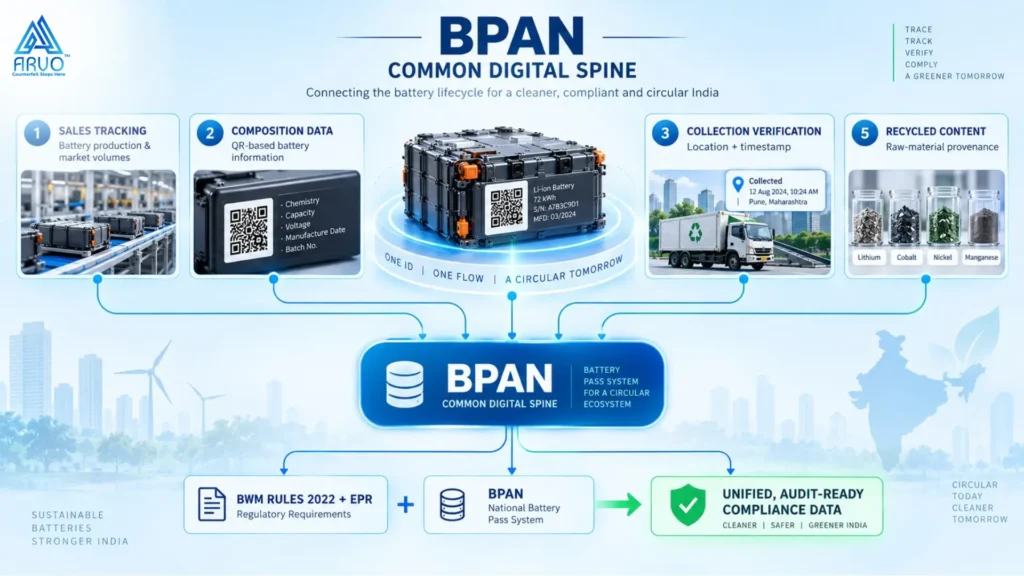
The BPAN guideline, published by the Principal Scientific Adviser to the Government of India, explicitly describes the Battery Pack Aadhaar system as a “common digital spine” that different regulatory workstreams can reference. This is not an interpretation. It is the stated design intent. The PSA guideline identifies that BPAN was built to reduce duplication of data capture across agencies and stakeholders, improve auditability, and support enforcement under Extended Producer Responsibility and Battery Waste Management rules.
Source: PSA.gov.in Battery Pack Aadhaar Guideline, ‘common digital spine’ design framework
Here is how BPAN EPR integration works in practice across the five critical compliance touchpoints.
Touchpoint 1: Sales Volume Tracking
Under BWM Rules, producers must report total batteries placed in the market. Under BPAN, every battery receives a unique 21-character identity at the point of manufacture. The BPAN system automatically generates an auditable count of every battery produced and introduced. The BWM sales volume report becomes a direct query against the BPAN database rather than a manual compilation from production records.
Touchpoint 2: Composition Data for Recyclers
Under BWM Rules, recyclers need composition data to achieve recovery targets. Under BPAN, the QR code on every battery encodes complete material composition: cathode chemistry, anode type, electrolyte formulation, hazardous materials, and recommended disassembly procedures. When a recycler scans the BPAN QR code, they receive everything needed for safe, efficient processing. No laboratory analysis required. No guesswork about battery chemistry.
Touchpoint 3: Collection Verification
Under BWM Rules, producers must verify that batteries are collected and routed to registered recyclers. Under BPAN, every scan of a battery’s QR code at a recycling facility generates a location-stamped, time-stamped record confirming the battery has entered the recycling stream. The collection event is documented automatically through the same system that tracks the battery’s lifecycle.
Touchpoint 4: Recycling Outcome Documentation
Under BWM Rules, material recovery percentages must be documented and reported. Under BPAN, the dynamic data layer records recycling outcomes against each specific battery’s BPAN identity. The 90% recovery target can be verified at the individual battery level, not just the aggregate batch level. This granularity is what transforms battery producer responsibility India from a paper exercise into a data-driven, auditable process.
Touchpoint 5: Domestically Recycled Content Verification
Starting FY 2027-28, producers must incorporate minimum percentages of domestically recycled materials. BPAN’s raw material traceability data, captured at the manufacturing stage, provides the provenance documentation to verify that recycled content originates from domestic recyclers rather than imported virgin materials. The closed-loop traceability from recycling outcome to new production input is documented within a single system.
Source: The Policy Edge, Guidelines for Battery Pack Aadhaar, January 12, 2026, BWM Rules automation analysis
The Compliance Crossover Map: How Every BWM Requirement Maps to a BPAN Data Layer
The following table maps each BWM Rules 2022 compliance requirement to the specific BPAN data layer that fulfils it.
| BWM Rules 2022 Requirement | BPAN Data That Fulfils It | BPAN Tier | Automation Level |
| CPCB portal registration of producer | Battery Manufacturer Identifier (BMI) in BPAN code | Tier 1 (Alphanumeric) | Fully automated |
| Sales volume reporting | Unit count from BPAN generation records | Tier 1 (Alphanumeric) | Fully automated |
| Battery composition disclosure | QR-encoded material composition data | Tier 2 (QR Code) | Fully automated |
| Recycler disassembly information | QR-encoded hazardous materials and recovery data | Tier 2 (QR Code) | Fully automated |
| Collection verification | Scan event at recycling facility with location and timestamp | Tier 3 (Server) | Fully automated |
| Material recovery documentation | Recycling outcome data recorded against BPAN identity | Tier 3 (Server) | Fully automated |
| Ownership transfer tracking | Dynamic data layer ownership change records | Tier 3 (Server) | Fully automated |
| Domestically recycled content proof | Raw material provenance data linking recycled input to production | Tiers 2 and 3 | Fully automated |
| Annual compliance returns filing | On-demand reports generated from BPAN database | All 3 Tiers | Report generation automated |
Every row in the table above reads “fully automated.” That is the power of the common digital spine. When your BPAN infrastructure is operational, your BWM compliance data is generated as a byproduct of normal operations, not as a separate manual process.
Source: Crossover mapping based on MoEFCC BWM Rules 2022 and PSA.gov.in BPAN Guideline, 3-tier data architecture
How ARVO Delivers Unified BWM and BPAN Compliance in 7 Days
ARVO’s platform is purpose-built to serve as the technology layer that operationalises the common digital spine. The system addresses every cell in the crossover map above and deploys in 7 days.
Copy-Proof Nova Codes: The QR Layer for BPAN and BWM
Every battery receives a Nova code with CDP encryption. The QR encodes all BPAN Tier 2 static data including the material composition, specifications, carbon footprint, and recycler disassembly information that BWM compliance requires. When a recycler scans the Nova code, they receive everything they need for safe processing and accurate material recovery reporting. The same scan that serves BPAN also serves BWM.
Lifecycle Data Management Through the AIC Dashboard
The AIC (ARVO Integrated Cloud) dashboard manages all three BPAN data tiers: alphanumeric identity, QR-encoded static data, and server-based dynamic lifecycle data. Sales volumes, collection events, recycling outcomes, ownership transfers, and material recovery data are all stored, updated, and reportable through one centralised platform. On-demand compliance reports can be generated for CPCB EPR portal submissions, BPAN portal uploads, PLI documentation, and regulatory audits.
Supply Chain and Recycling Event Tracking
Every Nova code scan at any lifecycle stage, whether at a manufacturing facility, a distribution warehouse, a service centre, or a recycling plant, captures geographic location, timestamp, and scan context in real time. Collection events are documented automatically when batteries arrive at registered recyclers. The AIC dashboard provides manufacturers with end-to-end visibility from production through recycling, generating the documentation chain that both BWM and BPAN require.
7-Day Deployment
Day 1 to 2: Manufacturer onboarding and Nova code configuration. Day 2 to 4: QR label design and production line integration. Day 4 to 6: First compliant production run with lifecycle data capture activated. Day 7: AIC dashboard goes live with unified BPAN and BWM compliance reporting. No production downtime. No dual-system overhead. A few paise per unit. One infrastructure. Two regulatory frameworks. Both served.
Frequently Asked Questions
1. What are the Battery Waste Management Rules 2022 and who do they apply to?
The Battery Waste Management Rules, 2022 were notified by the Ministry of Environment, Forest and Climate Change (MoEFCC) on 22 August 2022. They establish an Extended Producer Responsibility (EPR) framework requiring every producer, importer, and brand owner who places batteries in the Indian market to be responsible for their collection, recycling, and environmentally safe disposal. The Rules apply to all battery categories: portable, automotive, industrial, and electric vehicle. Registration on the CPCB centralised EPR portal is mandatory before placing batteries on the market.
Source: MoEFCC, Battery Waste Management Rules, 2022; CPCB EPR Battery Portal
2. What are the material recovery targets for FY 2026-27?
For EV and portable batteries, the material recovery target is 90% of dry weight in FY 2026-27, up from 70% in FY 2024-25. For automotive and industrial batteries, the target is 60% of dry weight. The EV battery collection obligation reaches 70% by FY 2027-28. Producers must also begin incorporating a minimum 5% domestically recycled content in new batteries from FY 2027-28, increasing to 20% by FY 2030-31.
Source: IEA Policy Database; Karparivartan.com, January 2026
3. How does BPAN reduce the compliance burden for BWM Rules?
The BPAN guideline explicitly describes the system as a “common digital spine” designed to reduce duplication of data capture across regulatory workstreams. When BPAN is implemented, the data required for BWM compliance (sales volumes, composition data, collection events, recycling outcomes, recycled content provenance) is generated automatically through the same lifecycle tracking system. Producers no longer need to maintain separate data systems for BPAN and BWM. One infrastructure serves both.
Source: PSA.gov.in BPAN Guideline, ‘common digital spine’ reference
4. What happens if a producer fails to meet the BWM EPR targets?
Producers who fail to meet the mandated collection and recycling targets face compliance violations under the Environment (Protection) Act, 1986. The CPCB can flag non-compliance through the centralised portal when reported sales volumes do not reconcile with documented recycling certificates. Specific penalties depend on the scale and nature of the violation, but the regulatory trend is clear: enforcement is tightening. The gap between reported sales and documented recycling is the primary audit trigger.
Source: GreenPermits.in, Battery Waste EPR Compliance 2026, March 2026; Repose India, August 2026
5. Can ARVO’s system generate the compliance reports required for CPCB EPR portal submissions?
Yes. The AIC dashboard generates on-demand compliance reports that align with CPCB EPR portal filing requirements. Sales volumes are derived from BPAN generation records. Collection events are documented through scan data at recycling facilities. Material recovery outcomes are recorded against individual BPAN identities. Recycled content provenance is traceable through the raw material data layer. All data is audit-ready and exportable in formats compatible with CPCB reporting requirements. The system deploys in 7 days and costs a few paise per unit.
One Infrastructure. Two Regulatory Frameworks. Zero Duplication.
The Battery Waste Management Rules 2022 are not waiting. FY 2026-27 targets are live. The BPAN framework is moving through AIS standardization. Maintaining separate compliance systems for each is a choice that costs more, takes longer, and produces fragmented data that fails under audit scrutiny. The smarter choice is the one the government itself designed: use BPAN as the common digital spine that automates BWM compliance.
ARVO delivers the unified compliance infrastructure: copy-proof Nova codes, lifecycle data management, recycling event tracking, and the AIC dashboard with on-demand CPCB reporting. Deployed in 7 days. A few paise per unit. 99.97% QR authentication accuracy. One system serving BPAN, BWM, PLI, and EPR simultaneously.
Unify your compliance. Eliminate duplication. Start with ARVO: