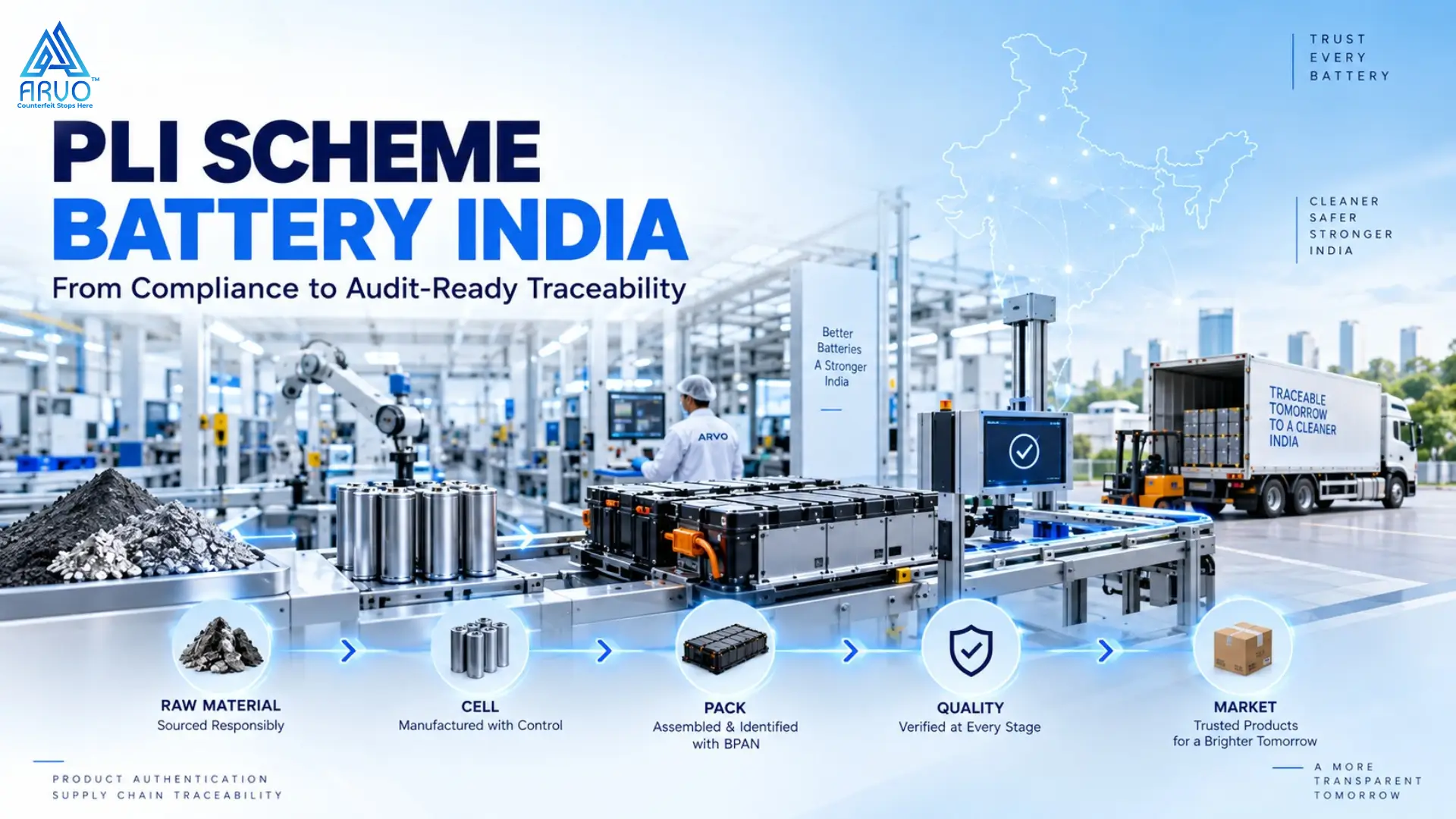
₹18,100 Crore. 50 GWh target. 4 beneficiaries. As of May 2026, only 1.4 GWh has been commissioned.
Source: MHI/PIB, Promotion of Domestic Battery Manufacturing Capacity, 13 February 2026; IMARC Engineering, August 2026
Those four numbers tell the story of India’s most ambitious battery manufacturing programme. The PLI scheme battery India framework, officially titled the National Programme on Advanced Chemistry Cell (ACC) Battery Storage, was approved by the Union Cabinet on 12 May 2021 with the stated objective of building 50 GWh of domestic cell manufacturing capacity. The government committed ₹18,100 Crore in incentives. Four companies were awarded capacity. The scheme was designed to position India as a global battery manufacturing hub.
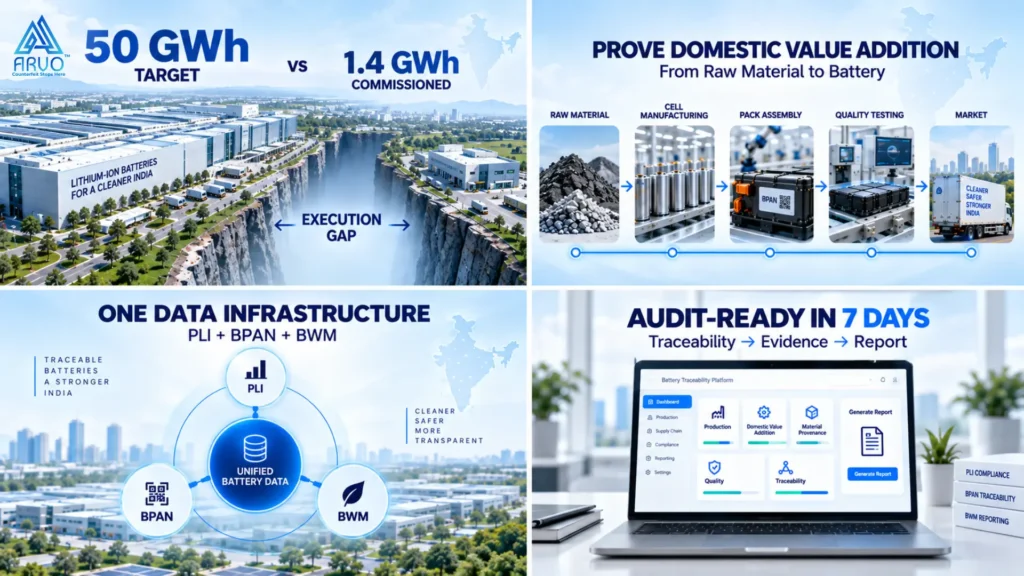
But the execution gap between ambition and reality- 50 GWh targeted versus 1.4 GWh commissioned- reveals something critical. The challenge is not capital. The challenge is not demand. The challenge is proving, with auditable documentation, that every cell manufactured, every material sourced, and every value-addition step claimed actually happened on Indian soil, with Indian inputs, to the standards the scheme demands.
This is where BPAN and the PLI scheme battery India framework converge. The Battery Pack Aadhaar System creates exactly the traceability infrastructure that PLI audits require: documented manufacturing provenance, verified domestic value addition, and audit-ready batch records that prove compliance at every stage of the production chain.
Table of Contents
The PLI-ACC Scheme: What It Requires and Where Beneficiaries Are Struggling
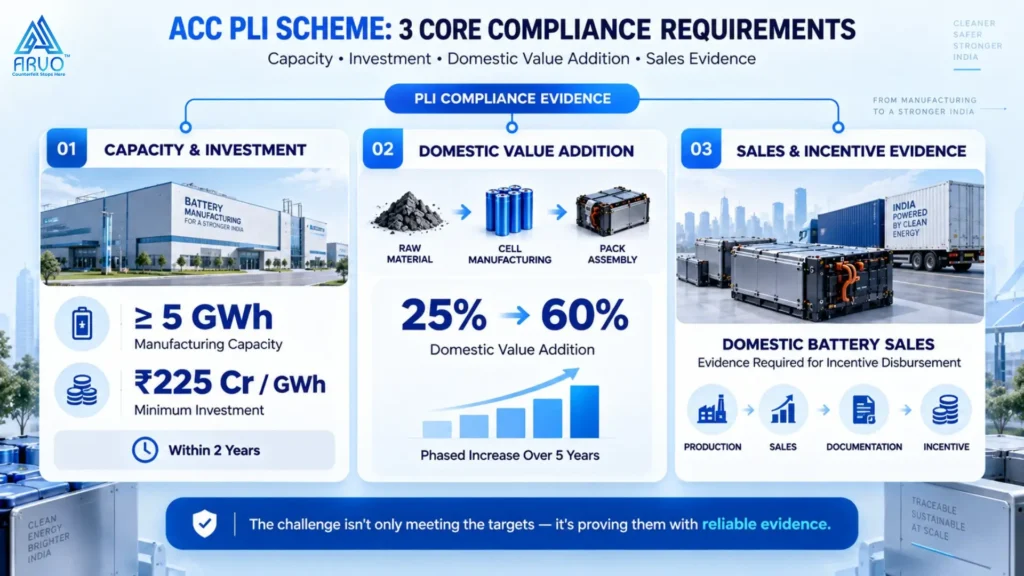
The ACC PLI scheme rests on three non-negotiable requirements beneficiaries must meet to receive incentive disbursements.
Requirement 1: Capacity and Investment
Each beneficiary must establish a manufacturing facility of a minimum of 5 GWh capacity. The mandatory investment is ₹225 Crore per GWh of committed capacity. Facilities must be set up within two years of programme agreement signing. The total expected direct investment across all beneficiaries is approximately ₹45,000 Crore.
Source: MHI/PIB, Allotment for 50 GWh, 24 March 2022; heavyindustries.gov.in PLI-ACC page
Requirement 2: Domestic Value Addition (DVA)
This is the requirement that has proven most challenging for beneficiaries. Manufacturers must achieve a minimum 25% domestic value addition at the start, rising to 60% within five years. DVA means that a defined percentage of the battery’s value must come from materials sourced, processed, or manufactured within India. The incentive payout is directly linked to DVA achievement. A manufacturer that meets capacity but fails DVA does not receive the incentive.
Source: heavyindustries.gov.in, PLI Scheme for National Programme on ACC Battery Storage; India Briefing, ACC Battery PLI Bids
Requirement 3: Incentive Disbursement on Sales
Incentives are disbursed over five years from the date of commissioning, calculated on the sale of batteries manufactured in India. This means manufacturers must not only build and operate the facility but must also demonstrate, with documented evidence, that the batteries being sold were manufactured domestically with the claimed DVA percentages. Sales without documented manufacturing provenance do not qualify.
Source: MHI PLI-ACC Scheme documentation
The IEEFA’s March 2026 assessment of the scheme identified three critical bottlenecks that beneficiaries face: stringent domestic value addition requirements that first-time battery manufacturers find difficult to meet, an aggressive two-year installation timeline, and supply chain challenges including delayed procurement of specialised equipment. These bottlenecks are not just operational. They are documentation bottlenecks. Proving DVA, proving manufacturing origin, and proving compliance during audits requires traceability infrastructure that most beneficiaries have not yet built.
Source: IEEFA, Assessing India’s ACC PLI Scheme, Jyoti Mukul, March 2026
The 50 GWh vs 1.4 GWh Execution Gap: Why Documentation Is the Hidden Bottleneck
As of May 2026, the Ministry of Heavy Industries reported that 40 GWh of capacity had been awarded to four beneficiary firms under the ACC PLI scheme. Of this, only 1.4 GWh of giga-scale manufacturing capacity had actually been commissioned.
Source: MHI/PIB, 13 February 2026; IMARC Engineering, India Battery Recycling and ACC Push, August 2026
| Metric | Target | Achieved (May 2026) | Gap |
| Total Capacity Targeted | 50 GWh | 40 GWh awarded | 10 GWh unawarded |
| Capacity Actually Commissioned | 40 GWh (awarded) | 1.4 GWh | 38.6 GWh gap |
| DVA Requirement Met for Incentive | 25% minimum | Struggling (IEEFA) | Critical challenge |
| Investment Committed | ₹45,000 Crore | In progress | Ongoing |
The 38.6 GWh gap between awarded and commissioned capacity is not primarily a construction gap. Facilities are being built. Equipment is being procured. The gap is a readiness gap. Specifically, it is a gap in the ability to prove, with verifiable documentation, that the manufactured output meets the scheme’s DVA requirements, that the raw materials are sourced as claimed, and that the production processes qualify for incentive disbursement.
The IEEFA report explicitly notes that DVA requirements have proven “difficult for first-time battery manufacturers.” The challenge is not meeting the DVA threshold itself. The challenge is proving it. Proving that the cathode material was processed in India. Proving that the cell assembly happened at the registered facility. Proving that the claimed percentage of domestic inputs matches the actual production records. Without battery production traceability infrastructure, every PLI audit becomes an exercise in manual data reconciliation from disconnected systems.
Source: IEEFA, Assessing India’s ACC PLI Scheme, March 2026; Indian Institute of Solar Energy, India Battery Storage Policy 2026, June 2026
The 5 PLI Audit Requirements That BPAN Directly Addresses
When a PLI beneficiary faces an audit, five categories of documentation are scrutinised. The ACC PLI scheme compliance framework demands evidence, not assertions, for each one. Here is what auditors look for and how BPAN’s three-tier data architecture provides it.
Audit Requirement 1: Manufacturing Provenance
Auditors must verify that the batteries claimed under PLI were actually manufactured at the registered facility. BPAN addresses this through the Battery Manufacturer Identifier (BMI), the first five characters of every 21-character BPAN code. The BMI encodes the country and the specific manufacturer. Every battery produced at the facility carries an indelible digital identity linking it to the registered manufacturing location. Manufacturing provenance is not claimed. It is encoded.
Audit Requirement 2: Domestic Value Addition Verification
DVA verification requires documentation proving that a defined percentage of the battery’s value originated from domestic sources. BPAN’s Tier 2 QR code encodes raw material composition and cell origin data. The Tier 3 dynamic data layer records supplier details and material lot numbers. Together, these layers create an auditable chain from raw material to finished battery. An auditor can scan a single battery’s QR code and trace the material provenance through documented records.
Audit Requirement 3: Production Volume Documentation
PLI incentives are disbursed on the sale of batteries manufactured in India. This requires verifiable production volume data. Every BPAN generated represents one battery pack produced. The BPAN database provides an automatic, tamper-proof count of every battery produced at the facility. No manual volume reporting. No reconciliation with separate production logs. The count is inherent in the system.
Audit Requirement 4: Quality and Specification Compliance
The PLI scheme is technology-agnostic but requires that produced batteries meet specified quality standards. BPAN’s QR code encodes technical specifications: nominal voltage, capacity, energy density, chemistry type, and carbon footprint data. Quality testing certifications are recorded in the dynamic data layer. An audit can verify that each battery’s specifications match the quality commitments made in the programme agreement.
Audit Requirement 5: Sales Documentation
Incentive claims require documented evidence that batteries were sold to customers and entered the market. BPAN’s lifecycle tracking records ownership transfers and distribution events. Every battery that moves from the manufacturer to an OEM, distributor, or end customer generates a tracked event. Sales documentation becomes a direct output of the BPAN system rather than a separate administrative process.
Source: PLI-ACC Scheme documentation, MHI; BPAN data architecture, PSA.gov.in Guideline
How BPAN Traceability Proves Domestic Value Addition at Every Stage
The DVA requirement is the most documentation-intensive element of the PLI scheme. Here is how BPAN traceability provides proof at each stage of the value chain.
Stage 1: Raw Material Sourcing
BPAN records the country of origin for key raw materials. When cathode precursors are sourced from a domestic processor in Gujarat rather than imported from China, the BPAN data trail documents this origin at the batch level. DVA calculations for material sourcing become data-driven rather than declarative.
Stage 2: Cell Manufacturing
The cell origin is encoded directly in the BPAN’s 21-character code. Cells manufactured at the PLI beneficiary’s domestic facility carry a BMI that identifies the Indian manufacturing location. Cells imported for initial production (before full domestic manufacturing is achieved) carry a different origin code. The DVA calculation can distinguish between domestically manufactured cells and imported cells automatically.
Stage 3: Pack Assembly
The pack assembly stage is where the BPAN is generated. The manufacturing date, facility identification, and complete bill of materials are recorded. Every component that contributes to the domestic value addition, whether sourced domestically or imported, is documented in the batch record linked to the BPAN. The DVA percentage for each production batch can be calculated directly from the BPAN data.
Stage 4: Quality Testing and Certification
Quality testing results and compliance certifications are recorded in the BPAN dynamic data layer. For battery cell manufacturing in India operations under PLI, this creates an unbroken chain from raw material sourcing through cell production, pack assembly, quality verification, and market entry. Every step is documented. Every document is linked to a specific battery’s BPAN identity.
Source: MoRTH BPAN Guidelines; PSA.gov.in BPAN Guideline, BMI and data architecture specifications
The PLI-BPAN-BWM Compliance Triangle: One Infrastructure for Three Frameworks
Indian battery manufacturers currently face three major regulatory workstreams simultaneously: the PLI-ACC scheme requiring manufacturing provenance and DVA proof, the Battery Waste Management Rules 2022 requiring EPR compliance and material recovery documentation, and the BPAN framework requiring lifecycle traceability and digital identity for every battery.
Maintaining separate compliance systems for each framework is operationally unsustainable and financially wasteful. The BPAN guideline explicitly describes itself as a ‘common digital spine’ designed to serve multiple regulatory workstreams from a single data infrastructure. When implemented correctly, BPAN’s three-tier data architecture simultaneously provides PLI audit documentation (manufacturing provenance, DVA proof, production volumes, quality records, sales data), BWM compliance data (sales volumes, composition data, collection events, recycling outcomes, recycled content provenance), and BPAN lifecycle traceability (21-character identity, QR-encoded static data, server-based dynamic data).
Source: PSA.gov.in BPAN Guideline, ‘common digital spine’ design framework
For giga factory India operations investing ₹225 Crore per GWh of capacity, the cost of maintaining three separate compliance systems is high. The cost of maintaining one system that serves all three is a few paise per unit. The economic logic is unambiguous.
How ARVO Makes PLI Beneficiaries Audit-Ready in 7 Days
ARVO’s platform provides the traceability infrastructure that transforms PLI compliance from a documentation scramble into an automated, audit-ready system.
Copy-Proof Nova Codes: Manufacturing Provenance on Every Battery
Every battery pack receives a Nova code with CDP encryption. The code encodes the BMI, cell origin, material composition, specifications, and carbon footprint data. Manufacturing provenance is permanently embedded in the battery’s digital identity. DVA data is traceable at the individual battery level.
AIC Dashboard: PLI Audit Reports on Demand
The AIC (ARVO Integrated Cloud) dashboard centralises all BPAN data tiers and generates on-demand compliance reports mapped to PLI audit requirements. Production volumes, DVA calculations, raw material provenance, quality certifications, and sales documentation are all accessible through a single interface. When the auditor arrives, the report is ready. The data is verified. The documentation chain is unbroken.
Supply Chain Visibility for DVA Verification
Every Nova code scan at any stage captures geographic location, timestamp, and scan context. Manufacturers can trace every battery from raw material receipt through cell production, pack assembly, quality testing, and market distribution. The supply chain visibility that PLI audits demand is built into the system from Day 1.
Unified Compliance: PLI + BWM + BPAN in One System
ARVO’s platform serves all three regulatory frameworks through a single infrastructure. PLI provenance data, BWM EPR documentation, and BPAN lifecycle traceability are all generated from the same Nova code scans and AIC dashboard. Zero duplication. Zero fragmentation. One system.
7-Day Deployment
Day 1 to 2: Manufacturer onboarding and Nova code configuration. Day 2 to 4: Label design and production line integration. Day 4 to 6: First BPAN-compliant production run with PLI-ready data capture. Day 7: AIC dashboard goes live with audit-ready reporting. No production downtime. A few paise per unit.
Frequently Asked Questions
1. What is the PLI-ACC scheme and how much funding has been committed?
The National Programme on Advanced Chemistry Cell (ACC) Battery Storage was approved by the Union Cabinet on 12 May 2021 with a budgetary outlay of ₹18,100 Crore. The scheme aims to establish 50 GWh of domestic ACC manufacturing capacity. Four beneficiary firms have been awarded 40 GWh of capacity. Each beneficiary must invest a minimum of ₹225 Crore per GWh of committed capacity and set up the manufacturing facility within two years.
Source: MHI, PLI-ACC Scheme; PIB, 24 March 2022
2. What is the domestic value addition (DVA) requirement under PLI?
PLI beneficiaries must achieve a minimum 25% domestic value addition at the start, increasing to 60% within five years. DVA means that a defined percentage of the battery’s value must originate from materials sourced, processed, or manufactured within India. Incentive disbursement is directly linked to DVA achievement. The IEEFA’s March 2026 assessment identified DVA requirements as one of the primary challenges for first-time battery manufacturers under the scheme.
3. How does BPAN help prove domestic value addition during PLI audits?
BPAN’s three-tier data architecture captures raw material origin at the batch level, cell manufacturing location through the BMI code, component sourcing details in the QR-encoded static data, and production process documentation in the dynamic data layer. Together, these create a continuous, auditable chain from raw material to finished battery. DVA percentages can be calculated directly from BPAN data rather than compiled from disconnected production, procurement, and quality systems.
4. Why has only 1.4 GWh been commissioned against the 50 GWh target?
The IEEFA and multiple industry analyses identify three primary factors: stringent DVA requirements that first-time manufacturers find difficult to document and prove, an aggressive two-year installation timeline, and supply chain bottlenecks including delays in procuring specialised manufacturing equipment. The documentation challenge, specifically the ability to prove DVA with auditable records, is a significant contributor to the execution gap. BPAN traceability directly addresses this documentation bottleneck.
Source: IEEFA, March 2026; Indian Institute of Solar Energy, June 2026; IMARC Engineering, August 2026
5. Can ARVO’s system generate the specific reports that PLI auditors require?
Yes. The AIC dashboard generates on-demand reports covering manufacturing provenance (BMI-linked production records), domestic value addition (raw material origin traceability with batch-level documentation), production volumes (automatic count from BPAN generation records), quality compliance (specification data and testing certifications), and sales documentation (ownership transfer and distribution tracking). All reports are linked to individual BPAN identities, providing auditors with battery-level verification rather than aggregate assertions. The system deploys in 7 days.
Make Every PLI Audit a Formality. Build the Traceability Infrastructure Now.
The PLI-ACC scheme has committed ₹18,100 Crore to building India’s battery manufacturing future. The execution gap between 50 GWh targeted and 1.4 GWh commissioned tells us that capital alone does not guarantee success. What guarantees success is the ability to prove, with documented, auditable, tamper-proof evidence, that every battery manufactured meets the DVA requirements, the quality standards, and the production targets the scheme demands.
ARVO provides the traceability infrastructure that transforms PLI compliance from a documentation challenge into an automated system. Copy-proof Nova codes. AIC dashboard with on-demand audit reporting. Supply chain visibility from raw material to market. Unified compliance for PLI, BWM, and BPAN. Deployed in 7 days. A few paise per unit.