E-Rickshaw Battery Traceability in India: The Five Gaps to Close
The battery is an e-rickshaw's most valuable part, yet it rarely carries an identity. The five traceability gaps, and what draft BPAN and AIS 156 mean.
By Abhijeet Kumar, ARVOPublished Updated 10 min read
In short
Most e-rickshaw batteries in India have no identity of their own, even though WRI India puts the battery at 30-40% of the vehicle's upfront cost. Packs are swapped, stolen and recycled informally without a record. Unit-level identity closes that gap, and India's draft Battery Pack Aadhaar guidelines point the same way.
- The battery is the most valuable part of an e-rickshaw: WRI India puts it at 30% to 40% of the upfront cost.
- Most packs carry only a label or batch number, so swaps, theft, fires and informal recycling leave no trail.
- India's draft Battery Pack Aadhaar guidelines cover L-category EV batteries and would record a new BPAN in VAHAN when a pack is replaced, but they are not yet notified.
- AIS 156 already requires pack traceability for L-category electric vehicles, from phase 1 on 1 December 2022.
- A copy-proof identity on every pack helps prove ownership, settle warranty claims, support financing and narrow recalls.
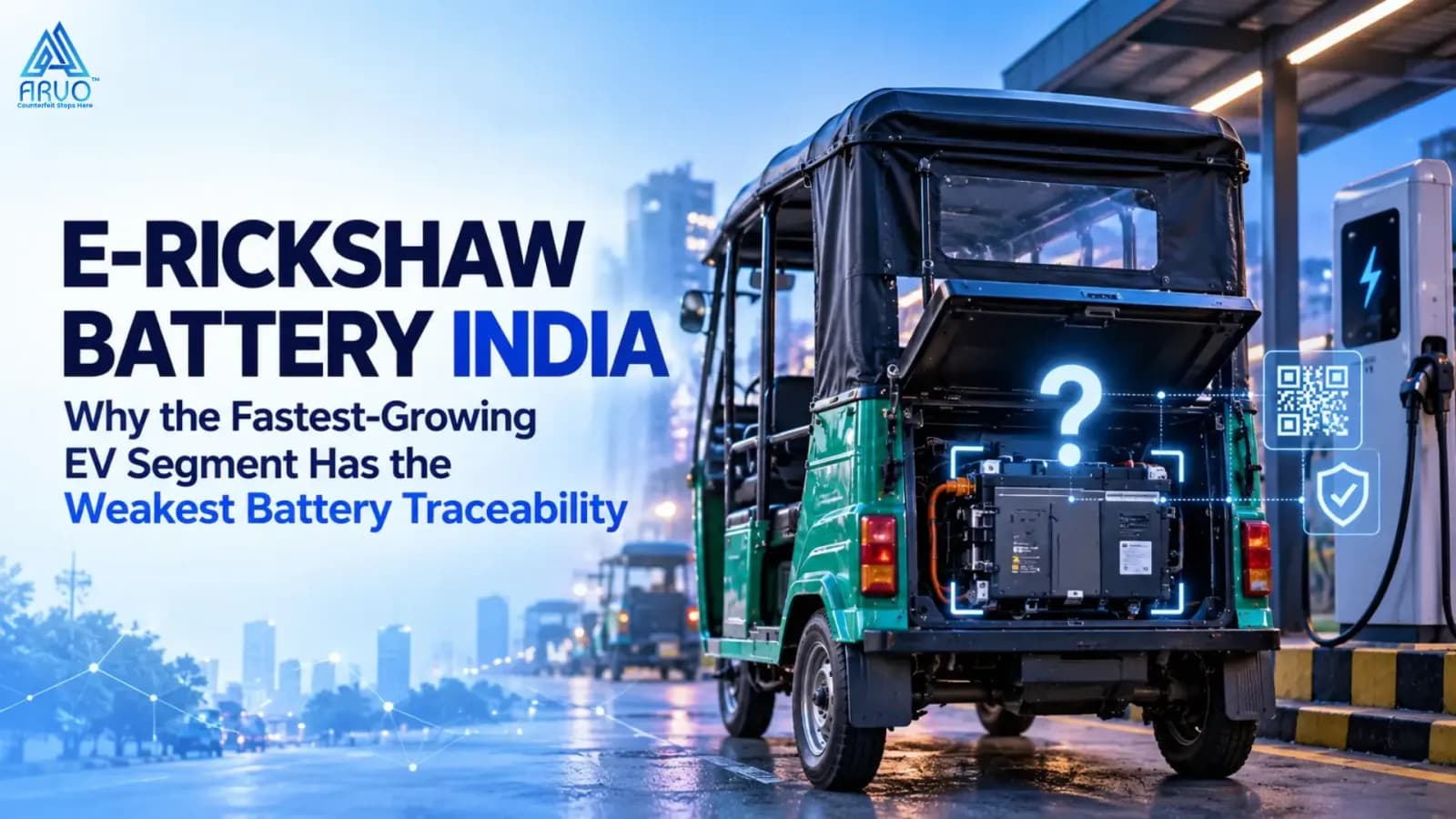
At about 4:42 am on 17 August 2026, a fire broke out in a building in Raghubir Nagar, West Delhi. Police suspect an e-rickshaw battery exploded while it was charging, and two people died, according to Patrika's report. A few weeks earlier, in July 2026, the Ministry of Electronics and Information Technology (MeitY) had battery management apps taken down after videos showed people using them over Bluetooth to cut power to moving e-rickshaws, as Business Today reported.
Both stories raise the same question: where did this battery come from, and who is responsible for it? For most e-rickshaw batteries in India, nobody can answer. The battery is the most valuable and the most dangerous part of the vehicle, yet it rarely has an identity of its own. It can be stolen, swapped, resold or replaced without leaving a trace.
This guide is for e-rickshaw and electric three-wheeler OEMs, pack assemblers and fleet operators. It covers how big the segment is, how the move to lithium changes the risk, the five biggest traceability gaps, and what India's draft Battery Pack Aadhaar guidelines and AIS 156 mean for L-category makers.
How big is the e-rickshaw battery market in India?
E-rickshaws are often treated as the informal end of electric mobility. The numbers say otherwise. A Down To Earth analysis of VAHAN data found that five states registered nearly 4.5 lakh e-rickshaws in FY 2025-26, close to 80% of the national total, and that India's EV share of all new registrations falls from 8% to 7% if e-rickshaws are left out.
| Indicator | Figure | Source |
|---|---|---|
| E-rickshaws registered in India, as of November 2024 | Over 18.1 lakh | WRI India, citing VAHAN (January 2025) |
| E-rickshaw registrations in the top five states, FY 2025-26 | Nearly 4.5 lakh, close to 80% of the national total | Down To Earth analysis of VAHAN data (July 2026) |
| E-rickshaws estimated to run without registration | About 4.75 lakh (mid-2025 estimate) | EVMS, reported by JMK Research (February 2026) |
| Battery share of an e-rickshaw's upfront cost | 30% to 40% | WRI India (January 2025) |
| India e-rickshaw market, 2025 | $1.35 billion | MarkNtel Advisors (2026) |
| Forecast India e-rickshaw market, 2032 | $3.45 billion (14.33% CAGR) | MarkNtel Advisors (2026) |
Two of these figures matter most to anyone building or financing an e-rickshaw fleet. WRI India puts the battery at 30% to 40% of the vehicle's upfront cost, which makes it the single most valuable component on the road. And the Electric Vehicle Manufacturers Society (EVMS) estimated that about 4.75 lakh e-rickshaws were running without registration, so a large share of the fleet, and the batteries in it, sits outside any official record.
Why does the shift from lead-acid to lithium raise the stakes?
For years the e-rickshaw battery was a lead-acid story. WRI India reported in January 2025 that lead-acid e-rickshaws made up about 90% of the market, and that lead-acid batteries typically need replacing every year. That is changing fast: MarkNtel Advisors credits fully lithium-ion e-rickshaws with about 55% of the market in 2026.
The shift is good for drivers. A lithium pack charges faster, lasts more cycles and carries a battery management system (BMS) that records voltage, temperature and charge history. But it changes the risk picture in three ways.
- Higher value per pack. A lithium pack is worth far more than the lead-acid battery it replaces, which makes it a better target for thieves and counterfeiters.
- Longer life, more owners. A pack that lasts several years may pass through more than one vehicle, owner or financier. Each handover is a point where its history can be lost.
- More to go wrong. Lithium cells that are poorly made, badly assembled or damaged can overheat and catch fire, and a fire leaves little behind to investigate.
The e-rickshaw battery is moving from a cheap, replaceable part to a valuable, long-life asset, without yet having the identity and tracking that valuable assets need.
Is e-rickshaw battery theft a traceability problem?
It is, because the battery is the easiest high-value part to remove and the hardest to trace once it is gone. In one case in south-east Delhi, reported by LawStreet in March 2019, police arrested a gang that stole vehicle batteries, including from e-rickshaws, and recovered 76 batteries. The gang sold them to a scrap dealer for ₹500 to ₹2,000 each. CCTV footage and a tip-off led to the arrests.
Notice how the case was solved: through cameras and local intelligence, not because a battery could prove who owned it. Once a pack reaches a scrap dealer or is broken down into cells, nothing on it connects it to its maker, its financier or its owner. That is the core weakness of stolen battery tracking in the e-rickshaw market today.
What are the five traceability gaps?
Theft is only the most visible symptom. Behind it sit five gaps that affect every OEM, pack assembler and fleet operator in the segment.
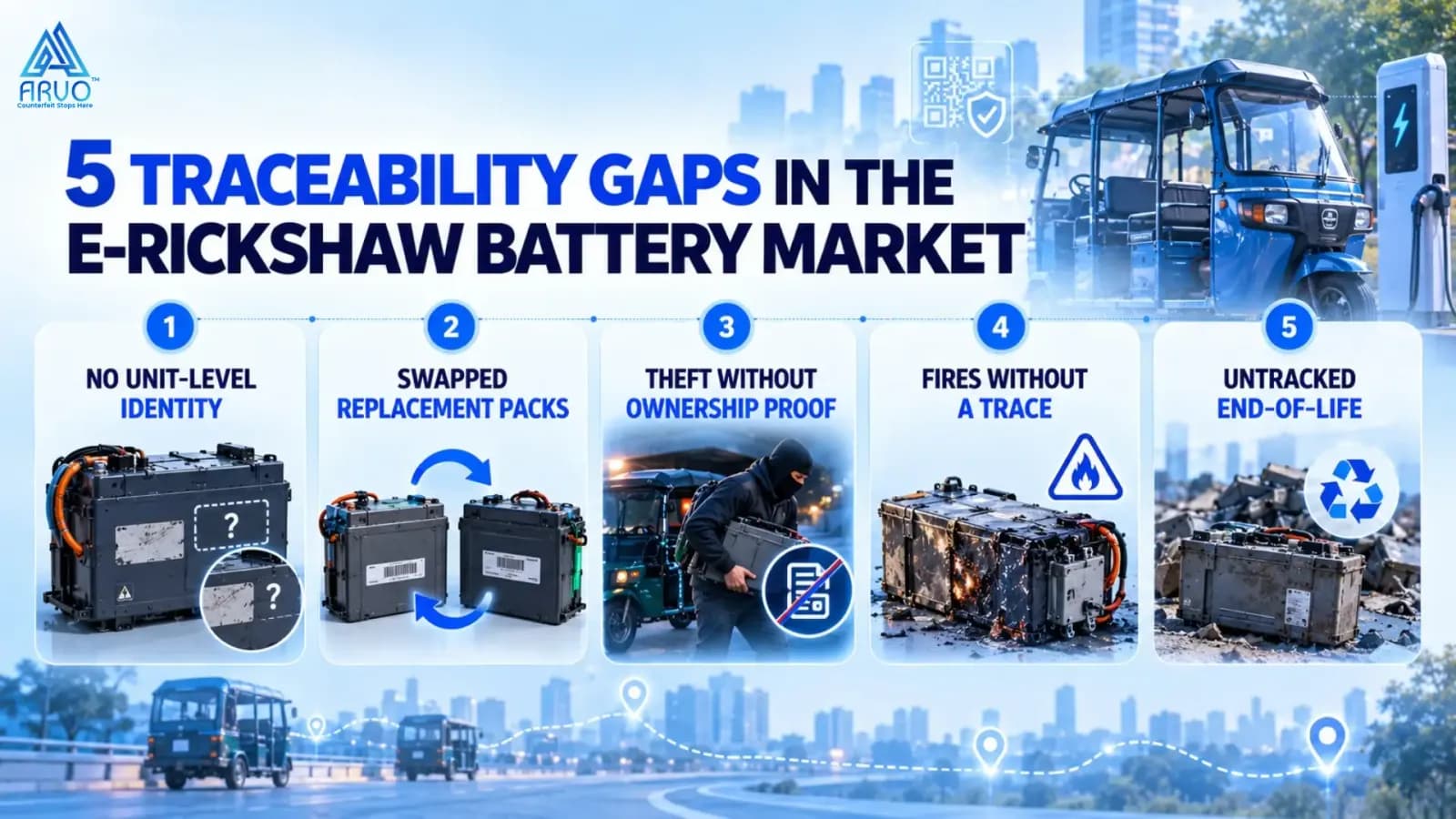
1. No unit-level identity
Most e-rickshaw packs leave the assembly line with a printed label and, at best, a batch number. Nothing on the pack proves which unit it is, who made it or when. In a segment where many vehicles run unregistered, the battery often has even less identity than the vehicle carrying it.
2. Swapped and substandard replacement packs
Because lead-acid batteries are typically replaced every year, the average e-rickshaw goes through several battery changes in its life. Most of them happen in local workshops, where a pack of unknown origin can be fitted under a known brand's name. When a lithium pack is assembled from cells of unknown quality, neither the driver nor the fleet owner can tell.
3. No proof of ownership after theft
When a stolen pack is recovered, police and owners rely on invoices and memory to prove whose it is. When it is sold for scrap or broken into cells, it drops out of every record. Without unit-level identity, recovery depends on luck rather than process.
4. Fires without a trail
After a battery fire, investigators need to know who made the pack, which batch its cells came from and how it was charged. Often that information does not exist. India does not even keep a central count: in a February 2026 Lok Sabha reply, the Ministry of Heavy Industries said specific, centralised data solely tracking battery-fire incidents across the country is not available. A maker cannot recall what it cannot identify, and it cannot defend itself against blame for packs it never made. We look at this in more detail in our guide to lithium-ion battery tracking.
5. End of life goes off the grid
WRI India, citing a NITI Aayog report, says about 90% of end-of-life batteries were recycled informally, in ways it describes as inefficient and unsafe. Under the Battery Waste Management Rules, 2022, producers carry responsibility for collection and recycling, and a pack that cannot be traced to the end of its life is hard to count towards those obligations. Our guide to the Battery Waste Management Rules 2022 explains what producers have to report.
What do BPAN and AIS 156 mean for L-category makers?
Two frameworks are pulling the e-rickshaw battery market towards unit-level identity: India's draft Battery Pack Aadhaar guidelines and the AIS 156 battery safety standard.
The draft Battery Pack Aadhaar guidelines
At the end of December 2025, the Ministry of Road Transport and Highways (MoRTH) published draft guidelines for a Battery Pack Aadhaar System. The draft covers EV batteries for L-category vehicles (two-wheelers, three-wheelers and quadricycles), EV batteries for M and N category vehicles, and industrial batteries above 2 kWh. Each pack would carry a 21-character Battery Pack Aadhaar Number (BPAN), marked on the pack both as text and as a QR code, and the producer or importer would upload the pack's dynamic data to an official BPAN portal.
Three details in the draft matter for e-rickshaw makers:
- Its chemistry codes include lead-acid, not only lithium-ion.
- Its table of stakeholder responsibilities has the vehicle maker record the BPAN in Form 20 so that it feeds the VAHAN database.
- When a battery pack in a vehicle is replaced with a new one, the new BPAN is recorded in VAHAN.
In other words, the draft is built to follow exactly the swaps that make e-rickshaw batteries hard to trace today.
The rules are not settled. The draft has not been formally notified, gives no compliance dates and recommends taking the framework forward through the Automotive Industry Standards (AIS) route. In July 2026, NewsBytes reported that the Society of Indian Automobile Manufacturers (SIAM) had asked MoRTH to postpone mandatory implementation to 2034 and to leave electric three-wheelers, especially e-rickshaws, out for now. The final scope may change. The direction will not: every major battery market is moving towards unit-level identity. Our BPAN compliance page decodes the 21 characters and includes a readiness checklist.
AIS 156 and L-category battery safety
AIS 156 sets the traction battery requirements for L-category electric vehicles. According to the Ministry of Heavy Industries' February 2026 reply, MoRTH amended AIS 156 by notification S.O. 4567(E) of 28 September 2022, applicable from 1 December 2022, and notified Conformity of Production requirements for all electric vehicle categories, including e-rickshaws, in December 2022.
The ARAI guide to battery safety standards, published by EVreporter, sets out two phases:
| Phase | Applies from | Requirements include |
|---|---|---|
| Phase 1 | 1 December 2022 | Traceability of packs, an additional safety fuse, protection against regenerative braking, cell-to-cell spacing, a microprocessor-based BMS with all protections |
| Phase 2 | 31 March 2023 | Thermal propagation test, cell testing to IS 16893 at a NABL-accredited lab, audio-visual warning for a thermal event, earth-leakage detection in the charger, EMC testing of the BMS |
For L-category makers, pack traceability is already part of the safety standard, not a future idea. Confirm the latest amendments with your testing agency.
Registration is tightening too
States are also closing the gap on unregistered vehicles. JMK Research reports that West Bengal made registration mandatory for all e-rickshaws in October 2025, which pushed a wave of previously unregistered vehicles into VAHAN between November 2025 and January 2026, and that Delhi is considering a registration window of its own. As more vehicles enter official records, the pressure to give their batteries an identity will grow.
Why do stickers, serial numbers and paper records fail?
Most e-rickshaw packs carry some form of marking. None of the common methods hold up in the conditions these batteries live in: dust, heat, rough handling, frequent swaps and a large informal repair market.
| Method | How it is meant to work | Why it fails in the e-rickshaw market |
|---|---|---|
| Painted or printed serial number | Identifies the pack | Scraped off, painted over or copied; sequential numbers are easy to guess |
| Paper warranty card | Proves purchase and ownership | Lost, damaged or never handed to the driver |
| Sticker or hologram | Shows the pack is genuine | Peeled off and reused; similar stickers are easy to source |
| Standard QR code | Links to product details | Photographed and reprinted, so a clone scans as genuine |
| Connected BMS or tracker | Reports location and health | Only on some lithium packs; can be removed, switched off or tampered with |
| App-based verification | Driver or buyer checks the pack in an app | Few drivers or workshops will install an app to check a battery |
Each method either comes off the pack or can be copied onto a fake one. A workable identity has to be unique to each pack, impossible to clone, durable enough for hard use, and quick to check with an ordinary phone.
What does unit-level traceability give OEMs and fleet operators?
Unit-level identity is not only a compliance task. For businesses in the e-rickshaw market it pays back in five practical ways.
- Proof of ownership. A scannable, copy-proof identity lets an owner or financier prove that a recovered pack is theirs, and makes stolen packs harder to resell openly.
- Cleaner warranty claims. Every claim can be matched to a real unit, its sale date and its owner, so claims on fake or swapped packs can be rejected with evidence.
- Better financing. Lenders find it easier to fund assets they can identify and follow, which matters in a segment where many drivers buy on credit.
- Narrower recalls. If a batch of cells proves faulty, a maker can find exactly those packs instead of recalling everything it sold.
- Readiness for BPAN and EPR. Packs that already carry a unique identity are easier to bring into a Battery Pack Aadhaar system and to count towards recycling obligations.
For a wider view of battery traceability across the EV sector, see our EV batteries industry page.
How ARVO helps e-rickshaw battery makers
ARVO (OneARVO Ventures Pvt. Ltd., Noida) gives every battery pack a NOVA copy-proof smart code that any phone camera can read; a Vision AI model trained to detect even a minor variation in the code makes copies fail verification, with about 99% verification accuracy. AIC holds every scan and each pack's journey with analytics, so you can see where packs are checked and spot unusual movements, and the records are secured on a blockchain so the journey can't be rewritten. Rollout takes about 15 days.
To see how it would work on your packs, talk to the ARVO team.
Questions answered in this article
- Is Battery Pack Aadhaar mandatory for e-rickshaw battery makers?
- No. MoRTH's Battery Pack Aadhaar guidelines are still a draft: they have not been formally notified and give no compliance dates. The draft covers L-category EV batteries, which include three-wheelers, but SIAM has asked for implementation to be postponed to 2034 and for e-rickshaws to be left out for now.
- How can fleet operators reduce e-rickshaw battery theft?
- Secure charging locations and CCTV help while packs are parked. Beyond that, give every pack a unique, copy-proof identity, record which pack is fitted to which vehicle, and check the identity at every swap or service, so ownership can be proved after recovery.
- Is a lithium e-rickshaw battery easier to trace than lead-acid?
- A lithium pack usually has a battery management system that records health and charge data, which helps. But that data lives inside the pack and can be lost, reset or tampered with. A copy-proof identity on the outside of the pack, linked to a central record, is what makes either chemistry traceable.
- What does AIS 156 require for electric three-wheeler battery packs?
- AIS 156 applies to L-category electric vehicles. According to the ARAI guide, phase 1 (from 1 December 2022) includes pack traceability and a BMS with all protections, and phase 2 (from 31 March 2023) adds a thermal propagation test, cell testing at a NABL-accredited lab and an audio-visual warning for thermal events.
- How does ARVO help e-rickshaw battery makers?
- ARVO gives each pack a copy-proof NOVA smart code that any phone camera can read, and AIC holds every scan and each pack's journey with analytics. Rollout takes about 15 days.
Sources
- India on e-wheels: E-rickshaws powering electric mobility growth in several states, finds DTE analysis, Down To Earth
- Powering Indian E-rickshaws: Toward Alternate Battery Technologies, WRI India
- Mandatory Registration of all Electric Rickshaws across States in India, JMK Research
- India E-Rickshaw Market to Reach USD 3.45 Billion by 2032, MarkNtel Advisors
- Delhi: E-Rickshaw Battery Explodes, Fire Breaks Out in Raghubir Nagar Building; Two Killed, Including 17-Year-Old, Patrika
- Respite for e-rickshaw drivers, commuters! Apps enabling pranksters to stop vehicles remotely deleted, says MeitY, Business Today
- Battery Burglars Nabbed, 76 Batteries Recovered, LawStreet
- Fire Prune Electrical Vehicles (Lok Sabha written reply, 10 February 2026), Press Information Bureau, Ministry of Heavy Industries
- Draft Guidelines for Implementation of Battery Pack Aadhaar System, Ministry of Road Transport and Highways
- India auto industry urges delay of battery Aadhaar 21-digit rule, NewsBytes
- Guide to Battery Safety Standards in India, compiled by ARAI, EVreporter