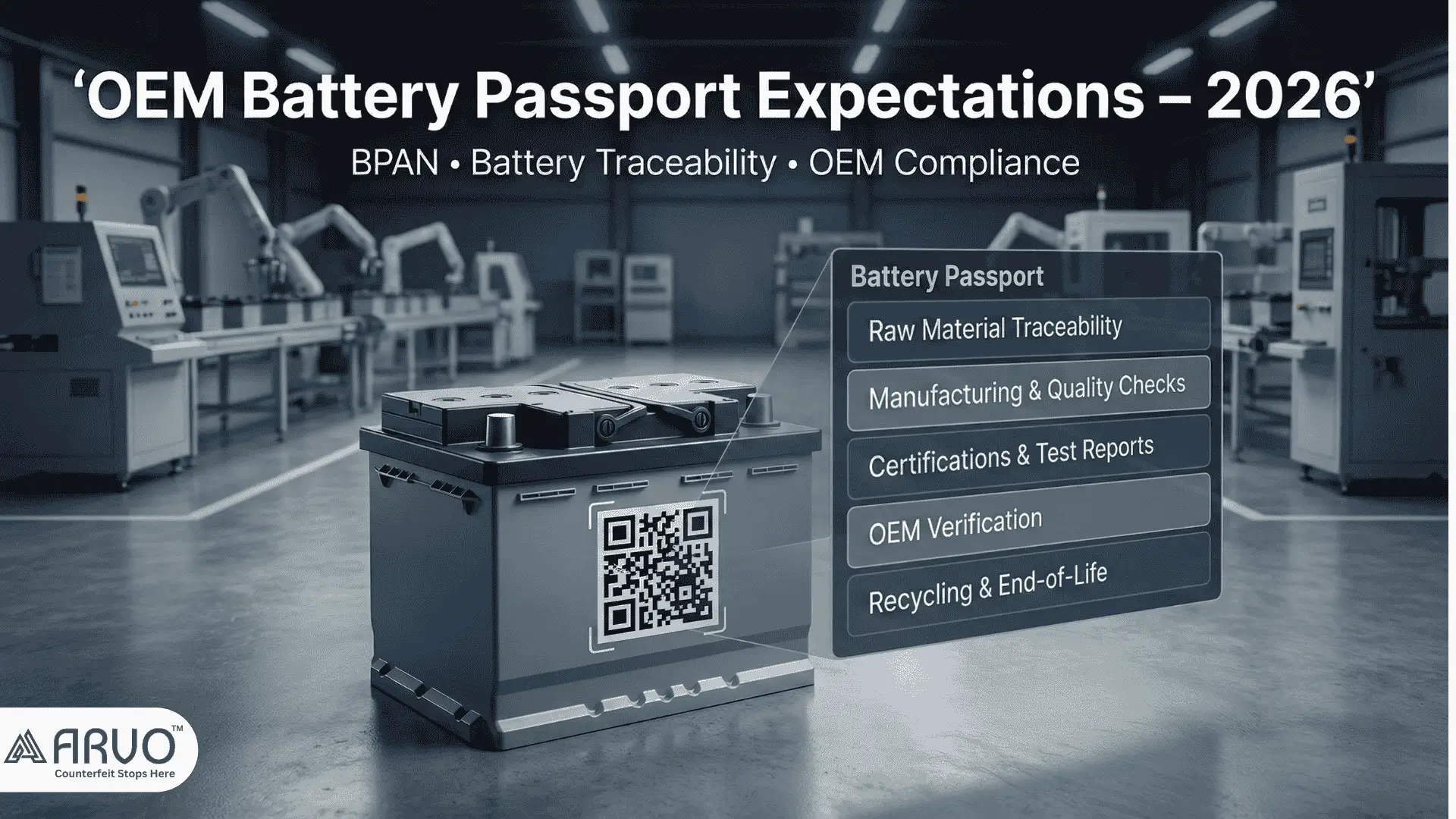
As India accelerates its electric mobility revolution, the era of “stick a QR code on a battery and call it traceable” is officially over. By January 2026, OEM Battery Passport Expectations 2026, will have shifted from simple documentation to a mandatory digital lifecycle. Global standards and India’s own Battery Pack Aadhaar Number (BPAN) initiative, a framework assigned to EV and industrial batteries above 2 kWh, are redefining the competitive landscape.
This blog breaks down what OEMs really expect, what the Indian BPAN regulation means for manufacturers, and how you can prepare your operations to be compliant, efficient, and competitive.
What’s Changing: From Compliance to Digital Traceability
Today:
- OEMs accept static certificates and documents
- Suppliers manually share data
- Quality teams handle ad-hoc requests
In 2026:
- OEMs expect digital, verifiable, lifecycle battery passports
- Traceability must be instant, auditable, and machine-readable
- Compliance cannot be retrofitted. it has to be built into manufacturing processes
This transformation is driven by:
- Global battery passport standards focused on transparency and sustainability
- India’s own Battery Pack Aadhaar Number (BPAN) draft regulation
India’s BPAN (Battery Pack Aadhaar Number): A Snapshot of the Draft Regulation
India’s Battery Pack Aadhaar System is a draft framework proposed by the Ministry of Road Transport & Highways (MoRTH) to create a unique digital identity for each battery pack introduced in the Indian market.
What BPAN Is
- A 21-character unique digital ID assigned to every battery pack (including EV and industrial batteries above 2 kWh).
- Functions like an Aadhaar for batteries, enabling full lifecycle traceability, from raw material sourcing to disposal.
- Includes both static and dynamic data (e.g., material composition, carbon footprint, state of health, usage history).
Why BPAN Matters for Manufacturers
- Establishes a standardized digital identity for each battery pack.
- Makes battery regulation data accessible to regulators, OEMs, recyclers, and other stakeholders via an official portal.
- Requires batteries to be marked with the BPAN in a permanent, visible way that won’t degrade.
- Helps ensure safety, prevent counterfeits, and improve circular economy compliance.
What’s Still in Draft
The BPAN guidelines are currently in draft stage, undergoing stakeholder consultation and refinement. However, forward-looking OEMs and manufacturers are already preparing because this framework is likely to become a central compliance requirement.
The BPAN Revolution: India’s “Aadhaar” for Batteries
The Ministry of Road Transport & Highways (MoRTH) has proposed a 21-character unique digital identity for every battery pack. This BPAN functions exactly like an Aadhaar card for hardware, ensuring that raw material sourcing, carbon footprint, and state of health (SoH) are instantly auditable.
The 3 Pillar Expectations for OEMs in 2026
1. Verified Digital Identity (BPAN Compliance) OEMs now demand that every battery has a machine-readable, 21-character BPAN. This is no longer a PDF; it is a live digital link that confirms:
- Manufacturer and Cell Origin.
- Material composition (Lithium, Cobalt, Nickel percentages).
- Compliance with the ACC PLI scheme for local value addition.
2. Dynamic Lifecycle Traceability The “OEMs Battery Passport Expectations 2026” require dynamic updates. Static data is insufficient. Manufacturers must record:
- Production Phase: Quality Assurance (QA) and Batch testing.
- Usage Phase: Charge/discharge cycles and thermal events.
- End-of-Life: Recycling or second-life repurposing details.
3. Automated Compliance & Risk Mitigation Manual document sharing is a bottleneck of the past. OEMs expect real-time queries through centralized portals like ARVO to verify safety standards and ESG (Environmental, Social, and Governance) targets.
OEMs Battery Passport Expectations in 2026: Beyond Checkboxes
1. Full Digital Battery Passport
OEMs want a digital battery passport, linking the physical battery to:
- Origin of raw materials
- Manufacturer details
- Supply chain data
- Performance metrics
- End-of-life or recycling history
This isn’t a PDF anymore, it must be:
- Machine-readable
- Accessible in real-time
- Tied to the BPAN identity
2. Lifecycle Visibility & Trust
OEMs demand transparency across the entire battery lifecycle because:
- Safety liabilities are increasing
- Environmental, Social, and Governance (ESG) criteria matter
- Second-life reuse and recycling require trusted data
True lifecycle visibility means capturing:
- Raw material traceability
- Production and QA reports
- Logistics and ownership history
- Usage and aging data
- Disposal or repurposing details
3. Instant OEMs Compliance Verification
Manual compliance reviews or document exchanges will be unacceptable by 2026.
OEMs expect:
- Automated data access
- Real-time queries
- Audit-ready digital records
This accelerates approvals, reduces errors, and strengthens supplier credibility.
Factory Floor Reality: Why This Is So Hard
Many manufacturers today struggle because:
- Data is scattered across ERPs, MES, QA, and legacy systems
- Compliance data lives in silos
- OEM demands vary per partner
- Retracing lifecycle data is time-consuming
Without a central digital framework, meeting OEM expectations becomes chaotic, reactive, and error-prone.
How to Achieve Battery Passport Readiness
Step-by-Step Preparation
- Assign unique digital identities (BPAN) at production.
- Centralize lifecycle data in one platform.
- Make data machine-readable (not just human-readable).
- Ensure audit-ready digital records are accessible to OEMs.
- Update records dynamically with usage and recycling data.
This approach turns compliance from a burden into a competitive advantage.
Why OEMs Prefer Suppliers with Digital Passports
Manufacturers using digital battery passports and BPAN-aligned systems gain:
- Faster OEM approvals
- Fewer compliance escalations
- Higher trust in tenders and bids
- Better integration with global traceability standards
In essence, compliance becomes a business accelerator, not a roadblock.
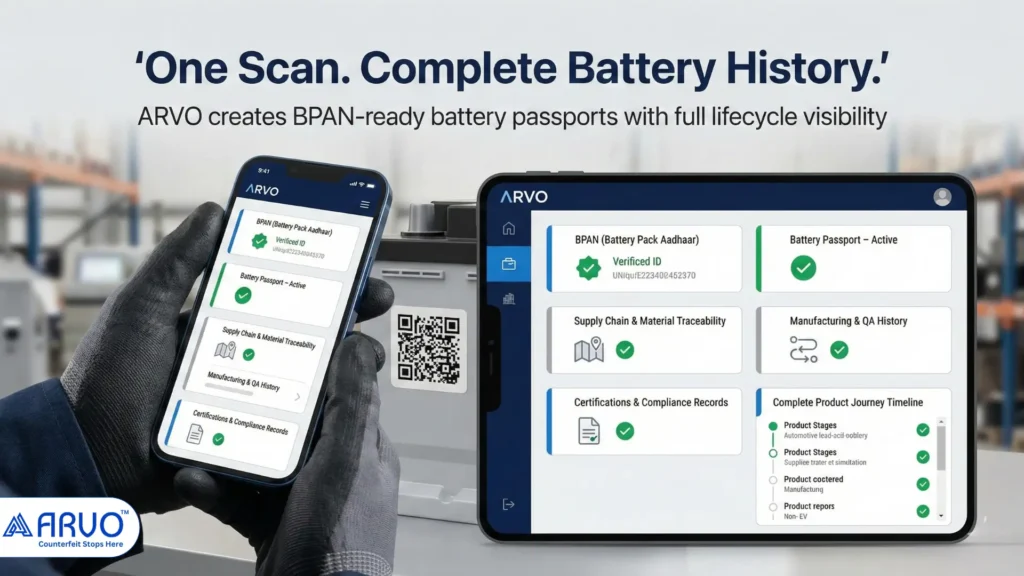
How ARVO Simplifies Your 2026 Compliance
At ARVO, we turn the complexity of BPAN and OEM expectations into a business advantage. Our platform provides:
- BPAN Generation: Automatic 21-character ID creation.
- Copy-Proof QR Codes: Secure physical marking that lasts the battery’s lifespan.
- Audit-Ready Dashboards: Instant data access for your OEM partners.
With ARVO, battery passport readiness is no longer complex or disruptive, it becomes part of your operational DNA.
Ready to build OEMs battery passport ready, BPAN-compliant battery passports with full lifecycle visibility? Contact ARVO and future-proof your compliance today.
Frequently Asked Questions (FAQ)
1. What are OEMs battery passport expectations in 2026?
OEMs battery passport expect digital, verified, lifecycle-linked battery passports with machine-readable data, traceability from raw materials to disposal, and instant verification access.
2. What is BPAN in India?
BPAN is a proposed 21-character unique digital identity for each battery pack, designed to enable full lifecycle traceability and compliance.
3. Which batteries will need BPAN?
Draft guidelines include electric vehicle batteries and industrial batteries above 2 kWh, with permanent marking and data upload requirements.
4. Will BPAN include performance data?
Yes, static and dynamic data, including performance metrics, usage history, and health indicators, will be captured and maintained.
5. How does ARVO help with OEMs compliance and BPAN?
ARVO enables the creation of BPAN-aligned digital identities, battery passports, QR codes, lifecycle traceability, and audit-ready compliance, all in one integrated solution.